


Boundary Disputes: Use Small Claims to Resolve Minor Land Disputes in the UK
Dispute with your neighbour over a fence, garden, or land boundary? Learn your rights under UK law and how our small claims service helps resolve minor boundary disputes quickly.


What Is a Boundary Dispute?
A boundary dispute arises when neighbours disagree about where one property ends and another begins. Issues can involve fences, walls, hedges or driveways, anything that marks the line of ownership. UK law treats land boundaries as general, not precise. Title plans in the Land Registry show only an approximate boundary; they can be inaccurate, and disputes often emerge when owners try to fix a line.
Minor boundary disputes occur where the disagreement is over a small strip of land, damaged fencing or encroachment that can be resolved through negotiation or the small‑claims boundary dispute process. Larger property boundary disagreements, for example, disputes over several metres of land or complex easements, typically need expert surveyors and may go to the High Court. Understanding which category your issue falls into is essential for choosing the right procedure.
Key Differences Between Small and Large Disputes
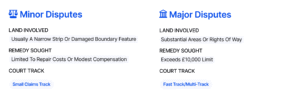
In minor disputes, the land involved is usually a narrow strip or a damaged boundary feature, and the remedy sought is limited to repair costs or modest compensation. Larger disagreements may span substantial areas or involve rights of way and are often allocated to the fast or multi‑track because they exceed the £10,000 limit.
Legal Framework for Boundary Disputes in the UK
Land Registration Act 2002
Under the Land Registration Act 2002, registration with general boundaries is considered sufficient for most titles. Owners may, however, agree on a boundary position through a boundary agreement or apply for a determined boundary if greater precision is needed. The practice guide explains that neighbours can agree which hedge, fence or wall marks the legal boundary, but such agreements can themselves create disputes.
Common Law Property Rights and Trespass
UK common law recognises a tort of trespass to land, which occurs when someone enters or encroaches on your land without permission. Trespass to land can include walking over your garden, squatting, or building over the boundary. Trespass is normally a civil wrong. Remedies include a compensation claim(damages) if the trespass causes financial loss, or an injunction requiring the trespasser to. In serious cases, possession proceedings may be necessary. Understanding trespass law helps homeowners recognise when a neighbour has unlawfully crossed the boundary.
Civil Procedure Rules: Small‑Claims Track
The Civil Procedure Rules divide court claims into three tracks. The small‑claims track is for lower‑value, less complex disputes, generally claims up to £10,000. The court encourages parties to settle or use mediation before trial. There is a free small‑claims mediation service provided by the court, and parties must complete a directions questionnaire to help the judge decide if small claims is appropriate.
Mediation and Local Council Services
Government guidance on resolving neighbour disputes emphasises informal resolution. You should try to settle a dispute about hedges or boundaries informally before the council intervenes. Councils can provide complaint forms and may charge a fee to consider a complaint. Mediation services, often run by local authorities or community groups, offer neutral facilitation. In England, Citizens Advice recommends talking to your neighbour, keeping copies of letters and notes, and seeking help from mediators if talks fail. Small‑claims courts expect parties to attempt settlement or mediation before issuing proceedings.
Common Types of Boundary Disputes
Boundary problems come in many forms. Below are typical neighbour boundary dispute scenarios:
- Fence damage or movement: Storms or building works can damage fences. Disputes arise over who must repair or replace panels or posts.
- Encroachment onto driveways or gardens: A neighbour may inadvertently build a fence, wall or shed inches into your garden or use part of your driveway. This is both an encroachment and a potential trespass.
- Shared (‘party’) walls: Party walls require notice and agreement before work, and you must follow the Party Wall etc. Act 1996.
- Tree and hedge growth: You may trim branches crossing your boundary, but only up to the legal line.
- Unlawful use of land: Using someone else’s garden or drive without permission counts as trespass.
Steps to Take Before Legal Action
For any fence dispute or other neighbour boundary dispute eligible for land dispute small claims, courts expect neighbours to try to resolve issues amicably before filing a claim. You should collect title deeds and plans of the disputed line and take photographs. Speak calmly with your neighbour, make notes of what was agreed, or send a polite letter if a conversation is not possible. Follow the Party Wall etc. Act 1996 for shared structures. Use council or community mediation services if talks stall; councils provide complaint forms and may charge a fee. Keep copies of all correspondence, evidence that you tried to settle matters, inform the court and meet the expectations of the Civil Procedure Rules.
When to Use Small Claims Court for Boundary Disputes
Small claims court is appropriate when you claim compensation for a boundary dispute, which includes the cost of minor repairs under £10,000, for example, replacing a broken fence, recovering the cost of repairing a driveway, or claiming damages for garden encroachment. Claims above £10,000 or those involving adverse possession, declarations of title or complex rights of way must be allocated to the fast or multi‑track. Injunctions to force the removal of structures may also need a different court procedure.
How CaseCraft.AI Helps with Boundary Disputes
CaseCraft.AI uses AI to streamline the small‑claims process for boundary disputes. We review your title deeds and photos, draft a pre‑action letter that explains your case, complete the court’s directions questionnaire, and support mediation or negotiation so that many matters settle without a hearing. If your case goes to a hearing, we guide you through it. Pricing stays transparent: a £15 processing fee to start, and a 15% success fee only if you win, no separate hearing fee.
Why Choose CaseCraft.AI for Your Boundary Dispute Claim
Choosing us means dealing with specialists who understand neighbour boundary disputes and offer expert legal help and boundary dispute support. We handle paperwork, keep your costs predictable with our success‑based fee, and guide you from first advice to final judgment while focusing on evidence and legal principles. Our goal is to achieve a fair outcome and reduce the stress of a neighbour conflict.

Preventing Future Boundary Disputes
Prevention is better than litigation. To avoid neighbour land encroachment, neighbour conflict, and property boundary disagreements, consider these measures:
Agree in writing with neighbours about new fences or walls, commission a surveyor before major works, and document repairs. Trim hedges only to the legal line and keep communication open. These steps make a neighbour boundary dispute less likely.
Examples of Minor Boundary Disputes We Handle
Examples include a fence built a few centimetres into your land, a wall damaged during renovations, a drive partially blocked or a shed that crosses the legal line. We manage these disputes from claim through to resolution.
We deal with these garden boundary claims, helping you obtain the evidence and legal remedy required.
A Clear Path to Resolution
Boundary disputes can be stressful, but the law provides clear procedures to resolve them. Start by understanding your property rights, checking deeds and talking to your neighbour. Use mediation services and keep records, and only turn to litigation if necessary. For dispute resolutions under £10,000, the small‑claims court is a cost‑effective option. With CaseCraft.AI, you gain a specialist partner who combines legal expertise with technology to handle your claim efficiently. By following the steps in this guide and using our service, you can protect your property, preserve neighbourly relations and resolve conflicts.
Case Study: Claim for Breach of Contract

A client paid £5,000 for a one-month agreement to use commercial premises but was denied access after just five days. The provider refused to refund the unused period.nnThe claim was filed for fundamental breach of contract and unjust enrichment. When the defendant failed to respond, the court issued a default judgment, granting full recovery including fees and interest.

CaseCraft.AI supports all common types of small money claims
From overgrown hedges to misplaced fences or driveways built across your land boundary disputes can strain neighbour relations and property value. CaseCraft.AI helps you resolve minor land disputes through the small claims process efficiently and affordably, without complex legal procedures.
Don’t Wait – Get Started Today!
Take the first step toward a faster, easier small claims process with CaseCraft.AI.