



1. You can withdraw a small claim at any time by filing a notice of discontinuance (Form N279) and serving it on all other parties.
2. If you discontinue after a defence has been filed, you may need to pay the defendant’s reasonable costs (although CPR 38.6 does not apply to cases allocated to the small claims track).
3. Court fees are generally non‑refundable; refunds are only available where the Ministry of Justice has overcharged or mischarged fees.
Why Withdrawing a Small Claim Needs Careful Steps
In England and Wales, it’s common for individuals or small businesses to start court action to recover a debt, claim for poor work or seek a refund. Sometimes the situation changes before judgment: the other side pays, the dispute is settled, or the claim is simply no longer worth pursuing. At that point, many people ask whether they can withdraw a small claim without causing more trouble.
This guide explains how the court’s small claims withdrawal rules work, why the procedure is called discontinuance, and what consequences flow from stopping a case mid‑way. It follows the Civil Procedure Rules (CPR) and the latest HM Courts & Tribunals Service (HMCTS) guidance, so you know when you can cancel your small claims court case safely and when costs might be payable. Along the way, you’ll learn about free mediation, consent orders, refunds and how digital platforms such as CaseCraft.AI simplify the process.
What Does It Mean to Withdraw or Discontinue a Small Claim?
Discontinuance (withdrawing your claim) means filing Form N279 and serving it on every party. From the date of service, the case is ended. You can discontinue the whole claim or part of it; permission may be needed if there are multiple claimants or interim payments. The notice is only valid once all defendants have been served.
In legal language, withdrawing a claim means formally ending it before judgment. Under the Civil Procedure Rules, this process is called discontinuance. When you discontinue, you ask the court to remove your claim from its list, and you promise not to pursue the same claim again without permission.
Unlike an informal withdrawal, for example, telling the court clerk you’re not interested, a formal discontinuance protects you from a strike‑out. It ensures there is a clear record that the claim has ended and stops the other side from incurring unnecessary costs. Even if you’re only claiming £200, you must follow the process.
When You Can Withdraw a Small Claim
Before deciding on a withdrawal, check what stage the case is at. The rules change once a defence or judgment has been entered and will affect costs and procedural steps:
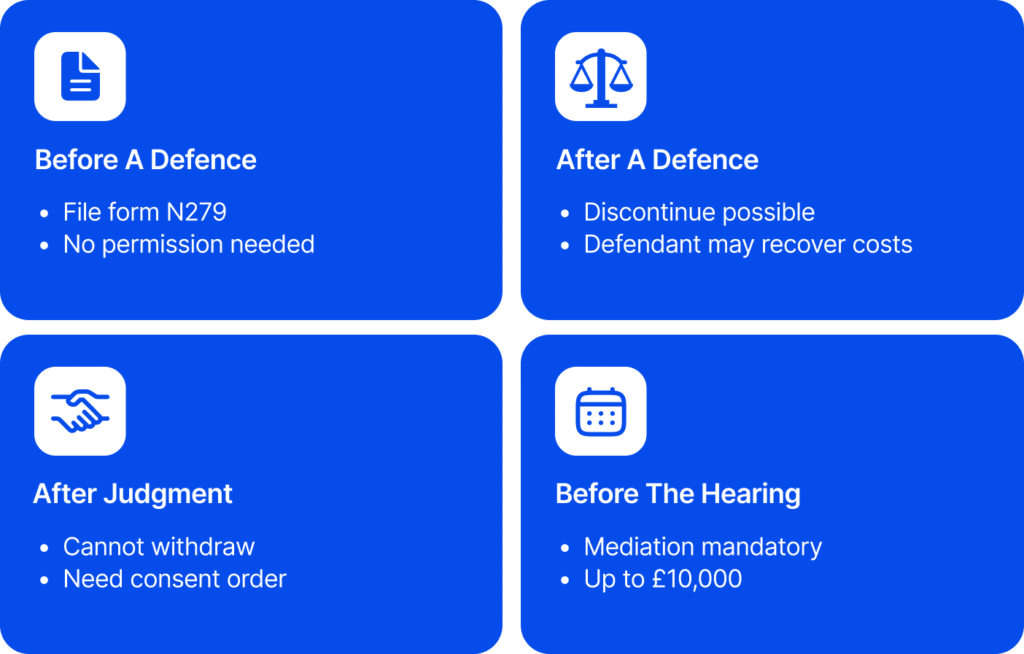
- Before a defence: you can end the claim by filing Form N279 and serving it on the defendant; no court permission is needed, and each side bears their own costs. Early withdrawal carries little financial downside because costs in the small claims track are limited.
- After a defence: you can still discontinue a small claim, but the defendant may recover their reasonable expenses and can apply to set aside your notice. Once you discontinue after a defence, you need the court’s permission to re‑file the same claim.
- After judgment: you cannot simply withdraw; you must agree terms with the defendant (usually through a consent order) or seek the court’s permission. If a default judgment is satisfied, notify the court rather than discontinuing.
- Before the hearing: mediation is mandatory for money claims up to £10,000. Even if you settle at mediation, you must still file a notice or seek a consent order to cancel the hearing.
Note: From May 22, 2024, mediation is mandatory for money claims up to £10,000 filed on paper or through legacy systems. Note that OCMC cases may follow a different timeline. As of November 2025, check the current status of OCMC integration.
The Legal Basis: Civil Procedure Rules Part 38
Civil Procedure Rules Part 38 sets out the framework for discontinuing a claim. You may discontinue all or part of your claim at any time, but if there are interim payments, injunctions or multiple claimants, you need the other parties’ consent. Discontinuance requires filing Form N279 and serving it on every defendant; the notice takes effect upon service. After service, the court can still decide how costs are dealt with.
Rule 38.6 states that the discontinuing claimant is liable for the defendant’s fees up to that date, though this rule is disapplied for small claims. If you stop a claim after a defence has been filed, you cannot start a new claim on the same facts without the court’s permission, ensuring defendants are not repeatedly harassed with identical proceedings. These small claims withdrawal rules apply whether you are discontinuing a paper case or looking to withdraw a money claim online via the digital service; either way, the same Form N279 must be used.
Step‑by‑Step: How to Withdraw a Small Claim
Dropping a case can seem daunting, but following a transparent process ensures the court recognises your withdrawal and prevents costs from spiralling. Here’s how to withdraw a small claim safely.
Step 1: Check the Case Stage and Consent
Before you do anything, confirm whether a defence has been filed. If none has been lodged, you can withdraw your claim before the hearing simply by filing and serving Form N279. Whether you are withdrawing a county court claim on paper or seeking a money claim online cancellation, the first question is always whether a defence exists. If a defence does exist, you may face the defendant’s expenses and will need permission to bring the claim again.
Check whether there are multiple claimants or interim payments; all co‑claimants must consent, and written permission is needed where you have received a part payment or injunction. CaseCraft.AI’s dashboard shows you if a defence has been filed and reminds you of necessary consents.
- Discontinue claim after defence filed: if you discontinue after a defence has been served, you will usually have to pay the defendant’s reasonable expenses and must obtain permission from the court before bringing the same claim again.
- Withdraw claim before hearing: if no defence has been filed, you can withdraw the claim before the hearing by filing the small claim discontinuance form and serving it on the defendant. This option is simple and incurs minimal costs because each party bears their own expenses.
Step 2: Complete and File Form N279
The small claim discontinuance form (Notice of Discontinuance) is used to tell the court you are withdrawing the whole or part of your case. Fill in the parties’ names, case number and court centre, state whether you are discontinuing all or part of the claim, attach any required consents and then sign and date the form confirming you will serve itjustice.gov.uk. Send the form to the court and every other party by post, email or through the online service and keep proof of posting or delivery. If you filed your case online, you can withdraw a money claim online by uploading the completed Form N279 via your account and then serving a copy on the defendant.
Step 3: Serve the Defendant
The notice is effective only when the defendant has been served. It isn’t enough to file it with the court. Send a copy to each defendant (or their solicitor) and keep evidence of posting or email. Once service is confirmed, the court will mark the case discontinued and vacate any hearing date. Digital platforms like CaseCraf.AI can generate and serve the form automatically, saving time and reducing errors.
Serving the notice correctly has the effect of cancelling your small claims court case. From that point, the court removes the claim from its list, and no further hearing will take place unless there is a counterclaim.
Costs and Consequences of Withdrawing a Claim
The key rule for small claims: CPR 38.6 does NOT apply to the small claims track. This is the most important thing to understand about costs when withdrawing a small claim.
Under normal civil procedure rules (CPR 38.6), a claimant who discontinues automatically becomes liable for the defendant’s costs up to the date of discontinuance. However, this automatic costs rule is explicitly excluded for small claims cases under CPR 38.6(3).
What This Means for You
Before a defence is filed:
- You can discontinue without court permission
- Each party bears their own costs
- You will not recover your court issue fee
- Minimal financial consequences
After a defence is filed:
- You can still discontinue without automatic costs liability (because CPR 38.6 doesn’t apply to small claims)
- The court may order costs only if your behaviour has been unreasonable (under CPR 27.14(2)(g))
- Unreasonable behaviour costs are rare and limited to specific expenses, such as:
- Court fees paid by the defendant
- Travel costs for attending hearings
- Expert fees (up to £750)
- Witness expenses for loss of earnings (up to £95 per day)
- You will need court permission to bring the same claim again
Court fees you’ve paid are non-refundable unless the Ministry of Justice confirms they overcharged or mischarged you. The refund scheme only covers specific fee errors, not cases where you simply changed your mind.
When Might Costs Be Ordered in Small Claims?
Even though CPR 38.6 doesn’t apply, a court can still order costs against you if you:
- Filed a claim that was clearly without merit
- Failed to engage with mediation in bad faith
- Caused unnecessary expense through unreasonable conduct
- Delayed unreasonably before discontinuing
These cost orders are exceptional in small claims and significantly more limited than in fast-track or multi-track cases.
Withdrawing a Claim after Settlement
Many small claims end through negotiation or mediation rather than a hearing. When you settle, you still need to close the court case. You can file a notice of discontinuance once the settlement is satisfied; the claim ends on the date the notice is served. If you need the settlement to be enforceable (for example, where payments are made in instalments), you can apply for a consent order: both parties sign the agreement and the judge endorses it so that it becomes enforceable if the defendant later defaults.
In a few cases, the court may itself strike out a claim for non‑compliance and order discontinuance. Missing deadlines can also lead to cost orders, so use diary tools or digital platforms to track directions and avoid inadvertent discontinuities.
Can You Discontinue Part of a Claim?
Yes. You can discontinue all or part of a claim. Partial withdrawal of small claims allows you to drop weak or settled elements, for example, a damages claim, while pursuing the remainder. When completing Form N279, list the parts you’re abandoning; any costs ordered will apply only to those elements. This strategy narrows the issues, reduces court time and focuses on the core dispute.
What Happens After You Withdraw a Claim?
Once the court processes your notice, the case is removed from the list and any hearing dates are cancelled. The court may make an order recording the discontinuance and will address any costs either immediately or at the conclusion of the remaining proceedings. If you have discontinued after a defence was filed, you need the court’s permission to bring another claim on the same facts, and any counterclaim by the defendant will continue. Discontinuance is final; there is no way to undo it if you later discover the settlement has fallen through, so wait until you are satisfied that all terms have been fulfilled.
Refunds and Court Fee Rules
People often assume that cancelling their case means they get their issue fee back. In practice, court fees are designed to cover the cost of processing claims and are non‑refundable once the case is issued. The Ministry of Justice’s refund scheme only applies where fees were overcharged or mischarged. If you paid the fee directly to the court or were ordered to pay someone else’s fee, and the fee is listed in the guidance, you can apply for a refund. For small claims that are correctly priced, no refund is available.
Other Refunds or Remissions
If you settled your dispute before paying the hearing fee, you might avoid that fee entirely. Hearing fees become due when the court sends you a notice of allocation; if you discontinue before that date, you won’t have to pay them. If you qualify for help with fees (because you receive benefits or have a low income), you may have your issue fee waived or reduced. Remissions must be applied for separately.
Practical Tips Before Withdrawing
Ending a claim prematurely has consequences, but settlement before a hearing is often possible. Before filing the discontinuance form:
- Confirm payment or settlement: Don’t discontinue until you have cleared funds or a binding agreement. If payment is still pending, apply for a stay (a temporary pause) instead of ending the case.
- Get written confirmation: Ask the defendant to confirm in writing that the dispute is resolved. Keep this evidence with your notice.
- Consider mediation: Mediation is mandatory for most small claims and provides a chance to settle without paying a hearing fee. Mediators can help record a consent order if you reach an agreement.
- Stay and counterclaims: If negotiations are ongoing or evidence is missing, apply for a stay rather than withdraw. Remember that any counterclaim will continue even if you discontinue, so be prepared to defend or settle it separately.
- Avoid strike‑out: Failing to comply with court directions or not attending hearings can lead to your case being struck out. Properly discontinuing stops the court from striking out your claim and reduces cost risks.
Taking Control of Your Claim
Discontinuing a court claim is more than just telling the judge you’ve changed your mind. It requires filing the correct form, serving it on every party and understanding the costs and procedural consequences. By following the rules in CPR Part 38 and using the notice of discontinuance form N279 correctly, you can withdraw a small claim and cancel a small claims court case without unexpected penalties.
These rules also allow you to discontinue a small claim when only part of the dispute needs to be dropped. You must use the small claim discontinuance form (Form N279) to end your case properly. Following the procedure ensures the court recognises the end of your case and prevents later confusion. If your settlement needs to be enforceable, ask the court for a consent order to discontinue; this records the agreement and allows you to enforce it if the defendant later defaults.
Whether you’re filing a claim or winding one up, tools like CaseCraft.AI make the process faster, fairer and less stressful. Because the system operates entirely online and uses bank‑grade encryption, you can start, manage and discontinue claims securely from anywhere, confident that your data is protected.
FAQ: Withdrawing a Small Claim
Can I withdraw my small claim before the defendant responds?
Yes. You can withdraw your claim before the hearing by filing Form N279 and serving it on the defendant. No court permission is needed, and costs are usually minimal. Always confirm that no defence has been filed first.
What form do I need to discontinue a claim?
The correct notice of discontinuance form N279 is available from HMCTS. The GOV.UK guidance states that you use this form to tell the court you want to discontinue all or part of a claim or counterclaim. Complete it, sign it and send copies to the court and all parties.
Do I get a refund if I withdraw my small claim?
Generally not. Court issue fees are non‑refundable once a claim is issued. Refunds are only available where fees were overcharged or mischarged, and only for specific categories identified by the Ministry of Justice.
Will I have to pay the defendant’s costs if I discontinue?
If the claim is on the small claims track, costs are limited. The general rule that the claimant must pay the defendant’s costs on discontinuance does not apply to small claims. However, if you discontinue after a defence is filed, the court can order you to pay expenses if your conduct is unreasonable.
Can I withdraw a claim after the hearing date is set?
Yes, but you must still file Form N279 and pay any hearing fees that are already due. If you discontinue at the last minute, you may be ordered to pay the defendant’s travel costs or witness expenses. Try to settle or discontinue as early as possible to avoid wasted costs.
Can I refile a claim I’ve discontinued?
If you withdraw a small claim after the defendant has filed a defence, you need court permission to start a new claim based on the same facts. Without permission, the new claim will be struck out. If you discontinue before a defence, you can usually issue a new claim later, but be mindful of limitation periods.