

Damage Caused by Neighbours: Claim if Neighbour Damaged Your Fence, Garden or Driveway
Neighbour damaged your fence, garden or driveway? Learn your rights under UK law and how our small claims service helps you claim compensation and resolve neighbour disputes.


What Counts as Neighbour Damage Under UK Law
Not every cracked panel or stray football automatically triggers a neighbour dispute claim. Neighbour damage occurs when someone living next door, or their guests, contractors or pets, causes a physical loss to your property. Typical examples include:
- Neighbour damaged fence: broken or removed panels, posts or hedges on your side of the boundary. When deeds are unclear, look at past conduct to see who normally repairs the fence and try to agree who will fix it. You cannot force a neighbour to repair a fence unless the damage is causing a nuisance or trespasses on your land.
- Garden damage claim: destruction of plants, trees or landscaping, invasion by harmful weeds or dumped rubbish. Neighbours must prevent the spread of invasive plants and may be liable if they fail to control them.
- Driveway damage compensation: cracks from heavy vehicles, oil spills or interference with access. Damage may be accidental (for example, a builder’s lorry leaving gouges) or intentional (e.g. removing a section of tarmac), and the legal response will differ.
The law distinguishes between accidental damage (e.g. a tree branch falling) and intentional trespass or nuisance. Citizens Advice explains that deliberate damage can be a criminal matter requiring police involvement, whereas accidental damage may be resolved through insurance claims or a civil action for negligence. Knowing whether the event was intentional or merely careless helps shape your strategy.
Your Legal Rights when a Neighbour Damages Your Property
Common Law Property Rights and Torts
As a homeowner or tenant, you have the right to exclusive possession and quiet enjoyment of your land. When a neighbour interferes with that right, two main torts apply:
- Trespass to land: entering or placing objects on your land without permission. Courts can grant injunctions to stop trespass and may award damages instead of an injunction if the injury is small, quantifiable in money and oppressive to restrain. Damages usually reflect the loss suffered or diminution in value, but for minor encroachments, the award may be nominal, and proportionality is key.
- Private nuisance: an ongoing interference with the use or enjoyment of your land, such as vibrations from building works or repeated oil leaks. Damages can include the cost of repairs, diminution in value and compensation for loss of enjoyment.
If the damage amounts to a persistent antisocial behaviour, local authorities or police can issue a Community Protection Notice (CPN) under the Anti‑Social Behaviour, Crime and Policing Act 2014. Shelter explains that a CPN can be issued when conduct has a detrimental effect on the quality of life, is persistent or continuing, and is unreasonable. It can deal with noise, rubbish in gardens and other environmental nuisances, and failure to comply can lead to sanctions.
Intentional damage can also constitute criminal damage under the Criminal Damage Act 1971, and police involvement may be appropriate. However, most neighbour disputes are civil matters that fall within the small‑claims court’s jurisdiction.

If the damage amounts to a persistent antisocial behaviour, local authorities or police can issue a Community Protection Notice (CPN) under the Anti‑Social Behaviour, Crime and Policing Act 2014. Shelter explains that a CPN can be issued when conduct has a detrimental effect on the quality of life, is persistent or continuing, and is unreasonable. It can deal with noise, rubbish in gardens and other environmental nuisances, and failure to comply can lead to sanctions.
Intentional damage can also constitute criminal damage under the Criminal Damage Act 1971, and police involvement may be appropriate. However, most neighbour disputes are civil matters that fall within the small‑claims court’s jurisdiction.
Steps to Take after Property Damage by a Neighbour
Before reaching for the claim form, follow a structured approach to resolve the dispute and build your case:
Collect evidence
Take clear photographs and video of the damage, capture the date and time, and keep the broken pieces. Citizens Advice notes that without good evidence, you will not have a strong claim. Keep invoices or quotes for repairs and correspondence in date order.
Talk to your neighbour
A polite conversation may prompt them to fix the problem or pay for repairs. Many disputes are resolved informally.
Write it down
Keep a damage diary noting each incident, who was present and how it affected you. Record all texts, emails and letters.
Get quotes and receipts
Obtain at least two repair estimates and keep receipts for any temporary fixes; you may be able to claim these costs back.
Consider insurance
Review your home insurance policy to see whether fences or driveways are covered; some policies exclude storm damage to fences. If your insurer pays out, they can pursue the neighbour’s insurer later.
Approach the neighbour formally
Send a written ‘letter of claim’ explaining the damage, the remedy you seek and a timeframe for response. CaseCraft.AI’s platform guides users through drafting a formal complaint letter.
Explore mediation
Mediation can save time and maintain neighbourly relations. CaseCraft.AI emphasise using mediation before filing a claim.
Contact your local authority…
…if the damage involves boundaries or persistent anti‑social behaviour. Councils can investigate statutory nuisances and issue abatement notices. For boundary disputes, you may need a surveyor to confirm where the line lies.
Housing Ombudsman
Social tenants can complain to the Housing Ombudsman if their landlord ignores damage caused by neighbours in the UK. The Ombudsman can investigate and make binding recommendations.
Only after these steps fail should you consider legal action. The court expects you to have attempted to settle and to follow the Pre‑Action Protocol.
Can You Claim for Neighbour Damage in Small Claims Court?
The small claims court (part of the county court) deals with simple disputes that do not involve large sums. Small claims are generally for sums up to £10,000 and often cover faulty products, poor service or landlord disputes. You normally have six years to bring a claim for breach of contract or negligence.
To succeed, you must show the neighbour owed you a duty (e.g. not to trespass), breached it by damaging your fence, garden or driveway, and caused you a loss. Key points:
- Evidence is critical. Gather documents, photos, receipts and witness statements. CaseCraft.AI’s system allows you to upload evidence and organise it into a compliant bundle.
- Check costs and time. Issue fees range from £35 to £455, depending on the claim amount, and hearing fees apply if it goes to court. Weigh these against the expected compensation and the stress involved.
- Follow pre‑action steps. Courts may penalise you with costs if you rush to sue without giving your neighbour a chance to remedy the problem.
Small claims limit for housing repairs. If you are claiming against a landlord for repairs, the court cap is £1,000 for the cost of repairs but £10,000 for compensation
The Small‑Claims Process
CaseCraft.AI’s guidance explains the typical steps:
- Prepare your case by compiling evidence and drafting the particulars of the claim. CaseCraft.AI provides automated document preparation and ensures forms meet court standards.
- File the claim online via CaseCraft.AI or the court’s Form N1. You must pay the court fee and include the neighbour’s details and your evidence.
- Service and response. The defendant receives a copy by post and has 14 days to reply. Failure to respond can result in a default judgment requiring them to pay immediately.
- Mediation. If the claim is defended, you will be offered a one‑hour compulsory telephone mediation. If mediation fails, the case proceeds to a hearing.
- Hearing. A judge listens to both sides and decides whether the neighbour must pay. You represent yourself; legal costs are generally not recoverable.
- Enforcement. If the neighbour does not pay after judgment, you can instruct bailiffs, apply for a charging order or seek other enforcement options.
Alternative Ways to Resolve Neighbour Damage Disputes
Small claims should be a last resort. Other avenues include:
- Mediation services. The Civil Mediation Council provides accredited mediators. Mediation is quicker and cheaper than court and often preserves relationships.
- Local council involvement. Councils can act if damage is linked to a statutory nuisance (noise, smoke, odours) or a boundary encroachment. They can issue abatement or improvement notices.
- Ombudsman schemes. Social housing tenants can complain to the Housing Ombudsman about neighbours who damage their property or landlords who fail to intervene.
- Insurance claims. Many home policies cover accidental damage; if your insurer pays, they may pursue the neighbour’s insurer.
How CaseCraft.AI Helps with Neighbour Damage Claims
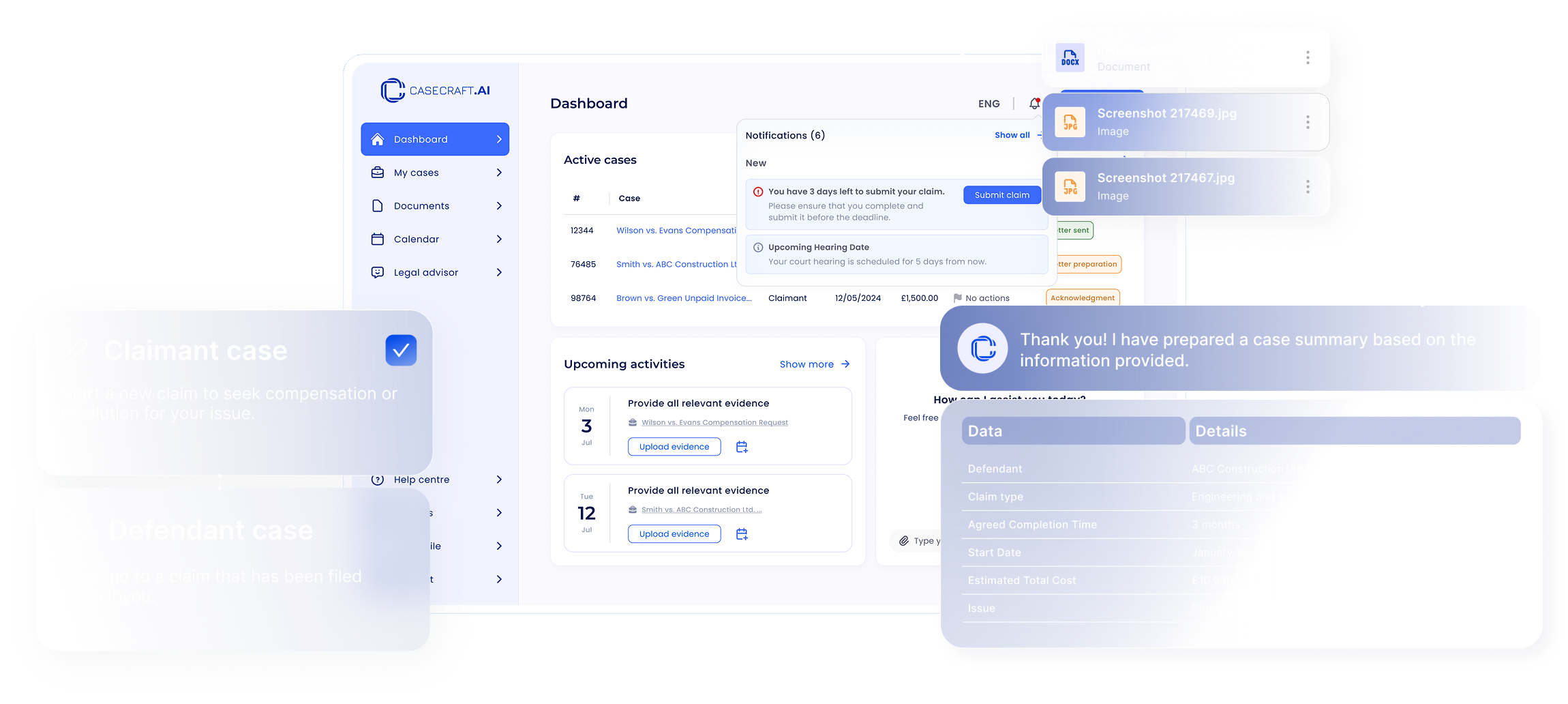
CaseCraft.AI is a UK‑based platform designed to simplify small‑claims litigation. It harnesses AI to prepare documents, compile evidence and manage deadlines. Its features include:
- Automated document preparation. The platform helps you complete claim forms, draft witness statements and organise pleadings.
- Evidence compilation. CaseCraft.AI guides you through uploading photos, repair quotes and diary entries so that nothing is overlooked. Notifications ensure you submit a complete bundle.
- Timely reminders. It tracks court deadlines and sends alerts so you do not miss key dates.
- Cost efficiency. Small claims rarely justify instructing a solicitor. CaseCraft.AI reduces legal spend by enabling you to self‑represent at a fraction of the cost. The property damage guide notes that CaseCraft.AI charges a £15 processing fee plus a 15% success fee, working on a no‑win, no‑fee basis.
- User support. If you need guidance, CaseCraft.AI offers step‑by‑step instructions. Their team of co‑founders combines legal, technological and financial expertise.
Why Choose CaseCraft.AI for Your Neighbour Damage Dispute
- Specialist focus. CaseCraft.AI is built specifically for small claims neighbour damage and other low‑value disputes. It understands the nuances of garden damage claims, driveway damage compensation and neighbour nuisance claims. You won’t be lost in a generic claims portal.
- Ease of use. The interface is intuitive, guiding you from evidence gathering to filing. Even if you’ve never been to court, the platform makes the process manageable.
- Transparent pricing. With a modest upfront fee and success‑based pricing, you know exactly what you will pay. There are no hidden solicitor costs.
- Time savings. Automated forms and reminders mean you spend less time worrying about paperwork and more time focusing on the outcome.
- Better outcomes. Organised evidence and compliant documents increase your chances of success. In 2023, only 3.5% of the 1.72 million small claims went to trial; many settle once the claimant demonstrates they are prepared and serious.
Preventing Future Neighbour Disputes
Resolving one dispute doesn’t guarantee peace forever. To minimise future clashes:
- Document boundaries. Keep copies of deeds, surveys and any boundary agreements. Photograph fences and driveways before and after building work.
- Use written agreements. For shared driveways or boundary maintenance, draft a simple written settlement agreement outlining responsibilities.
- Maintain your property. Regular maintenance reduces the risk of incidents. Keep trees trimmed, repair leaking gutters and avoid activities that could harm your neighbour’s land.
- Communicate early. Let neighbours know before starting major works and respond promptly to their concerns. Many disputes stem from misunderstandings.
- Insurance and cover. Ensure your home insurance includes accidental damage and reflects current values. Review policies annually.
- Record everything. Save receipts, quotes, correspondence and photographs. Even when there is no dispute, documentation is invaluable if one later arises.
Common Examples of Neighbour Damage Disputes We Handle
- Fence knocked down during renovations: A contractor demolishes the dividing fence without notice. You gather evidence, get quotes and file a small claims neighbour damage claim for repair costs.
- Garden ruined by pets or building works: A neighbour’s dog digs up your flowerbeds, or builders stack materials on your lawn. You may seek compensation for garden damage claims and loss of enjoyment.
- Driveway stained or cracked by vehicles: Repeated parking of heavy vehicles leaves oil stains or cracks. A driveway damage compensation claim can recover cleaning and resurfacing costs.

Friendly Asked Questions
Can I claim if my neighbour damaged my fence or garden?
Yes, if they (or their contractors/pets) caused the damage, you can bring a small claims neighbour damage case for repair costs, replacement, and related losses. Take photos, get repair quotes, and keep all receipts and messages.
How much can I claim in small claims?
In England & Wales, the small claims limit is generally £10,000. Keep the claim simple and evidence-led: invoices, estimates, before/after photos, and any witness notes.
Do I need to speak to my neighbour first?
Usually, yes. Send a calm email or letter with photos, repair costs, and a reasonable deadline. If they ignore you, send a Letter of Claim (pre-action) before issuing proceedings. Written steps help both dispute resolution and your case.
What evidence actually wins these cases?
Clear evidence of property damage: dated photos/videos, at least two quotes, receipts for temporary fixes, and a short incident timeline. For a boundary dispute, add a title plan/expert note. For trespass to land, show where the encroachment occurred.
How long and what will it cost?
Court fees scale with claim value; most claims resolve in a few months, sometimes sooner if they settle after the Letter of Claim or mediation. Costs are kept low on the small claims track; you usually can’t recover solicitor’s fees, so tidy evidence matters.
How does CaseCraft.AI help with neighbour damage claims?
We streamline the lot: evidence checklists, loss calculator, auto-drafted Letter of Claim, court-ready forms, and filing/tracking. You stay in control while we handle the admin, ideal for damage caused by neighbours, UK cases (fence, garden, driveway damage compensation).
Case Study: Claim for Breach of Contract

A client paid £5,000 for a one-month agreement to use commercial premises but was denied access after just five days. The provider refused to refund the unused period.nnThe claim was filed for fundamental breach of contract and unjust enrichment. When the defendant failed to respond, the court issued a default judgment, granting full recovery including fees and interest.

CaseCraft.AI supports all common types of small money claims
From broken fences to damaged gardens or driveways neighbour disputes often lead to unexpected repair costs and frustration. CaseCraft.AI helps you claim compensation quickly and fairly, guiding you through evidence collection, negotiation, and formal action — all without legal complexity.
Don’t Wait – Get Started Today!
Take the first step toward a faster, easier small claims process with CaseCraft.AI.