




1. Even a “non-refundable hotel booking refund” isn’t always final – when a hotel refuses a refund because you changed your mind, your chances are slim. Still, if the room was not as described or the hotel cancelled, you have stronger rights under the Consumer Rights Act 2015 and can often demand a full or partial refund.
2. Evidence is everything – a hotel refund refused UK dispute requires proof: screenshots of rate rules, booking pages, photos and videos of issues, payment receipts, and a log of your complaints. Without this, neither a card provider nor a court will help you.
3. You have options if “policy says no” – from complaining to the hotel to using chargeback or Section 75 and, as a last resort, filing a small claim via CaseCraft.AI, you can challenge unfair terms, test whether cancellation fees are reasonable and get your money back. Follow the step-by-step guide below to stay on track.
Travel plans change. Illness strikes, an emergency happens, or sometimes we simply make a mistake and accidentally book a non-refundable hotel. Maybe you arrive to find the room is damp and the shower is not working. More than ever, hotels and booking platforms rely on non‑refundable rates and rigid policies, so when a hotel refuses a refund, it can feel like you have no way out. The exact phrases appear in emails: “policy states that this booking is non‑refundable” or “cancellation fees apply”. If you booked through a big platform such as Expedia or Booking.com, their Expedia refund policy or Booking.com refund bad hotel language often points you back to the property.
Under UK law, however, you still have consumer protections. The Consumer Rights Act 2015 requires services to be carried out with reasonable care and skill, and any description on a hotel’s website or a platform listing becomes part of the contract. When a service fails to meet those promises, you can claim a price reduction or a full refund.
This guide takes you through everything you need to know when a UK hotel refund is refused. It explains what type of problem you have, how to assess the booking terms, what evidence to gather, and how to complain to hotels or platforms.
First, Identify Which Refund Problem You Actually Have
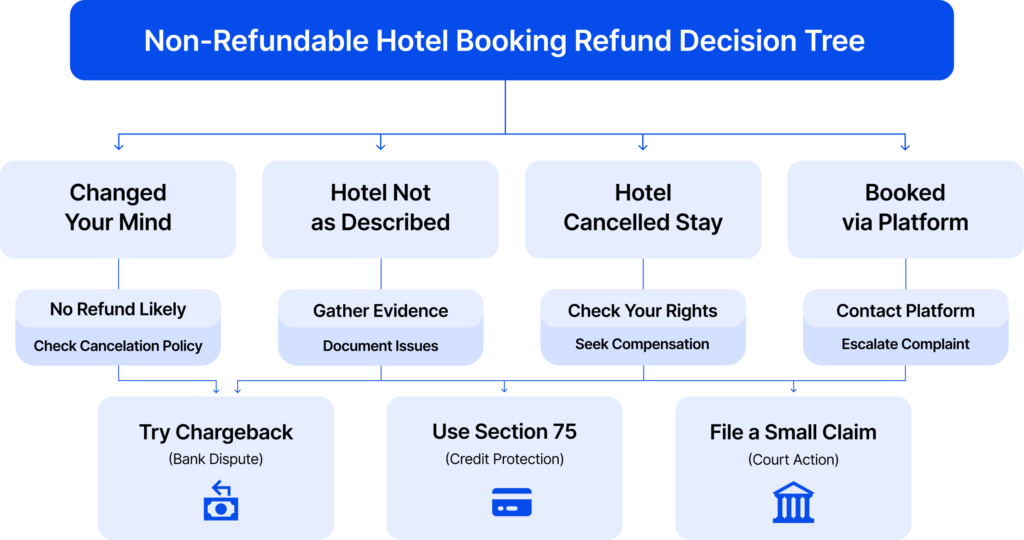
Before arguing about unfair terms, be clear about the kind of dispute you face. Each category has a different resolution path:
- You cancelled because you changed your mind or had an emergency. Many people ask, “Can I get a refund on a non-refundable hotel?” or “Are hotel bookings refundable?” If you cancel outside the free cancellation window, and the hotel can’t resell the room, you usually have no right to a refund. However, the hotel must not profit from cancellation fees; they should reflect genuine losses. If you buy travel insurance and cancel for a covered reason (illness, bereavement or jury service), the insurer might reimburse your non‑refundable booking.
- The hotel cancelled or materially changed your stay. When a hotel or platform overbooks, closes due to a hurricane or changes key terms (e.g., moves you to another property), you’re entitled to a full refund regardless of “non‑refundable” labels. This includes refunds of deposits and vouchers – the property can’t force you to accept credit instead. If paid via credit card over £100, Section 75 covers you.
- The room or service was not as described or of poor quality. Under the Consumer Rights Act 2015, hotels must provide services with reasonable care and skill; if the room is dirty, unsafe or missing promised amenities, you can claim a refund or reduction. This applies whether you booked directly or via a platform. Document everything and give the hotel a chance to fix it. If they refuse or do nothing, move to the next steps.
- You booked through a platform (Expedia, Booking.com, or similar). The contract is usually between you and the hotel, not the platform; policies like “non‑refundable hotel booking refund” or “expedia refund policy hotel” simply reflect the property’s terms. To make progress, you must first complain to the hotel, then involve the platform and later your card provider if necessary.
These distinctions guide the evidence you need and the route you’ll follow. Use the decision tree below to map your situation.
Check the Booking Terms, Then Test Whether They Are Fair
When a hotel refund refused message arrives, start by reviewing the terms you agreed to at booking. Platforms label rates as “free cancellation” or “non‑refundable”; some mention a refundable hotel booking if cancelled within a certain period. Look for these elements:
- Cancellation window and fee. A non‑refundable hotel booking refund typically requires you to forfeit the entire stay if you cancel. If the hotel cancelled, or the booking was automatically cancelled by an event (e.g., flight delays), ask whether the hotel resold the room; they must return any amount they didn’t lose.
- Rate rules and amenities. Download or screenshot the booking confirmation, rate rules, and property description. Under the Consumer Rights Act 2015, promises about facilities (e.g., spa, air conditioning) become contractual terms. If these are missing, the “policy says no” defence fails.
- Upfront payments and deposits. Are hotel deposits refundable? Non‑refundable deposits must be proportionate to the hotel’s actual losses; large deposits covering the entire stay may be unfair. Keep evidence of deposit amounts and dates.
If the contract terms are buried or unclear, raise this in your complaint. UK contract law allows you to challenge unfair terms that cause a significant imbalance in the parties’ rights. Businesses cannot keep deposits or charge cancellation fees that exceed their real losses.
Cooling‑Off/Cancellation‑Right Limits for Date‑Specific Accommodation
Many travellers assume the distance‑selling rules let them cancel within 14 days. Unfortunately, accommodation bookings for a specific date are excluded from the cooling‑off period when booked online, by phone, or through other distance-selling methods. This exclusion applies to distance contracts and off-premises contracts (such as doorstep sales). EU guidance (which informed UK law pre-Brexit) confirms that the 14‑day withdrawal right does not apply to hotel bookings, flights, or car hire booked remotely for specific dates. Note: The UK Consumer Rights Act 2015 retained this exclusion after Brexit, so it remains UK law despite the UK’s departure from the EU.
Nonetheless, unfair contract terms can still be challenged. If cancellation fees are hidden or arbitrary, they may be unenforceable; charges should only cover genuine administrative costs and losses. Some people ask: “Are hotel rooms refundable?” The answer depends on the specific terms and whether the hotel or platform treated you fairly. If you believe the cancellation fee is disproportionate, gather evidence of the hotel’s capacity to resell the room and challenge the fee accordingly.
Proof that Wins Refund Disputes
Your argument rests on the evidence you assemble. Whether you’re dealing with a Booking.com refund bad hotel situation or asking “can I dispute a non-refundable hotel charge?”, the following checklist applies. Use this information to convince the hotel, the platform, your card provider or ultimately a judge:
- Booking confirmation & payment receipt. Save the email or screenshot showing the rate, dates, and any refundable hotel booking options. Keep receipts for deposits.
- Rate rules & cancellation window. Capture the exact text of the property’s policy – when cancellations are allowed, what fees apply, and any exceptions. This helps show whether terms were clear and fair.
- Listing claims & amenities. Record promises about facilities (pool, breakfast, Wi‑Fi). Under the CRA, these form part of the contract. If the room didn’t match, you have grounds for a refund.
- Photos/video with timestamps. Take clear pictures or videos of defects (dirty bathroom, broken air conditioning). Use metadata to show the date and time.
- Complaint log. Note who you spoke to, when, and what was said. Send follow‑up emails to create a paper trail. If the hotel offers a partial refund, record this.
- Evidence that you gave the hotel a chance to fix the problem. In many cases, you must allow a reasonable time to remedy issues before leaving or seeking a refund.
The graphic below summarises the evidence needed to dispute an unfair hotel refund refusal.
Step‑by‑Step: How to Complain to the Hotel or Host?
When your stay goes wrong, and the hotel refund refused message arrives, follow these steps:
- Raise the issue immediately. Speak to the front desk or host as soon as you notice a problem. Politely state the issue and what you expect (e.g., room move, cleaning, partial refund). Document the conversation.
- Ask for a specific remedy. If the problem is minor, ask for a room change or discount. For serious issues, request a full refund for unused nights. When the hotel cancels your booking, insist on a full refund of all payments, including deposits.
- Follow up in writing. Send a brief email summarising your complaint: facts, evidence, and the remedy you’re seeking. Give a clear deadline (14 days is standard) for a response. Include attachments of photos, receipts and screenshots. This record is essential if you later ask: “Are hotel deposits refundable?”
- Escalate if ignored. If the hotel rejects your complaint or doesn’t respond by the deadline, move on to your card provider or platform. Show them the evidence and explain why the charge is unfair.
If You Booked Through a Platform (Expedia or Booking.com), Who You Contact and Why?
Major platforms act as agents; they do not provide the service themselves. Expedia’s terms say travellers must accept each travel provider’s rules; if a property overbooks or closes, Expedia will offer alternative accommodation or a refund. Refunds are returned via the original payment method and depend on the property’s Expedia refund policy. Booking.com likewise notes that non‑refundable reservations cannot be amended or refunded and that cancellation fees depend on the service provider’s policy.
When dealing with a hotel refund refused UK issue on a platform:
Contact the hotel first. Because your contract is usually with the hotel, not the platform, you must give the property a chance to resolve the problem. Explain your evidence and reference unfair contract terms.
Use the platform’s customer service. If the hotel ignores you, open a case with the platform. Upload evidence and refer to the property’s policy. Keep all correspondence. For Expedia, highlight that you seek either an alternative room or a full Expedia hotel refund per their terms.
Escalate to card protections if necessary. If both hotel and platform refuse, move to chargeback or Section 75 as detailed below. Do not simply ask “can you cancel a non-refundable hotel on booking com”, you must show the room failed to meet the contract or the hotel cancelled.
Card Protections that Can Change the Outcome
If the hotel and platform refuse to help, your bank may step in. Two main protections exist for UK consumers:
Chargeback
Chargeback is a voluntary scheme offered by card issuers. It allows them to reverse the transaction and reclaim funds from the merchant’s bank when goods or services are not provided or are faulty. It applies to debit and credit cards. Claims must usually be made within 120 days of the transaction and require evidence: transaction details, proof of contact with the hotel, and supporting documents. There is no minimum purchase value, so you can use it for a hotel refund of any amount.
Section 75
Section 75 of the Consumer Credit Act 1974 is a legal right that makes your credit card provider jointly liable with the merchant for misrepresented or non‑delivered goods or services. It covers purchases between £100 and £30,000 and requires that you pay at least part of the cost on a credit card; even paying a deposit qualifies. There is no 120‑day deadline, but claims should be made within six years. Section 75 claims may also cover consequential losses (e.g., replacement accommodation) and are stronger than chargeback because the card issuer cannot refuse to act unless your evidence is weak.
To compare both options visually:
When deciding whether to use chargeback or Section 75, consider the amount, payment method, and timelines. For example, if you spent £350 on a non‑refundable hotel booking refund and the hotel refuses to refund despite not providing the room, Section 75 applies because the purchase exceeds £100. If you paid £90 with a debit card, you can use a chargeback but must act within 120 days. Always provide a full evidence pack.
Travel Insurance: When It Helps with Non‑Refundable Hotels
Travel insurance can rescue you when emergencies cause a cancellation. Most policies cover accommodation costs, flights and other booked experiences if you cancel due to illness, injury, bereavement or jury duty. They do not refund you if you simply change your mind. Some travellers wonder, “Does travel insurance cover non-refundable hotel bookings?” – the answer depends on the policy and reason for cancellation. To claim successfully, you usually must:
Buy the insurance soon after booking the trip (before any known issues arise).
Attempt to recover costs from the hotel first (request a hotel refund, if refused, gather evidence).
Provide documentation: doctor’s letters, death certificates, or airline cancellation proof.
Show that the cancellation reason is listed in the policy (check covered events).
Travel insurance claims are processed after any refund or chargeback; insurers deduct recovered amounts. They don’t normally cover cancellation fees if you merely reschedule a trip for convenience.
When to Escalate Beyond Complaints?
When a hotel or platform remains unhelpful, you may need to send a formal letter before action and prepare for the small claims process. Here is the escalation pathway:
Formal Letter Before Action
Write a concise letter summarising what happened, the legal basis for your claim, the amount sought (including court fees and interest), and a deadline (usually 14 days). Quote relevant laws (Consumer Rights Act, unfair terms, Section 75) and mention that non‑response will lead to court action. Keep proof of posting or email delivery.
Alternative Dispute Resolution (ADR)
Some hotel chains and platforms belong to ADR schemes, such as the Travel Trust Association or ABTA. Check the hotel’s terms or ask the platform. ADR is cheaper and faster than court, but decisions are sometimes non‑binding. Use it if offered, especially when the amount is modest.
Small Claims Court
When all else fails, small claims court is your last resort. In England and Wales, you can claim up to £10,000; in Scotland, the limit is £5,000. Court issue fees depend on the claim amount: for example, a claim up to £300 costs £35, £1,500.01 and £3,000 costs £115, and claims between £5,000.01 and £10,000 cost £455. Hearing fees range from £27 to £346. You may also need to pay for mediation in some cases. Check the current HM Courts & Tribunals Service guidance for the latest procedural requirements and whether mediation is mandatory for your claim value.
Prepare a bundle with your chronology, all correspondence and evidence. The judge will consider whether the hotel or platform breached the contract by failing to provide reasonable care and skill and whether cancellation fees were fair. If you win, the court can order the hotel to refund you and pay your fees. Remember that chargeback hotel booking / Section 75 hotel booking claims may be faster and simpler than litigation; the court should be the last step.
How CaseCraft.AI Helps?
Filing a claim yourself can be daunting. CaseCraft.AI streamlines the process by turning your evidence into a structured claim bundle. It automatically generates legal forms and pre‑action letters, organises screenshots, emails and receipts into a chronological timeline, and provides AI‑driven guidance on the next steps. Most claims can be prepared and filed in under 15 minutes. Because it’s built for small claims, the service is limited to disputes up to £10,000, matching the court limit.
Turn your evidence into a clear next step. Start your small claim with us.
Note: This guide provides general information about UK consumer rights when hotels refuse refunds. It is not legal advice. Outcomes depend on your specific circumstances, the exact terms of your booking, and how you can prove your case. While the law provides strong protections in certain situations, not all refund requests will succeed.
FAQ
Are hotel bookings refundable under UK law?
It depends. Most “non‑refundable” rates genuinely have no refund if you cancel due to a change of mind or minor inconvenience. Yet if the hotel cancels your stay, materially changes the booking, or fails to deliver what was promised (e.g., no hot water), you may claim a full or partial refund under the Consumer Rights Act 2015. Hotels must not use unfair contract terms or keep deposits that exceed their actual losses.
Can I get a refund on a non‑refundable hotel?
You rarely get a refund if you simply change your plans; that is why the rate is cheaper. However, if the room was dirty, unsafe or not as described, if the hotel cancelled, or if you booked by mistake and contact them immediately, you can request a non‑refundable hotel booking refund. Provide evidence of the problem and ask whether they can resell the room. Travel insurance may also cover cancellations for serious reasons.
Can I dispute a non‑refundable hotel charge?
Yes. If a hotel refused a refund even though it failed to deliver the agreed service, you can raise a dispute with your card provider. Use chargeback for debit or credit card transactions (within 120 days). Use Section 75 for credit card purchases over £100. Supply evidence that you tried to resolve the issue with the hotel first.
Expedia hotel refund: who decides – Expedia or the property?
Expedia acts as an agent; the contract is with the hotel. When you request an Expedia hotel refund, Expedia must check the property’s cancellation policy. It will only be refunded if the property agrees or if the property overbooks or closes. Therefore, contact the hotel first and involve Expedia if the hotel ignores you.
Booking.com refund for a bad hotel: what steps work best?
For a booking.com refund for a poor hotel, document the issues and complain to the hotel immediately. If they refuse to help, contact Booking.com customer service. Provide photos, emails and copies of the listing. Make it clear that the property failed to provide services as described. If the platform still denies your claim, use your card protection rights.
Are hotel deposits refundable?
Deposits should reflect the hotel’s actual loss if you cancel. If they represent a large percentage of the stay or are taken without justification, they may be unfair and unenforceable. Ask for a breakdown of the losses and challenge the fee if it seems arbitrary.