




1. No win, no fee (or Conditional Fee Agreement) lets you bring a legal claim without paying a solicitor up front. You only pay if you win, usually by giving up part of the compensation as a success fee.
2. Success fees are capped by law and tend to be up to 25% of damages in personal‑injury cases; other claim types can attract higher percentages. You might also need After‑The‑Event (ATE) insurance to protect against the other side’s costs.
3. Small claims under £10,000 rarely qualify for no-win, no-fee because solicitor fees can’t be recovered on the small‑claims track. Self‑representation and low‑cost tools like CaseCraft.AI are often better options for these modest disputes.
Introduction
A successful lawsuit can be life‑changing, but hiring a solicitor can be expensive. To make justice more accessible, lawyers in England and Wales often offer no win, no fee agreements, formally called Conditional Fee Agreements (CFAs). Under this model, you only pay your solicitor if you win your case – if you lose, you won’t be charged for their time. This arrangement has transformed access to justice in personal‑injury and employment disputes, allowing claimants to litigate without huge upfront bills.
However, there are limits. No win, no fee does not mean “no cost at all”; success fees reduce your compensation, and you may still owe disbursements and insurance premiums. Moreover, small claims under £ 10,000 are usually excluded because court rules prevent recovery of solicitor fees. This guide explains how no win, no fee works in the UK, who qualifies, what percentage solicitors take, and why self‑help platforms like CaseCraft.AI can be a better fit for small claims.
What Is a No Win, No Fee Agreement?
A no win, no fee agreement is a Conditional Fee Agreement (CFA) between you and your solicitor. In plain terms, it means you don’t pay your solicitor’s fees unless you win your case. If the claim succeeds, the solicitor takes a success fee, a percentage uplift on their standard costs. The losing party may be ordered to pay base costs (standard legal fees), but success fees are paid from your compensation.
Key points:
You only pay if your case is successful.
The success fee is capped by law (usually up to 25% for personal injury).
Base costs (the solicitor’s usual hourly rate) may be recoverable from the losing side in eligible cases.
You might still pay disbursements such as court fees, expert reports or ATE insurance.
Understanding this distinction is crucial: a no win, no fee arrangement reduces the risk of paying solicitor fees if you lose, but it doesn’t eliminate all costs.
How Does No Win, No Fee Work in Practice?
Before entering a CFA, you’ll go through several stages. Each step ensures that both you and your solicitor understand the claim’s merits, the fee structure and the risks involved.
Step 1: Initial Case Assessment
The process begins with a risk assessment. Solicitors only take on no win, no fee claims when they believe there is a good chance of success. The House of Commons notes that lawyers share the risk with their clients and will consider the case’s merits, the likelihood of winning and the level of the success fee. Cases with shaky evidence or low potential damages may be declined because the solicitor will only be paid if the claim succeeds.
Step 2: Signing the Agreement
If the solicitor believes your claim has merit, they will offer a Conditional Fee Agreement. This contract sets out:
- Their hourly rate (base costs).
- Success fee percentage – how much of your compensation they’ll take if you win.
- What costs are covered, and which expenses (such as expert reports or court fees) you’ll still pay.
- Your obligations – for example, cooperating with your solicitor and telling the truth.
Reputable firms provide a cooling‑off period so you can read the terms carefully. Under the Solicitors Regulation Authority’s principles, solicitors must be transparent about costs and ensure clients understand the agreement before signing.
Step 3: Paying the Success Fee
If your case is successful, the solicitor’s success fee is deducted from your compensation. For personal injury claims, success fees are capped at 25% of damages. Employment and other civil claims may attract higher percentages (often 20–40%). Suppose you win £10,000 in compensation; a 25% success fee means your solicitor takes £2,500, leaving £7,500 for you. You might still recover your solicitor’s base costs from the defendant, but the success fee always comes from your award.
If you lose your case, you usually don’t owe your solicitor for their time. However, you may still be liable for disbursements such as court fees or expert witness costs. Claimants in higher‑value cases often take out After‑The‑Event (ATE) insurance to protect against paying the other side’s costs.
What Does No Win, No Fee Cover?
No win, no fee agreements are widely used in the UK, but they’re not available for every type of claim. Common claim types include:
- Personal injury: road‑traffic accidents, work injuries and clinical negligence claims.
- Employment disputes: wrongful dismissal and discrimination claims.
- Professional negligence: claims against solicitors, accountants or surveyors.
These claims have relatively high potential damages and allow solicitors to recover some base costs from the defendant. Small claims under £10,000 rarely qualify because court rules limit the recovery of legal costs. For minor consumer disputes or simple debts, self‑representation or tools like Casecraft.ai are more economical.
What Are the Advantages of No Win, No Fee?
No win, no fee arrangements offer several benefits:
No upfront legal fees – you don’t pay unless you win, making justice accessible to those without savings.
Shared risk – solicitors shoulder the risk of losing and are incentivised to build a strong case.
Access to justice – CFAs opened the door for claimants after legal aid was cut.
Affordable finance – success fees are capped (25% for personal injury) and might be recoverable from the defendant in some cases.
These advantages explain why CFAs have become standard in personal‑injury litigation.
What Are the Disadvantages or Risks?
Despite the benefits, no win, no fee agreements have downsides:
- Reduced compensation: the success fee comes out of your damages, reducing your final payout.
- Disbursements still apply: court fees, expert reports and ATE insurance are often payable whether you win or lose.
- Case selection bias: solicitors decline borderline or low‑value claims because they can only get paid if they wink.
- Not available for small claims: costs aren’t recoverable in small claims, so most solicitors refuse No Win No Fee agreements for claims under £10,000.
Being aware of these risks helps you decide whether a CFA suits your situation.
How Does No Win, No Fee Work in Small Claims Court?
Small‑claims procedures are designed to be simple, fast and inexpensive. County‑court claims up to £ 10,000 are normally allocated to the small‑claims track. Unlike higher‑value cases, each side usually pays its own legal costs, and the winning party can only recover fixed fees (issue fee, limited witness expenses and court costs). This means solicitors rarely offer no win, no fee arrangements for small claims; there is no realistic way for them to recover their fees.
CaseCraft.AI offers a technology‑based alternative. Its platform guides users through each stage of a small claim, from drafting a pre‑action letter to filing court forms and preparing for hearings. By automating document assembly and providing procedural prompts, Casecraft.ai makes self‑representation more accessible. Customers pay a modest fee or a small percentage of their recovered sum, avoiding high solicitor costs and bypassing the limitations of traditional no win, no fee small claims arrangements.
What Happens If You Lose Under No Win, No Fee?
If you lose your claim under a no win, no fee agreement, you generally don’t owe your solicitor for their time. However, you may still be responsible for certain costs:
- Court fees: fees for issuing the claim and other procedural steps.
- Disbursements: costs such as medical reports or expert evidence.
- Opponent’s costs: in some non‑small‑claim cases, you may have to pay a portion of the other side’s legal fees if the court orders it.
- ATE insurance premium: if you purchased ATE insurance, the premium is often non‑refundable.
In small claims, the cost risk is lower because courts seldom award substantial costs against losing parties. Nevertheless, it’s wise to budget for court fees and disbursements even when your solicitor acts on a no win, no fee basis.
What Percentage Do No Win, No Fee Solicitors Take?
The percentage your solicitor takes depends on the type of claim:
- Personal injury: up to 25% of damages for pain, suffering and past losses.
- Employment disputes and professional negligence: typically 20–40%. There is no statutory cap, but fees must be reasonable.
- Commercial litigation: success fees can be up to 100% of the base costs (not damages) in commercial CFAs.
Success Fee Example
| Settlement amount | Success fee % | Success fee | Net to claimant |
| £4, 000 | 25% | £1, 000 | £3, 000 |
| £10, 000 | 25% | £2, 500 | £7, 500 |
| £ 20,000 | 30% | £6, 000 | £14, 000 |
| £30, 000 | 35% | £10, 500 | £19, 500 |
The table shows how success fees reduce your award. Always ask your solicitor to confirm the percentage in writing before signing a CFA.
Alternatives to No Win, No Fee
For many claimants, particularly those pursuing small claims, there are other ways to fund legal action:
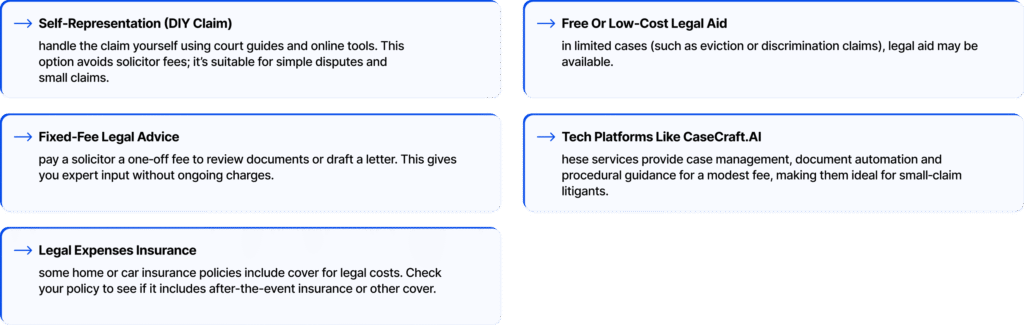
Selecting the right option depends on your claim’s value, complexity and your appetite for doing the work yourself.
When to Consider a No Win, No Fee Arrangement
No win, no fee isn’t always the right choice. Consider a CFA when:
The claim is worth more than £10,000. Recoverable costs mean your solicitor’s base costs may be covered by the defendant, making the success fee worthwhile.
The case is complex. Evidence, expert witnesses or procedural intricacies justify professional representation.
You want to share the risk. A CFA aligns your solicitor’s interests with yours because they only get paid if they win.
Avoid a CFA if the claim falls within the small‑claims limit or if a sizeable success fee would leave you with little compensation. In those cases, explore self‑representation or fixed‑fee advice.
Conclusion
Understanding how no win, no fee works helps you weigh the benefits against the risks. These agreements open the door to justice by removing upfront fees and sharing risk, but success fees reduce compensation, and solicitors cherry‑pick strong claims. They also rarely apply to small claims, where court rules limit recoverable costs. For modest disputes, self‑representation or affordable legal technology like CaseCraft.AI can be more cost‑effective.
If you’re considering a claim above the £10,000 small‑claims threshold, a conditional fee agreement could be a viable funding model. Ask potential solicitors what percentage success fee they charge, whether you’ll need after‑the‑event insurance, and how disbursements are handled. For lower‑value claims, explore self‑help tools, fixed‑fee advice and insurance options instead.
Disclaimer: This content is for informational purposes only and does not constitute legal advice. If you need guidance on your specific situation, you should seek independent legal advice.
FAQ: No Win, No Fee Agreements
What does no win, no fee mean in the UK?
A no win, no fee agreement, formally known as a Conditional Fee Agreement, is a contract where a solicitor only charges you if your case succeeds. If you lose, you don’t pay for their time. You may still be liable for court fees and disbursements, so it isn’t entirely free.
Do I pay anything if I lose a no win, no fee case?
Usually, you don’t pay your solicitor’s fees if your claim fails. However, you may have to cover court fees, expert reports or the other side’s costs (unless protected by ATE insurance). In small‑claims cases, cost awards against you are rare.
What percentage do solicitors take on no win, no fee?
Success fees vary by claim type. In personal injury cases, they are capped at 25% of damages. Employment and professional‑negligence cases may attract success fees of 20–40%. Always agree on the percentage in writing.
Is no win, no fee available for small claims?
Rarely. The small‑claims track covers claims up to £10,000, and parties usually pay their own legal costs. Because solicitors cannot recover their fees, they seldom offer no win, no fee arrangements for small claims. Self‑representation or CaseCraft.AI are better choices.