




Learn how the small claims court works in the UK. Step-by-step guide to filing, hearings, and judgments for claims under £10,000.
- Accessible justice – Small claims court is a simplified county court procedure for disputes under £10,000, allowing individuals and small businesses to resolve money and property issues without a solicitor. It covers unpaid invoices, faulty goods, tenancy disputes and more.
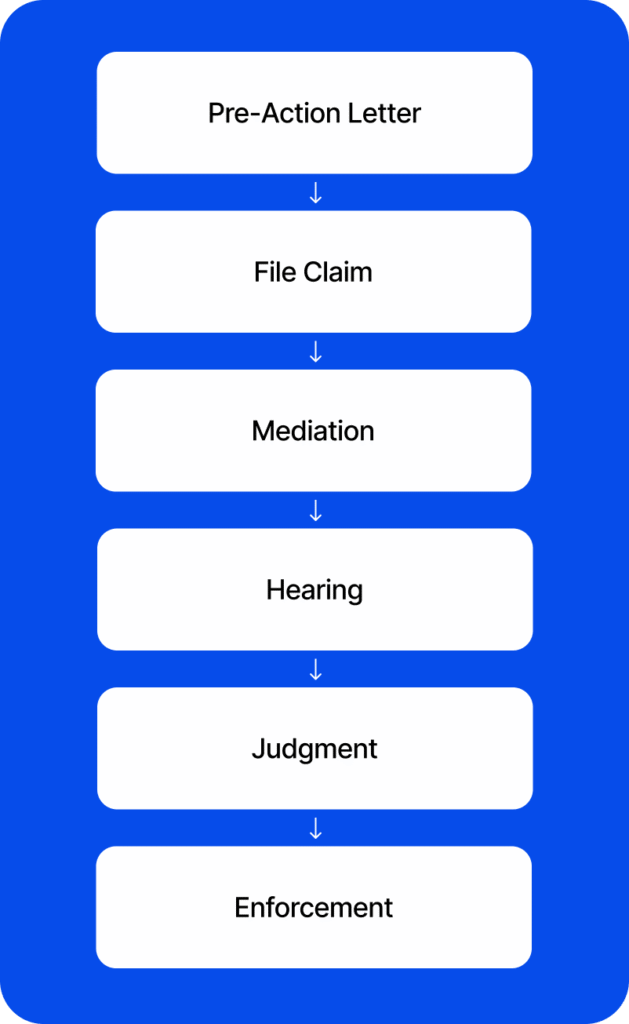
- Structured yet flexible – The process follows clear stages: write a pre‑action letter, file the claim, wait for the defendant’s response, attempt mediation, attend a short hearing if needed, receive judgment and enforce it. Hearings are informal, with at least 21 days’ notice, and evidence exchanged 14 days before.
- Costs and timeframes – Filing fees range from £35 to £455, depending on claim value. Most parties cover their own legal costs. Disputed cases take around 3–9 months, while uncontested claims can settle within 4–6 weeks. Digital tools like CaseCraft.AI can shorten preparation time and improve organisation.
Introduction
Small claims court offers a fast, affordable route for settling civil disputes in England and Wales. It’s part of the county court system and is designed so that ordinary people and small businesses can resolve money or property issues without heavy legal costs or complex procedures.
Whether you are chasing an unpaid invoice, seeking compensation for faulty goods, or sorting a deposit dispute, understanding how the small claims court works is essential. Yet many potential claimants feel daunted by the process, fear of paperwork, long delays and uncertainty about costs often stop people from pursuing legitimate claims.
Imagine lending a friend £3,000 to help them through a difficult period. Months pass, and your messages go unanswered. You feel awkward about taking formal action, but you also can’t afford to write off the debt. That’s where small claims court comes in. It provides a structured process to claim what you are owed, and the court expects parties to try to settle first through negotiation or mediation.
This article explains how to make a small claim in the UK step by step. It covers eligibility, the types of disputes you can take to court, the procedure for filing and responding, what happens at a hearing and how judgments are enforced.
What Is a Small Claims Court?
A small claims court isn’t a separate court at all; it’s a track within the County Court designed for straightforward civil disputes worth up to £10,000. The “small claims track” handles claims for money or specific performance (such as requiring a landlord to return a deposit) where the factual and legal issues are not complex. Claims above £10,000 usually move to the fast or intermediate tracks, while personal injury and housing disrepair claims are capped at £1,000. Because the sums are lower, the court rules aim to reduce cost and complexity: hearings are informal, each side generally pays their own legal costs, and judges actively manage cases to encourage settlement.
In most small claims hearings, the judge won’t wear a wig or gown. You and the other party will sit facing the judge in a normal room, and the judge will ask questions to clarify the issues. Because lawyers aren’t usually required, the process is designed for “litigants in person” to navigate themselves.
What Types of Disputes Can You Take to Small Claims Court?
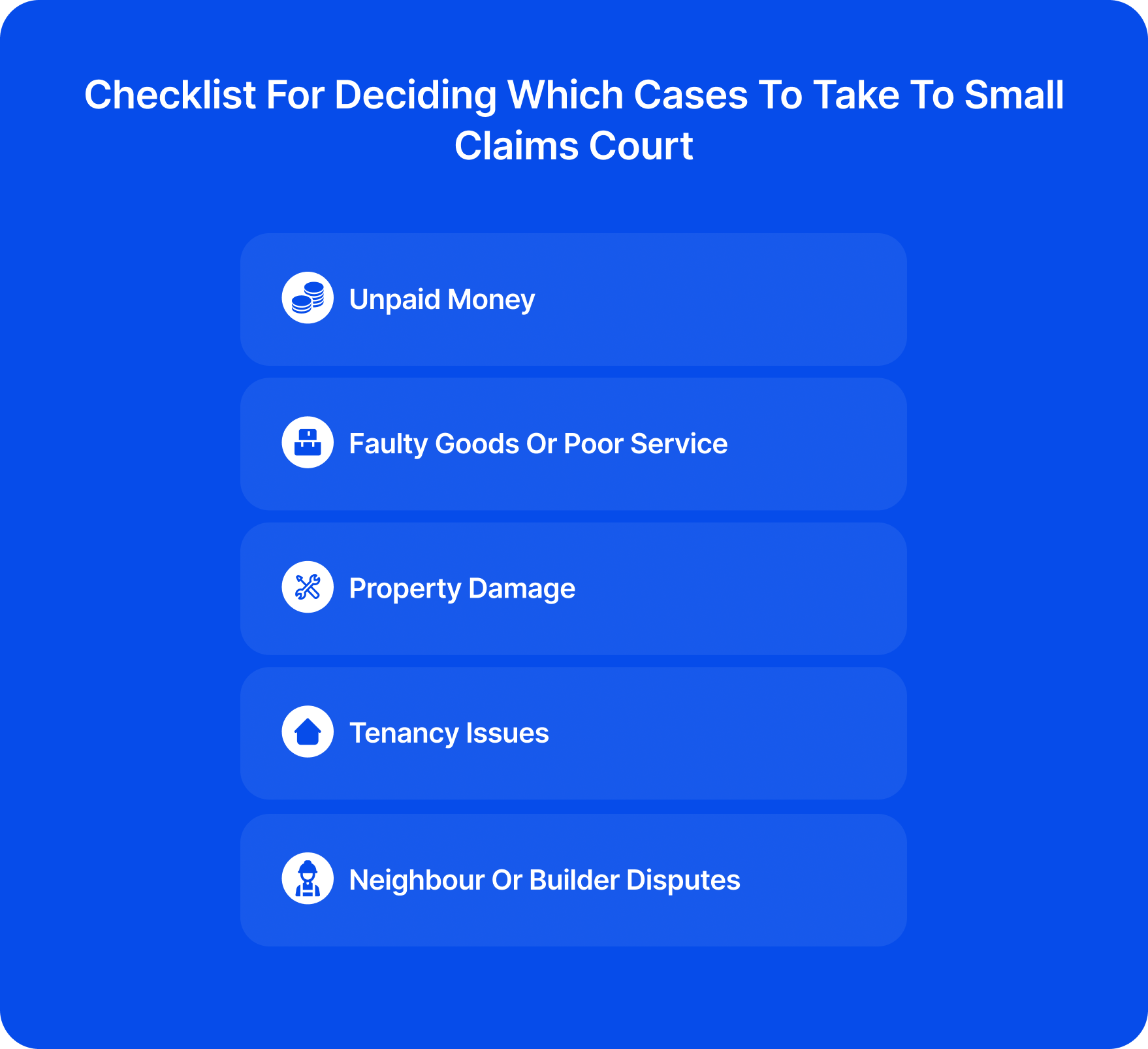
Many everyday disagreements fall under the small claims court UK process. Typical examples include:
- Unpaid money – loans, unpaid invoices or deposit disputes. If someone owes you a sum under £10,000, you can bring a county court money claim to recover it.
- Faulty goods or poor service – claims under the Consumer Rights Act for defective products, shoddy repairs or services not delivered as promised.
- Property damage – costs of repairing damage to property, including vehicle repairs following a minor road traffic accident (without serious injury).
- Tenancy issues – recovering a tenancy deposit, requesting repairs or compensation for disrepair, or disputes over rent or service charges.
- Neighbour or builder disputes – boundary disagreements or unpaid work by builders.
The small claims track can also handle simple contract breaches or refund disputes. Claims for personal injury (e.g. whiplash) or housing disrepair must be under £1,000. More complex issues or claims above the limit are allocated to the fast or multi‑track, which have different rules and higher costs.
Who Can Use a Small Claims Court?
Any individual, tenant, landlord or small business in England or Wales can use the small claims court procedure, provided the defendant is also based in England or Wales. You don’t need to be a UK citizen; you simply need a dispute that falls within the jurisdiction. The process is designed for self‑representation, so legal representation is optional. In fact, most people represent themselves to keep costs down. Solicitors’ fees are rarely recoverable, so it’s often not economical to hire one unless the dispute is complex or you’re unfamiliar with legal procedures.
There are some exceptions. If the case involves complicated law, high value, personal injury above £1,000 or housing repairs above £1,000, the court can allocate it to a higher track. In addition, if the defendant doesn’t live in England or Wales, you may need to use a different process (for example, through the European Small Claims procedure or other international rules). Finally, claims involving defamation, libel or harassment are not suitable for small claims.
The Small Claims Process (Step‑by‑Step)
The small claims court explained here follows seven key steps. Before diving into them, remember that the court expects you to act reasonably, provide the other side with clear information about your complaint and try to resolve it before starting legal proceedings. Digital tools like CaseCraft.AI can help you create letters, organise evidence and keep track of deadlines throughout the process.
Step 1: Try to Resolve the Dispute First
Send a pre‑action letter (also known as a “letter before claim”) to the other party. This letter should set out what the dispute is about, what you want them to do (for example, pay a specific amount), and give a reasonable deadline to respond, typically 14 days. The letter should refer to the Pre‑Action Conduct Practice Direction and show willingness to consider mediation. If you skip this step, the court can penalise you for costs even if you win. CaseCraft.AI’s pre‑action letter generator can save time and ensure your letter meets legal standards, strengthening your position.
If the other party responds and you can reach a compromise, you avoid going to court. Many disputes settle at this stage, especially when accompanied by a clearly worded schedule of evidence and proposed solution.
Step 2: File the Claim
If negotiation fails, you can issue a claim online through the court’s digital money claim service or by using Form N1 (paper). You’ll need to provide the names and addresses of both parties, the amount being claimed, why it is owed and any supporting evidence. Filing fees depend on the value of your claim, from £35 for claims under £300 to £455 for claims between £5,000 and £10,000. Fees are slightly higher for paper forms. You must also pay a hearing fee if the case goes to trial, but many cases settle before the hearing.
Digital platforms like CaseCraft.AI can auto‑generate a court‑ready claim that meets HMCTS standards, checking compliance and formatting. Once filed, the court issues a claim number and serves the claim on the defendant. It’s important to keep a record of when service occurs because deadlines run from the date of service.
Step 3: Defendant’s Response
The defendant has 14 days from the date of service to acknowledge and respond to the claim. They can:
- Admit and pay the full amount.
- Admit part of the claim and propose a payment plan.
- Defend the claim, either denying liability or raising a counter‑claim.
- Ignore it, leading to a default judgment in your favour after the deadline expires.
If the defendant files a defence, the court will send both parties a notice of allocation. This sets out the small claims track directions and hearing fee due date. Parties must exchange documents and witness statements 14 days before the hearing. CaseCraft.AI’s dashboard helps claimants and defendants track these deadlines and compile evidence.
Step 4: Mediation
For claims under £10,000, the court requires parties to engage with the Small Claims Mediation Service offered by HMCTS. Mediation is free and usually takes place by telephone, lasting around an hour. A trained mediator speaks separately to each side to explore a possible settlement. If either party refuses to attend without good reason, the judge may penalise them for costs at the hearing.
Many disputes settle during mediation, saving time and court fees. If an agreement is reached, it is recorded in writing and becomes binding. You can still use a digital assistant like CaseCraft.AI to prepare a settlement offer, calculate amounts owed and draft a settlement agreement.
Step 5: Court Hearing (If Not Settled)
If mediation fails, the case proceeds to a small claims hearing in the UK. Hearings are usually short, lasting 30–60 minutes, and take place in a normal room rather than a formal courtroom. The judge will ask each party questions and consider the written evidence and witness statements. You’ll receive at least 21 days’ notice of the hearing date. You must send your evidence to the court and the defendant 14 days before the hearing.
Remote hearings by telephone or video are increasingly common. HMCTS guidance explains that the court will tell you which platform to use and provide instructions; participants must test their equipment and keep themselves on mute until asked to speak. At the hearing, the judge won’t wear a wig or gown and will explain the process. It’s a good idea to attend a hearing as an observer beforehand to understand the informal atmosphere.
Step 6: Judgment
After hearing both sides, the judge will give a small claims judgment. The judgment may order the defendant to pay a specific amount, dismiss the claim, or require some other action (such as returning property or fixing a problem). In most cases, the losing party has 14 days to pay. If they don’t pay, the winning party can pursue enforcement. Judgments are recorded on the Register of Judgments and affect the debtor’s credit record for six years unless paid in full within one month.
Step 7: Enforcement (If Not Paid)
If the defendant doesn’t comply with the judgment, you can use several enforcement options:
- Warrant of control – instruct the county court bailiffs to seize goods and sell them to satisfy the debt.
- Attachment of earnings order – deduct payments directly from the debtor’s wages.
- Third‑party debt order – freeze money in the debtor’s bank account.
- Charging order – secures the debt against the debtor’s property; it must be paid when the property is sold.
Each method has its own forms and fees. CaseCraft.AI’s enforcement guide helps you decide which option fits your situation and auto‑generates the relevant paperwork.
How Much Does Small Claims Court Cost?
Making a claim costs money, but the fees are relatively modest. The main costs are the issue fee (paid when you file your claim) and, if the case goes to a hearing, the hearing fee. The issue fee is calculated based on the value of your claim. For online filing, the government’s fee scale is:
| Claim value | Online filing fee |
| Up to £300 | £35 |
| £300.01–£500 | £50 |
| £1,000.01–£1,500 | £80 |
| £1,500.01–£3,000 | £115 |
| £3,000.01–£5,000 | £205 |
| £5,000.01–£10,000 | £455 |
The court only awards fixed costs such as the issue fee, reasonable travel expenses, loss of earnings (capped at £95 per day) and witness expenses. If a party behaves unreasonably, for example, ignoring directions or refusing mediation, the judge can order them to pay the other side’s legal costs.
Note: All information is accurate as of November 2025. Court fees and procedures can change, so always check the latest guidance on GOV.UK. For online filing, the government’s current small claims fee scale applies.
How Long Does Small Claims Court Take?
The small claims court UK process aims to resolve disputes quickly, but timelines vary. According to the Ministry of Justice’s 2025 statistics, the median time from claim issue to trial was 40.6 weeks. However, this figure includes defended cases; uncontested claims often settle much sooner. A general guide is:
| Stage | Typical timeframe |
| Pre‑action negotiations | 2–6 weeks |
| Filing and service | 1–2 weeks |
| Defendant’s response | 14–28 days |
| Mediation | 4–6 weeks (cases often settle here) |
| Hearing (if required) | 3–6 months after filing |
| Judgment and payment | within 14 days of judgment |
For uncontested claims, settlement may occur within 4–6 weeks. Disputed claims typically take 3–9 months, depending on court workload. Delays often arise if parties miss deadlines for submitting evidence or if the defence introduces complex issues. Organised documentation and timely responses help keep the case on track.
What Happens After a Small Claims Judgment?
Once the judge issues a decision, the losing party must comply. If the defendant pays within 14 days, the matter ends. If they cannot pay at once, they may apply to pay in instalments. If no payment is made, the claimant can choose an enforcement method. The judgment will stay on the debtor’s credit record for six years if unpaid, making it harder for them to borrow or obtain credit.
A defendant who didn’t respond to the claim can ask the court to set aside a default judgment if they have a good reason (for example, they never received the claim). Appeals are possible but only on specific grounds (usually a legal error), and the permission of a judge is required. A specialist solicitor or barrister can advise on whether an appeal is viable.
Advantages of Small Claims Court
- Low cost and accessibility – Court fees are relatively low, and there is no need for legal representation.
- Self‑representation – The process is designed for individuals and small businesses to represent themselves; judges assist parties by asking questions.
- Speed – Uncontested claims settle quickly, and even disputed cases are usually resolved within months rather than years.
- Online filing and mediation – Claims can be filed through a digital service; mediation is available by phone.
- Clear rules – The Civil Procedure Rules part 27 limit costs, restrict expert evidence and ensure hearings remain informal.
Limitations of Small Claims Court
- Monetary cap – Claims are limited to £10,000 for most disputes and £1,000 for personal injury or housing disrepair.
- Limited cost recovery – You usually can’t recover legal fees. If you instruct a solicitor, you may end up paying more in fees than you recover.
- Complex cases excluded – Technical or legally complex disputes may be transferred to higher tracks.
- Enforcement hurdles – Winning doesn’t guarantee payment; you may need to take further enforcement action.
- Stress and time – Even though the process is simpler, preparing a case, compiling evidence and attending hearings can still be time‑consuming.
Common Mistakes to Avoid
- Skipping the pre‑action letter – Failing to send a clear, compliant letter before action can lead to cost penalties.
- Missing deadlines – Courts set strict deadlines for responses and evidence; missing them can result in default judgment or adjournment.
- Poor evidence – Submitting disorganised or incomplete documents weakens your case. Include contracts, emails, invoices and photos.
- Over‑claiming – Asking for more than you can justify may undermine your credibility. Claim only what you can prove.
- Ignoring enforcement – Don’t assume the defendant will pay. Understand enforcement options and act quickly if payment is not received.
CaseCraft.AI: Your Digital Small Claims Assistant
Traditional small claims paperwork can be daunting. CaseCraft.AI is a digital assistant that streamlines each step of the small claims process in the UK. The platform automatically generates legal forms based on your answers, saving hours of drafting time. It guides you through evidence gathering, deadlines and mediation, much like a legal expert would. Users complete the filing process in under 15 minutes, and the system produces a court‑ready claim that meets HMCTS standards.
CaseCraft.AI operates on a success‑based pricing model; there’s a £15 setup fee and 10% payable only if your claim succeeds. It also generates pre‑action letters, structured settlement offers and evidence packs to encourage early resolution.
Disclaimer: This guide is for information purposes only and does not constitute legal advice. Small claims procedures can vary based on individual circumstances, so consider seeking independent legal guidance if you need advice tailored to your situation.
FAQ: How Small Claims Court Works?
What is the small claims court in the UK?
Small claims court is the simplified track within the County Court for resolving civil disputes under £10,000 in England and Wales. It covers straightforward money and property claims and is designed for self‑representation. Hearings are informal, and judges assist parties in presenting their case. Claims for personal injury and housing disrepair are limited to £1,000.
How much does it cost to take someone to small claims court?
The issue fee is based on the value of your claim, £35 for claims under £300, up to £185 online or £455 on paper for claims between £5,000 and £10,000. You may also pay a hearing fee if the case goes to trial. Each party usually pays their own legal costs, so you should factor that into your decision.
Do I need a solicitor for small claims court?
No. The small claims track is designed for claimants and defendants to represent themselves. Judges will guide you through the procedure and ask questions to clarify the issues. Hiring a solicitor may not be cost‑effective because legal fees are rarely recoverable.
How long does a small claims case take?
Timelines depend on whether the case is defended. Uncontested claims often settle within 4–6 weeks. Defended claims typically take 3–9 months, with the median time from issue to trial standing at 40.6 weeks in 2025. Delays may occur if parties miss deadlines or if the issues are complex.