




1. Time limits are strict – if you miss the three-year limitation period in most personal injury cases, the court may bar your claim. Act early and keep the clock in mind.
2. Evidence decides the result – judges decide civil claims on the balance of probabilities. Without a robust evidence checklist, medical records, accident reports, photos and receipts, your chances of success in a personal injury claim diminish.
3. Choose the right route – low-value road traffic injuries usually go through the Official Injury Claim portal. Complex or higher-value cases may require a solicitor and a formal letter before action. Picking the wrong route wastes time and money.
Thinking about a personal injury claim can be daunting. This guide shows you how to assess your chances before starting a claim in the UK. It sets out the five checks that solicitors use to gauge whether a case has good prospects, explains the personal injury claim process, and helps you decide whether an online claim portal or a traditional route suits you. You’ll learn how to gather evidence, understand liability and causation, and navigate strict time limits.
Throughout, we highlight UK‑specific rules, such as the three‑year limitation period and the “balance of probabilities” standard, and show how platforms like CaseCraft.AI can help organise your evidence and generate formal letters without overpaying lawyers.
Note: This guide explains how UK claim viability is assessed and uses personal injury as an example. CaseCraft.AI does not provide legal advice or act as a personal injury law firm. We support evidence organisation and pre-action documentation only, and injury-related support is limited to claims up to £1,000. For higher-value or complex injury cases, consult a qualified solicitor.
A Practical Way to Check If Your Claim Is Likely to Succeed
When you assess your chances before starting a claim, you are really checking whether your case would look strong enough to pass an insurer’s first legal test. In the UK, claims are judged on duty of care, causation, time limits, and evidence, not on how unfair the situation feels. If these foundations are weak, even genuine claims often fail before they reach court.
This section shows you how to check those foundations in plain English, using the same structure insurers use to decide the chances of success in a personal injury claim.
Mini‑Summary of What Follows
- Liability and duty of care: who owed what duty, and how breaches occur in road traffic, workplace and public accidents.
- Causation and evidence: why linking the incident to your injuries matters, and what an evidence checklist looks like.
- Time limits and prospects: how the three‑year limitation period and the balance of probabilities standard influence your chances of success.
Trust Cue
Civil courts decide claims on the balance of probabilities. That means the judge must be satisfied that your version of events is more likely than not.
Quick Actions
- Check your claim viability – run through the five checks and the scorecard below.
- Start organising evidence with CaseCraft.AI – build a timeline, upload documents and generate a letter before action when ready.
What “Good Prospects” Actually Means in the UK?
In criminal cases, prosecutors must prove guilt beyond a reasonable doubt, but civil claims use a lower standard. A judge will ask whether your case is more likely than not to be true. To succeed at trial, a claimant must show, based on factual, witness and expert evidence, that the defendant acted negligently or breached their duty and caused injury on the balance of probabilities.
This is why lawyers talk about prospects of success. If the evidence suggests a 51% or greater chance that your claim is true, the claim may proceed. Insurers often require prospects above 51% before funding legal expenses. Think of it as tipping a set of scales in your favour; every piece of credible evidence counts.
Note: This article provides general guidance on how to assess your chances before starting a claim. It does not constitute legal advice. If you’re unsure about your claim or need specific advice, speak to a qualified solicitor.
The Five Checks that Decide Whether You Have a Viable Claim
Together, these five checks form the core test insurers and courts use to judge the chances of success in a personal injury claim, and they decide whether your case is likely to proceed, be reduced, or be rejected.
1) Time Limit (Limitation)
The limitation period sets a deadline for bringing claims. For most personal injury claims in England and Wales, you have three years from the date of the accident or the date you became aware of your injury to issue court proceedings. A civil litigation update notes that this three‑year period applies across personal injury claim types and that children have until their 21st birthday to start a claim. People lacking mental capacity benefit from extended or suspended limitation periods. Missing the time limit usually bars the claim entirely.
Why it matters: Once the limitation period expires, courts rarely allow extensions. Starting early keeps recollections fresh, preserves evidence and avoids procedural pitfalls. If you’re using the Official Injury Claim (OIC) portal, note that entering a claim on the portal does not stop the clock; you must still finish within three years.
2) Liability and Duty of Care
To succeed, you must show that the defendant owed you a duty of care and breached it. In road traffic accidents, drivers must take reasonable care to avoid causing injury; in workplace accidents, employers must maintain safe conditions and provide proper equipment; in public places, occupiers must ensure premises are safe.
To prove negligence, you must establish the duty of care, show a breach (failing to act as a reasonable person would), and demonstrate that this breach caused injury. Evidence such as accident reports, CCTV footage, witness statements and expert opinions helps prove breach.
Practical example: if you slipped on an unmarked wet floor in a supermarket, the occupier’s duty to maintain safe premises may have been breached. However, if warning signs were clearly displayed, the duty may have been discharged, and your chances of success in a personal injury claim diminish. Assess whether you can point to specific negligent acts or omissions.
3) Causation (Can You Link the Injury to the Incident?)
Even if someone breached their duty, you only recover compensation if the breach caused your injury or loss. This is often the hardest element to prove. You must show that your injuries were a foreseeable result of the negligent act, not an unrelated pre‑existing condition. Medical records and expert reports can help establish this link, and diaries documenting symptoms over time can strengthen your case. If the defendant argues that the injury would have occurred anyway, your prospects may fall below the balance of probabilities.
4) Evidence Strength (What You Can Prove, Not Just What You Remember)
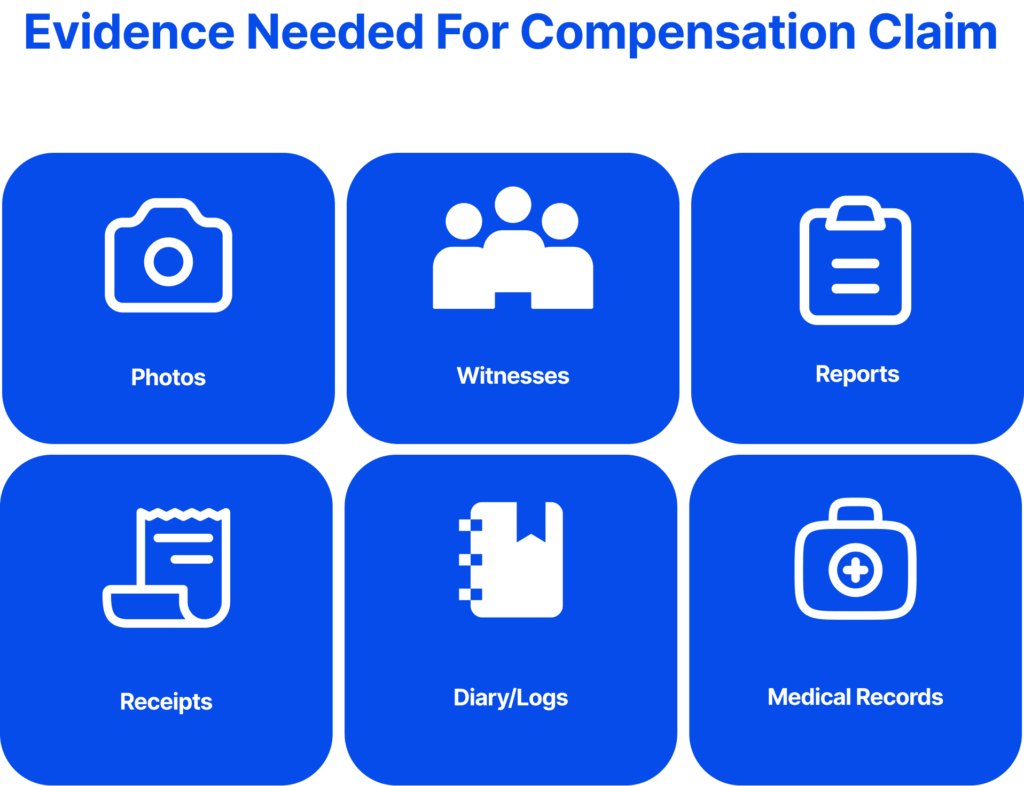
Solid evidence turns memories into proof. Essential items for a personal injury case are: medical reports, accident reports, photos or videos of the scene, witness contact details and statements, and financial evidence such as receipts and payslips. Gathering evidence quickly is critical; the Compensation Experts note that early collection makes it easier to secure witness cooperation and maintain an accurate record. Read the CaseCraft.AI guide on how to present your evidence in court.
Evidence checklist for your claim:
- Medical records and reports showing diagnosis, treatment, prognosis and causation. A medical examination is mandatory for whiplash claims on the OIC.
- Accident reports from employers, police or local authorities. Reporting is a legal requirement for workplace accidents.
- Photographs and video of the scene, vehicles, equipment and injuries.
- CCTV or dashcam footage, if available.
- Witness names and contact details so statements can be obtained.
- Receipts and invoices for expenses (medical costs, repairs, travel).
- Payslips and proof of earnings to support loss of income claims.
- A diary or log documenting your symptoms, medical appointments and how the injury affects daily life.
5) Risk Factors that Reduce Payout or Success Odds
Contributory negligence occurs when your own actions partly caused the accident or worsened your injuries. Under the Law Reform (Contributory Negligence) Act 1945, courts can reduce compensation proportionally to your share of blame. Not wearing a seatbelt in a road traffic accident can lead to a reduction in compensation if you are found partly responsible for your injuries. Similar reductions can apply if you ignored safety instructions at work or entered a restricted area without permission.
Other risk factors include inconsistent timelines, missing documents or failing to report the accident promptly. Delays make evidence harder to obtain and can undermine your credibility.
After working through these five checks, you should have a clearer sense of whether you have good prospects. Next, score your answers.
A 5‑Minute Claim Viability Scorecard
Think of this scorecard as a quick self‑assessment. It doesn’t guarantee outcomes, only a court can decide, but it helps you decide whether to proceed, gather more evidence or seek advice. Give yourself one point for each “yes”.
| Check | Question | Score |
| Time limit | Has less than three years elapsed since the accident (or since you discovered the injury)? | 1/0 |
| Duty and breach | Can you point to a clear duty of care and explain how it was breached? | 1/0 |
| Causation | Do medical records or other evidence link the breach directly to your injury? | 1/0 |
| Evidence strength | Do you have multiple pieces of supporting evidence (reports, photos, receipts, witnesses)? | 1/0 |
| Risk factors | Were you blameless or only minimally at fault? | 1/0 |
Interpreting your score:
- 0–2: Weak foundation – gather more evidence, check the time limit and consider speaking to a solicitor.
- 3–4: Plausible but needs strengthening – build your evidence pack, address any contributory negligence and ensure a clear narrative.
- 5: Strong fundamentals – your claim appears viable; move to the formal steps below.
Which Route Should You Use?
Not all claims follow the same path. Picking the right route can save time and money. Consider three broad options.
If It Is a Minor Road Traffic Injury
The Official Injury Claim (OIC) service is a free, government‑backed portal for whiplash and minor road traffic accidents. The service handles claims up to £5,000 for personal injury and £10,000 when you include other protocol damages. If your injury falls below these thresholds and the accident occurred in England or Wales after 31 May 2021, you must usually submit your claim through the OIC. You self‑manage your case, upload evidence, arrange a medical report and negotiate with the insurer. Legal costs are not recoverable in this track, so hiring a solicitor may not be cost‑effective. Using the OIC effectively requires careful entry of details and strict adherence to time limits.
Key terms to remember:
- Claim portal/online claim portal: The OIC is an online claim portal. You will need an OIC login to start and manage your case.
- Portal MOJ: The portal was developed by the Motor Insurers’ Bureau on behalf of the Ministry of Justice and is sometimes referred to as the portal MOJ.
- Damage claims portal: The portal covers injury and some property damage; NVC (non‑protocol vehicle costs) are usually dealt with separately.
If your injury is valued above £5,000 or the combined claim exceeds £10,000, the OIC is not suitable. In those situations, you may recover legal costs if you succeed, so professional representation becomes more attractive.
If You Need Representation
You should speak to a solicitor when liability is disputed, injuries are serious, or your claim exceeds the OIC limits. A solicitor can investigate liability, commission expert reports, and draft a letter of claim (also known as a letter before action) summarising the facts, injuries, rehabilitation needs and financial losses.
Under the personal injury pre‑action protocol, the defendant’s insurer must acknowledge this letter within 21 days and provide a detailed response within three months. If they fail to respond, you may issue court proceedings. The protocol encourages early rehabilitation and alternative dispute resolution, including mediation.
Using a solicitor may be appropriate if there are complex legal questions (for example, multiple defendants, product liability, or serious brain injuries), if you lack the capacity to act, or if you want an expert to negotiate a settlement. While legal fees cannot usually be recovered in small claims, some “no win, no fee” arrangements may defer costs until the claim concludes.
If It Is Mainly Financial Loss and You Are Pursuing It Yourself
For property damage or other losses outside the OIC, you may bring a small claim through the County Court. The small‑claims track limit for non‑road traffic personal injury cases increased from £1,000 to £1,500 in April 2022, but for purely financial claims (e.g., vehicle repair costs), the limit is £10,000. When acting without a solicitor, you must follow the pre‑action protocol: send a clear letter before action, enclose evidence (e.g., repair invoices, receipts) and give the defendant 21 days to respond.
In small claims, both parties usually pay their own legal costs and are automatically referred to a free, one‑hour mediation if the claim is under £10,000. You can also use CaseCraft.AI to generate a compliant Letter of Claim with all the necessary details and evidence attachments.
What to Do Before You Start Your Claim?
Completing these steps first protects your evidence, keeps you within time limits, and prevents avoidable mistakes that often weaken otherwise valid claims.
1. Document and Preserve Evidence
Take photos of the scene and your injuries. Collect CCTV or dashcam footage, and secure any damaged equipment or clothing. Note weather conditions and exact times. Preserve physical evidence, don’t repair vehicles or discard broken items until insurers have seen them.
2. Get Medical Attention and Create a Record Trail
Seek immediate medical treatment. Even if injuries seem minor, medical records validate your claim and create a timeline of your symptoms. For whiplash claims via the OIC, a medical report is mandatory before settlement. Follow all treatment advice and attend follow‑up appointments.
3. Report Appropriately
Notify your employer of workplace accidents and ensure the incident is recorded in the accident book. For road traffic collisions, exchange details with other drivers and report the incident to the police if required. For accidents in public places, report to the occupier or local authority. Prompt reporting creates an official record and reduces the risk of disputes.
4. Start a Clean Timeline and Loss Tracker
Use a notebook or digital tool to log every detail: dates of appointments, symptoms, conversations with insurers, days off work and expenses. Keep receipts, invoices and payslips organised. This timeline helps prove causation and quantify your losses, which influences how long compensation takes to pay out.
5. Decide Your Route
Review your claim value and circumstances to decide whether to use the claim portal (OIC), a traditional claim with a solicitor, or a self‑managed small claim. Consider the severity of injuries, complexity of liability and potential recoverable costs. Don’t rush into a formal process before you’ve completed this checklist.
How CaseCraft.AI Helps You Assess and Prepare?
CaseCraft.AI is designed for UK claims customers who want to organise evidence and build strong cases without paying hourly rates. You can upload documents, photos and receipts, build a timeline, and generate formal letters such as a Letter Before Action. The platform helps you convert your evidence into a structured personal injury claim process and produces a claim‑ready pack, reducing admin errors and missing documents. It supports online claim routes, such as the OIC, by helping you gather and format information before entering it into the portal. For small claims, CaseCraft generates a compliant letter of claim/letter before action with annexed evidence and a clear summary of damages. It also stores your documents securely so you can respond quickly to insurer requests.
Ready to move forward? Start your claim assessment, upload your evidence, complete the scorecard and get a tailored action plan.
FAQ
How do I know if I have a strong claim?
You have a stronger chance of success when you can satisfy all five viability checks: your claim is within the three‑year limitation period; there is a clear duty of care and breach; medical evidence links the breach to your injury; you have a robust evidence pack; and you were not significantly at fault.
What evidence is most important?
Courts rely on medical records, accident reports, photographs and videos, witness statements, and proof of financial loss. A 2025 guide recommends keeping a diary, receipts and payslips. For whiplash claims, a medical examination is mandatory.
What if it’s my word against theirs?
In civil claims, the judge decides on the balance of probabilities. Without independent evidence, your chances may drop below 51%. Strengthen your case by obtaining witness contact details, CCTV footage, dashcam videos and contemporaneous records.
What if I was partly to blame?
If you contributed to the accident (for example, by not wearing a seatbelt), the court may reduce your compensation proportionally. This is called contributory negligence. Document everything you did to minimise harm, and be honest about your role when assessing prospects.
How long do I have to start a claim?
Most personal injury claims must be issued within three years of the accident or of discovering the injury. Children have until age 21 to start proceedings, and those lacking capacity may have longer.
Should I use an online claim portal or a solicitor?
Use the Official Injury Claim portal for minor road traffic injuries worth up to £5,000 for injury and £10,000 in total. For higher‑value or complex claims, or when liability is disputed, consult a solicitor. The portal cannot recover legal costs, whereas representation may be worthwhile for larger claims.