




1. Don’t ignore a county court claim form – missing the deadline can lead to a default judgment and a county court judgment (CCJ) that affects your credit and may lead to enforcement.
2. Identify which form you need – use an N9A form to admit the claim, an N9B form to defend the claim or part of it, and an acknowledgement of service if you need more time. Partial admission requires both N9A and N9B forms.
3. Act within the 14- and 28-day deadlines – you usually have 14 days from deemed service to send an acknowledgement of service and 28 days to file your defence. Send forms to the right address and keep proof of postage.
A county court claim form is a formal legal document. It means someone (the claimant) is asking the court to order you to pay a specified or unspecified amount. Doing nothing leads to a default judgment and a county court judgment, harming your credit and letting the claimant enforce payment. The good news is that, with clear steps and forms, you can respond correctly, even without a lawyer.
This guide explains what a county court claim form is, how to distinguish the N9A form, N9B form and acknowledgement of service, and what happens after you respond. It covers deadlines, partial admissions, and how to avoid a default judgment. It also links to related guides about county court judgment meaning, acknowledgement of service, defending a claim, set aside judgment and the small‑claims process.
What Is a County Court Claim Form?
A county court claim form, often labelled Claim form (N1), is issued when someone sues you for money. It is part of a response pack that includes:
- A claim form with the claimant’s name, claim number, claim amount and particulars of claim.
- Form N9A (admission form): used to admit all or part of the debt.
- Form N9B (defence and counterclaim form): used to defend the claim or make a counterclaim.
- Form N9 (acknowledgement of service form): used to tell the court you will file a defence but need more time.
You must check the issue date and the deemed date of service (usually two working days after posting). Deadlines run from the deemed service date, not from the day you open the envelope. If you are unsure whether it is a genuine court claim, compare the claim number with the Civil National Business Centre (CNBC) details.
First, Check What You Have Received and Don’t Miss the deadline.
You might get letters from debt collectors, but a genuine county court claim form comes in an official response pack. Confirm the claim number, issue date, claimant’s name and amount claimed. Note the deemed date of service; claims are deemed served two working days after being posted. From that date:
- 14 days to return the admission form (N9A) or defence form (N9B), or to file an acknowledgement of service.
- 28 days to file your defence if you file an acknowledgement of service.
If you are near the deadline, it is safer to send an acknowledgement of service immediately to secure the 28‑day defence deadline. Missing the deadline allows the claimant to ask the court for a default judgment, which may lead to a CCJ.
Emergency Step
Near the deadline? Submit the acknowledgement of service form (N9) immediately to get an extra 14 days to prepare your defence. You can still choose to admit or defend later.
What Do the Forms Mean (N9A vs N9B vs N9)?
Here is a comparison of the forms found in the response pack:
| Form | Purpose | When to use | Where to send |
| N9A form (admission form) | Admit all or part of the debt and make an offer to pay | Use if you accept you owe some or all of the money. For partial admission, you must also complete N9B | Send to the claimant if admitting the full amount; send to the court (with N9B) if admitting part |
| N9B form (defence and counterclaim) | Defend all or part of the claim, and optionally make a counterclaim | Use if you dispute the whole claim or part of it, or if you want to counterclaim | Send to the issuing court; if you admit part of the claim, send N9A to the claimant and N9B to the court |
| N9 form (acknowledgement of service) | Ask for extra time to file your defence or challenge the court’s jurisdiction | Use when you intend to defend but need more time; it extends the defence deadline from 14 to 28 days | Send to the court within 14 days |
Acknowledge that for unspecified claims (e.g., personal injury), there are other forms (N9C/N9D), but this guide focuses on specified money claims (small claims).
Choose whether to admit the full amount (N9A), admit part and defend the rest (N9A + N9B), defend all (N9B), or file an acknowledgement of service to ask for more time.
Key Deadlines (the Timeline Competitors Lead With)
Time matters. These are the standard deadlines for responding to a county court claim form:
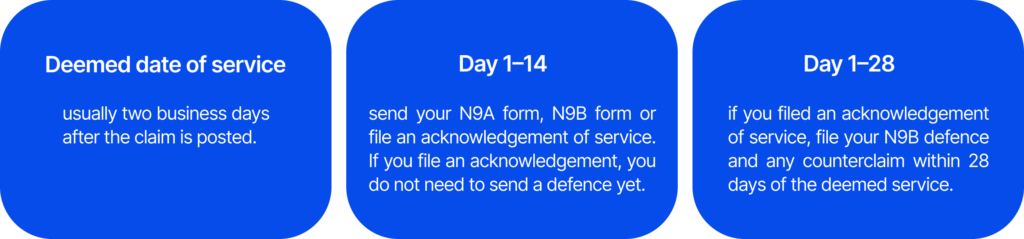
If you and the claimant agree in writing, Civil Procedure Rule 15.5 allows you to extend the defence deadline by up to 28 days. Remember, doing nothing or missing deadlines risks a default judgment.
Choose Your Response (Decision Tree Section)
This section helps you decide whether to admit, defend, part‑admit or ask for more time. For each option, there is a simple procedure and common mistakes to avoid.
Option 1: You Agree You Owe the Money (Use the N9A Form)
You use the N9A form when you accept you owe the debt and want to propose repayment. It asks for details of your income, outgoings and assets, and an offer to pay by instalments or a lump sum. Keep these points in mind:
- Be realistic, offer what you can afford. An unrealistic offer may be rejected, and the court may order payment at the claimant’s rate.
- If you admit the full amount, send the completed N9A to the claimant at the address on the claim form, not to the court. Keep a copy.
- If you admit part and dispute the rest, send the N9A to the claimant and the N9B form (with your defence) to the court.
- Always date and sign the admission form and include supporting evidence (e.g., proof of payments made). Use recorded delivery for proof of postage.
When you submit N9A, the claimant can accept your offer, negotiate or ask the court to decide. Paying in full before judgment avoids a CCJ entry.
Option 2: You Dispute the Claim (Use the N9B Form)
You use N9B when you believe you do not owe the debt or the amount is wrong. The form asks you to state what you admit (if anything) and provide reasons for disputing the rest. Tips:
- Stay factual. Address each point in the particulars of the claim. Explain why you dispute it and refer to any supporting documents or law.
- Attach evidence. Include copies of invoices, contracts, bank statements or correspondence and label each page with the claim number. Keep originals safe.
- Statement of truth. You must sign a statement confirming your defence is true.
- Counterclaim. If the claimant owes you money arising from the same matter, you can counterclaim in the same form. Court fees may apply.
- Send on time. File the N9B defence within 14 days of service, or within 28 days if you filed an acknowledgement of service.
Option 3: You Agree With Some of It, not All (Partial Admission)
Partial admission is common if you think part of the debt is valid, but some charges are incorrect, or the amount includes unfair fees. In this case:
- Complete the N9A form to admit the part you agree with and propose payment.
- Complete the N9B form to defend the rest.
- Send the N9A to the claimant and the N9B to the court.
The claimant can accept or dispute your partial admission. If they dispute it, the court will decide who is right.
Option 4: You Need More Time (Acknowledgement of Service)
If you intend to defend but need longer to prepare, file an acknowledgement of service (Form N9). This simple form tells the court you will file a defence later and extends your deadline from 14 to 28 days. It is also used if you believe the court does not have jurisdiction (for example, if you live abroad). File it within 14 days of the deemed service date and send it to the court. Use this time to gather evidence and prepare your defence.
How to fill in N9A (Admission) Without Tripping Yourself Up?
Follow these steps to complete an N9A form properly:
Check the claim details. Make sure the claim number, issue date and claimant’s name match the claim form.
Complete your personal details. Provide your full name, address and contact details. If your contact address is different from your current address, note this.
State what you are admitting. If you admit the full amount, tick the appropriate box. If you only admit part, specify the admitted amount and explain which part you dispute.
List your income and outgoings. Be honest and include wages, benefits, rent, bills, debt repayments and other expenses. This helps the claimant or court assess your payment proposal.
Propose a payment plan. Offer a realistic instalment amount or lump sum.
Sign and date the statement of truth. Unsigned forms may be rejected.
Send the form. If admitting all, send the N9A to the claimant and keep a copy. If partially admitting, send it to the claimant and send your N9B defence to the court. Use recorded delivery and keep proof of postage.
Completing the N9A correctly helps you avoid a judgment that orders payment at a rate you cannot afford. When your offer is accepted and paid on time, no CCJ is registered.
How to Fill in N9B (Defence and Counterclaim) Clearly?
The N9B form is your opportunity to explain why you dispute the claim. Follow these steps to make a clear defence:
Read the particulars of the claim carefully. Identify each allegation and decide whether you admit, deny or don’t know.
For each point, state whether you admit or deny it and provide a reason for any denial. For example, “I deny I owe £500 because the invoice was cancelled on [date].” Do not just write “I disagree.”
Attach evidence. Label each page with your claim number and a brief description. Evidence might include receipts, email correspondence, bank statements or a contract showing that the debt is paid or disputed. Make copies for yourself.
Counterclaim (optional). If the claimant owes you money arising from the same transaction, include a counterclaim. State the facts, amount claimed, and remedy sought. Note that court fees may apply.
Sign the statement of truth at the end of the form. A false statement could lead to contempt of court.
Send the form to the court, not to the claimant, by the deadline. If you filed an acknowledgement of service, you have 28 days from the deemed service date.
Following this structure helps the court understand your defence and increases your chance of success. A well‑reasoned defence can lead to the claim being dismissed or reduced.
Where to Send the Forms?
Getting the address right is crucial. The correct place depends on how you are responding:
- Admission (full). Send your completed N9A form to the claimant at the address shown on the claim form.
- Admission (partial). Send N9A to the claimant and N9B to the issuing court.
- Defence. Send N9B to the issuing court.
Acknowledgement of service. File Form N9 with the court, either by post or online.
Always check the claim form for the correct court address, especially if your claim was issued through the County Court Business Centre or Civil National Business Centre. These centres handle electronic claims for money and are not the same as your local county court. Make copies of everything, use recorded delivery or an online filing system, and keep proof of postage or submission. Do not assume the claimant’s address is the same as the court’s.
What Happens After You Respond?
Once you send your form(s), the next steps depend on your response:
- If you admit the claim and make an offer, the claimant can accept your payment proposal, negotiate, or ask the court to set a payment plan. Paying on time avoids a CCJ.
- If you defend the claim, the court will send your defence to the claimant. The case may enter directions (where parties exchange evidence) and may be allocated to the small claims track (claims under £10,000). The court will ask both sides to complete a directions questionnaire. A judge may hold a hearing at your local county court or decide the case on the papers. If your defence succeeds, the claim is dismissed.
- If you partially admit, the claimant must decide whether to accept the part you admit. If they do not accept, the court will decide the disputed amount.
Throughout this process, you can use CaseCraft.AI to manage deadlines, prepare evidence and generate forms automatically. CaseCraft.AI is built for non‑lawyers and supports claims up to £10,000. It charges a modest setup fee and takes a percentage only if your claim succeeds. It also keeps your data secure and complies with UK data protection laws.
What Happens If You Don’t Respond? (Default Judgment and CCJ)
If you ignore a county court claim form or miss the deadline, the claimant can ask the court for a default judgment. The court will decide the claim without considering your side and order you to pay the full amount. This results in a county court judgment (CCJ). A CCJ is recorded on the public register for six years and can harm your credit file, making it harder to obtain loans, rent property or pass employment checks.
You may still respond if the time limit has passed and the claimant has not yet applied for judgment. Send the form immediately. If a default judgment has already been entered, you can apply to set aside the judgment (using Form N244) if you have a good reason, such as not receiving the claim or having a genuine defence. See our dedicated guide on setting aside a default judgment for details.
Examples of Common Scenarios
These scenarios illustrate how to respond to a county court claim form.
Debt you don’t recognise. You receive a claim for a debt that is not yours. You file an acknowledgement of service within 14 days and then submit an N9B defence explaining that you are not the debtor, supported by evidence (e.g., identity theft report).
Old debt (statute‑barred). A creditor claims a debt last acknowledged more than six years ago. You use N9B to argue that the debt is statute-barred. Provide documents showing the last payment date and explain how the limitation law applies. National Debtline emphasises that a defence may be based on limitation.
Partial admission. A credit card company claims £3,000, but you only agree that £2,500 is owed. You complete N9A to admit £2,500 and propose instalments, and N9B to dispute the remaining £500 (e.g., arguing for unfair fees). Send N9A to the creditor and N9B to the court.
Near the deadline. You receive the claim late or open it near the 14‑day limit. You file an acknowledgement of service immediately to secure extra time, then prepare your defence.
Next Steps
Responding to a county court claim form is about acting quickly, choosing the correct form and keeping evidence. The N9A form is for admitting all or part of the claim, the N9B form is for defending or counter‑claiming, and the acknowledgement of service extends your defence deadline. Deadlines matter: 14 days for the initial response and 28 days for the defence. Missing them risks a default judgment and a CCJ.
Use CaseCraft.AI to prepare your response pack. The platform generates the right forms, calculates deadlines, helps you organise evidence and guides you through small‑claims procedures. Acting promptly and using the right tools protects your rights and increases your chances of a fair outcome.
Note: This content is for general information only. It is not legal advice. It does not replace advice from a qualified solicitor or legal adviser. Court procedures can change, and every case is different. If you are unsure how to respond to a county court claim form, you should seek independent legal advice.
FAQ
What is a county court claim form?
A county court claim form is a legal document that starts a civil claim for money. It contains the claim number, issue date, claimant’s details and particulars of the claim. Receiving one means the claimant has already filed a court case, and you must respond within strict deadlines to avoid a default judgment.
What’s the difference between N9A and N9B?
The N9A form is the admission form. Use it if you agree you owe some or all of the money and want to propose payment. The N9B form is the defence and counterclaim form. Use it to dispute the claim or part of it and to make a counterclaim. If you admit part and dispute the rest, use both forms.
How long do I have to respond to a court claim?
You usually have 14 days from the deemed date of service to submit your response. If you file an acknowledgement of service, you get 28 days to file your defence. Failing to respond on time allows the claimant to request a default judgment.
What is an acknowledgement of service, and what does it do?
An acknowledgement of service (Form N9) is a short form telling the court that you intend to defend but need more time. It extends your deadline to file a defence from 14 days to 28 days and can also be used if you want to contest the court’s jurisdiction.
What happens if I ignore a county court claim form?
Ignoring a claim or missing the deadline usually results in a default judgment. The court orders you to pay the full amount without considering your side, and a CCJ is recorded on your credit file. Act quickly if you receive a claim form.
Can I admit part of the claim and defend the rest?
Yes. This is called partial admission. Complete the N9A form to admit the amount you accept and propose payment. Complete the N9B form to dispute the remainder. Send N9A to the claimant and N9B to the court.