



1. Templates are cheap but risky – free legal document templates and Word document templates can be handy for non-critical needs like simple non-disclosure document templates or a disclaimer document template. They often omit jurisdiction-specific clauses and quickly become outdated. Use them only for low-stakes situations.
2. Generic AI helps, but isn’t court-ready – AI legal document review and AI legal document analysis tools save time by summarising and comparing documents, but can hallucinate or misstate the law. Confidentiality is a concern; never upload sensitive contracts to free AI services.
3. CaseCraft.AI is purpose-built for UK small claims under £10,000 – CaseCraft.AI automatically prepares court-ready forms, organises evidence and tracks deadlines. It uses secure UK servers and bank-grade encryption, and you only pay 10% if you win.
Most people who need a legal document start in one of two places. They download a legal document template, or they use AI for legal documents to generate or review text quickly. Both options are accessible. Neither guarantees that the document will work when it matters.
In the UK, this gap becomes critical in small claims. Documents must be accurate, jurisdiction-specific, and consistent with court procedure. A document that is unclear, incomplete, or based on the wrong assumptions can weaken a claim before it is even issued.
This guide explains when legal document templates are appropriate, when AI legal document review and analysis can help, and when neither option is sufficient for small claims disputes.
The Quick Answer: When templates, AI and CaseCraft.AI each Make Sense?
- Use templates when you need a generic non-disclosure document template, a loan agreement document template or another common document, and cost is your main concern. Stick to simple, repeatable agreements with low risks. Check that the free legal document templates UK providers offer are drafted for England and Wales and updated regularly. For other business needs (e.g., a budget document template, RACI document template, PID project initiation document template or requirements document template), templates are fine because enforceability is less of an issue.
- Use AI tools for legal document review when you need to scan long contracts, summarise clauses or compare versions quickly. Modern AI tools for legal document review and AI legal document analysers spot inconsistencies and summarise terms, helping lawyers save time. However, these tools may hallucinate, so use them for internal analysis rather than final drafts.
- Use CaseCraft.AI when you need a legally sound, HMCTS‑compliant small‑claim document. It auto‑generates legal forms, organises evidence, and files your claim online in as quickly as 15 minutes. CaseCraft.AI’s AI-powered contract review and legal document automation ensure your claim meets UK standards and tracks deadlines. With success‑based pricing, you only pay if you win.
What Are Legal Document Templates and What Are They Good For?
Legal document templates are static forms, often Word document templates, designed as starting points for agreements. Some providers offer smart questionnaires that produce a template document or Word file tailored to your answers. They’re popular because they’re cheap or free, and they cover common situations like:
Non‑disclosure agreements (NDAs): A non-disclosure document template protects confidential information between two parties.
Loan and debt agreements: a loan agreement document template or loan document template UK sets out repayment terms without drafting from scratch.
Disclaimers: a disclaimer document template limits liability for website content, events or products.
Other types of templates people confuse with legal documents include a budget document template, RACI document template, PID project initiation document template, standard operating procedure document template and requirements document template. These business tools don’t require legal enforceability, so using a template is appropriate.
When Templates Work
Templates work well for low‑complexity, repetitive documents where the stakes are low and you understand the underlying law. They save time and avoid starting from a blank page. Because they are static, you can easily edit them in Word or Google Docs.
Where Templates Fall Short
Free legal document templates that UK users often download often come from generic or foreign websites. Lawyers warn that templates may be drafted for US law or outdated; if your template isn’t checked against current UK rules (Consumer Rights Act, GDPR or employment law), it can be unenforceable. There are several risks: free templates are usually too general, they omit important clauses, include jargon that non‑lawyers can’t interpret, and might be the wrong form altogether. Using the wrong form can delay your claim and increase costs.
The Hidden Risks of Templates
Even smart templates that ask questions can’t know the full context of your dispute. Risks include:
- Wrong jurisdiction: many templates come from US sites and don’t reflect UK law.
- Out‑of‑date clauses: laws change frequently. A template might not reflect GDPR updates, consumer rights or small‑claims procedure.
- Missing protections: free forms skip bespoke clauses (indemnity, intellectual property or dispute resolution) that you might need.
- Unclear language: legal jargon can make a document invalid if parties misunderstand terms.
- Misfiling: using the wrong document (e.g., mixing up an N1 claim with a statutory demand) leads to delays and extra fees.
Red Flags for Template Users
- Does the template specify England and Wales law and jurisdiction?
- When was it last updated? Does it reflect 2025 legislation?
- Are essential clauses missing (e.g., dispute resolution or confidentiality)?
- Does every party understand the legal terms?
If you answer no to any of these, consider a solicitor or a dedicated platform like CaseCraft.AI for your case.
What “AI‑Prepared Legal Documents” Actually Means?
“AI‑prepared” covers several different tasks. AI legal document generator tools create draft clauses from prompts. An AI legal document analyser or AI services for legal document comparison scan documents and flag risks. AI tools for legal document review summarise long contracts, highlight standard clauses and generate plain‑English explanations. AI summarises legal documents’ functions (sometimes called AI to read legal documents), producing digestible summaries to speed up review.
It’s important to distinguish tasks:
- Drafting/generation: AI legal document generator products create bespoke documents from scratch. Quality depends on the training data and instructions. Without jurisdiction‑specific guidance, the results may be generic or inaccurate.
- Review and analysis: AI legal document review and AI legal document analysis tools examine existing documents to flag missing clauses, summarise content, or compare versions.
- Comparison: AI services for legal document comparison overlay two versions and highlight changes. This is useful during negotiations.
- Automation: AI-powered contract review and legal document automation integrate AI into workflows, generating standard forms and tracking status.
Limitations and Risks
Generic AI legal document analysis free pdf or public chatbots, such as ChatGPT, can hallucinate – legal AI models hallucinated on 17–34% of benchmark queries. A New York lawyer was sanctioned for citing fictitious cases generated by ChatGPT. Confidentiality is also a concern: the ABA warns lawyers to avoid disclosing client data in public AI tools and notes that prompts may be retained. Always read the vendor’s privacy policy, and avoid uploading sensitive contracts to free AI tools.
AI Legal Document Review: Strengths and Pitfalls
AI legal document review tools are widely used to speed up analysis and reduce manual effort, but their value depends on how and where they are applied within the legal process.
Where AI Shines
Speed and efficiency: AI helps law firms save time. Solicitors cite time-saving as the main benefit. By automating legal research, summarising and document comparison, AI for legal documents allows lawyers to focus on strategy.
High‑volume document analysis: In large-scale document reviews, AI-assisted analysis can significantly reduce the time and cost associated with manual review. This efficiency makes AI particularly effective for handling high-volume document sets, such as those involved in disclosure and e-discovery.
Consistent clause spotting: AI can flag missing confidentiality clauses or unusual indemnities, helping lawyers spot risks quickly.
Comparison and version control: AI highlights differences between contract drafts, saving hours of manual review.
Where AI Falls Short
- Accuracy and hallucinations: Domain‑specific AI tools still hallucinate on 17% or more of queries. Always verify AI‑generated text against authoritative sources.
- Confidentiality: Public AI services may store and reuse your data. Never upload sensitive information without a clear data‑use policy.
- Lack of jurisdiction: Generic models don’t automatically apply UK law. Without UK‑specific training, AI-generated legal documents may miss crucial requirements (e.g., Section 69 interest statements or Civil Procedure Rules citations).
- No enforcement mechanism: AI tools can draft or review documents, but can’t file claims, organise evidence or track deadlines.
Safe AI Use Checklist
- Choose the best AI app for legal documents with UK‑specific models and clear privacy policies.
- Don’t rely solely on AI to summarise legal documents; check citations manually.
- Ask whether the AI uses secure UK‑based servers and bank‑grade encryption.
- Use AI legal document analysis free tools only for non‑confidential, exploratory research.
- Always involve a qualified solicitor or platform like CaseCraft.AI when preparing court documents.
Templates vs AI vs Workflow Platforms: Comparison Table
| Feature | Templates | Generic AI tools | CaseCraft.AI workflow platform |
| Speed | Instant download; manual editing required | Fast for summarisation and comparison; drafting from scratch may require prompt engineering | End‑to‑end claim prep in as quick as 15 minutes |
| Cost | Often free; risk of expensive corrections later | Subscriptions vary: ChatGPT Plus ≈$20/month. | No processing fee; pay 10% only if you win |
| UK specificity | Rare; many templates are US‑centric | Depends on vendor; some UK law libraries exist, but generic tools aren’t jurisdiction‑aware | Purpose‑built for UK small claims; includes HMCTS‑compliant forms |
| Customisation depth | Limited, static Word files require manual tailoring | High; AI can generate bespoke language but may hallucinate | High; CaseCraft.AI asks questions, auto‑generates forms and organises evidence |
| Audit trail & evidence organisation | None; you must store documents yourself | None; you still need to organise files manually | Built‑in case file organisation, real‑time tracking and reminders. |
| Risk controls | Low; high risk of wrong clauses | Moderate; accuracy depends on the model; confidentiality issues | High; platform guided by UK solicitors; data encrypted on UK servers |
| Best for | Low‑value, non‑complex NDAs or internal business templates like budget documents | Rapid summarisation, research and clause comparison when speed matters | UK small‑claims disputes under £10k needing court‑ready documents and organised evidence |
How CaseCraft.AI Fits?
CaseCraft.AI isn’t a generic AI legal document generator. It’s a workflow platform designed for UK small claims. Here’s what sets it apart:
- AI‑powered claim automation: CaseCraft.AI automatically generates the right legal forms, organises your evidence and prepares a court‑ready claim that meets HMCTS standards.
- Fast filing and tracking: Users can file or defend a claim online in minutes, with a step‑by‑step questionnaire and eligibility check. Most complete their claim in under 15 minutes.
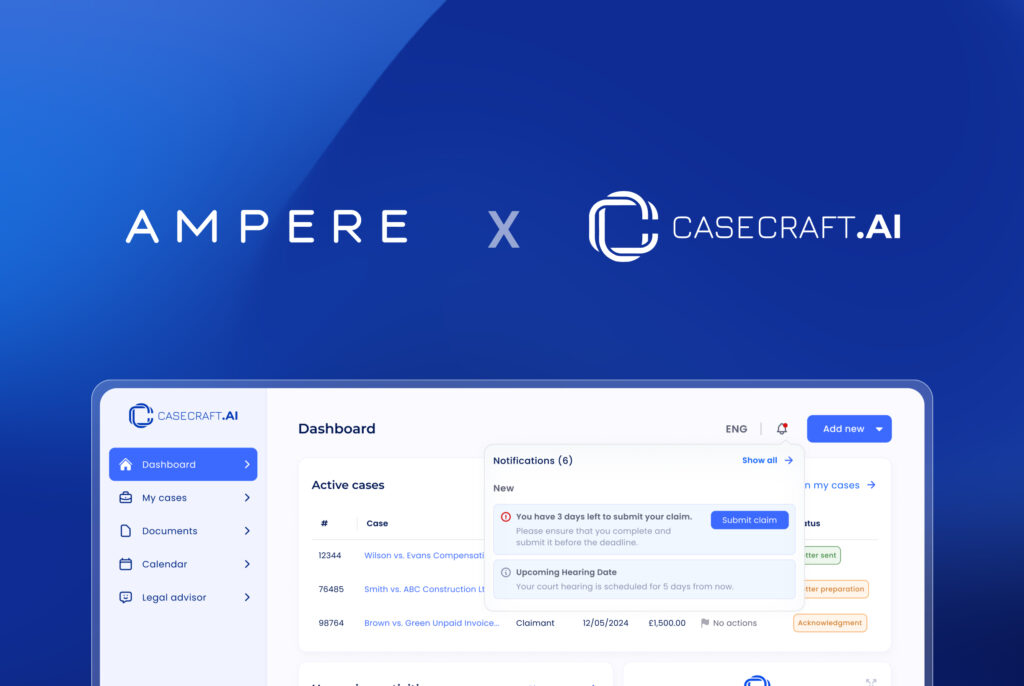
- Case management: The platform provides real‑time alerts, deadline tracking and a dashboard to monitor progress.
- Security and compliance: CaseCraft.AI uses bank‑grade encryption and secure UK‑based servers. It complies with UK GDPR and the Data Protection Act 2018, never sells or shares data and keeps users in control of their files.
- Success‑based pricing: You pay a processing fee upfront and only 10% of the claim amount if you win. There are no hourly rates or hidden fees.
- Legal clarity: CaseCraft.AI isn’t a law firm; legal services are provided by Sterling Lawyers Ltd, authorised by the Solicitors Regulation Authority. This ensures regulatory compliance while keeping costs low.
- Small‑claims focus: The platform handles disputes up to £10,000; that’s the small claims limit in England and Wales. Claims over £10,000 move to the fast track or other court procedures.
By combining AI automation with human oversight from regulated solicitors, CaseCraft.AI offers a safer alternative to free templates or generic AI tools. It produces AI-generated legal documents tailored to small claims, with court‑ready formatting and evidence organisation.
A Practical Checklist: Choose the Safest Option in 5 Minutes
Is your document for England or Wales? – If not, consult local law. If yes and under £10k, CaseCraft.AI is designed for you.
Is the issue low‑value and non‑critical? – If you’re drafting a simple NDA or using a budget document template, a free template is sufficient.
Do you need to file a court claim? – If you need a court‑ready document, choose CaseCraft.AI; AI tools alone cannot file claims.
Do you need a fast review of a long contract? – For summarisation or comparison, use AI legal document review tools, but verify results manually.
Are you sharing confidential data? – Avoid free AI legal document analysis free pdf tools; only use services with clear privacy policies and secure servers.
Do you require ongoing updates and tracking? – Templates have no tracking. AI tools seldom track; CaseCraft.AI provides real‑time alerts and case management.
Next Steps
Legal document templates and AI tools each serve a purpose. Templates are helpful for simple, non‑critical documents. AI review tools accelerate contract analysis but shouldn’t be trusted blindly. When dealing with a UK small claim where you need court‑ready documents, evidence organisation and real‑time tracking, CaseCraft.AI is the safest choice. It uses AI to automate legal document preparation, ensures compliance with HMCTS and UK law, secures your data on UK servers, and charges a success‑based fee.
If you have a small claim under £10,000, the next step is simple: start your claim with CaseCraft.AI. Let AI handle the paperwork while you focus on resolving your dispute.
FAQ
Is it safe to use free legal document templates in the UK?
Free templates can be a starting point, but they often omit UK‑specific clauses, may be outdated and could be drafted for US law. Using the wrong template can delay your claim and cost more in the long run.
Can AI review a legal document?
Yes. AI tools for legal document review and AI legal document analysis can summarise contracts, flag missing clauses and compare versions. Many solicitors cite time savings as the main benefit. However, AI can hallucinate and doesn’t understand context as a lawyer does.
What is the best AI for legal document review?
There’s no single “best” tool. Popular options include ChatGPT (low‑cost), Thomson Reuters CoCounsel and Lexis+ AI. The best AI app for legal documents depends on your needs. Always choose vendors with UK‑specific models and robust security.
Can AI summarise legal documents accurately?
AI summarize legal documents’ functions help you read long files faster. While AI does a good job on routine clauses, studies show that domain‑specific legal AI still produces incorrect information over 17 % of the time. Human review remains essential.
Should I upload contracts to free AI tools?
No. Public AI legal document analysis free services may store or reuse your data. ABA guidance warns lawyers to protect confidentiality. Only upload sensitive documents to secure platforms like CaseCraft.AI that use bank‑grade encryption.
When do I need a solicitor?
If your claim is complex, exceeds £10,000, involves personal injury or housing repair claims (limit £1,000), or if you’re unsure about jurisdiction or legal arguments, you should consult a solicitor. CaseCraft.AI facilitates straightforward claims but doesn’t replace professional legal advice.