




1. You can still claim without a contract – even where there is money owed, no agreement and no formal contract, you can still bring a claim if you prove unjust enrichment and follow the court rules correctly.
2. Evidence matters more than paperwork – bank transfers, chats and emails can all become evidence of money owed with no contract, if they show a payment was made, not returned, and there was a failure to repay funds.
3. Process and deadlines are strict – a proper letter before action with no contract, compliance with pre-action protocol debt steps, and the limitation period for unjust enrichment (usually six years) all determine whether you recover anything at all.
Money Owed With No Agreement Still Counts
Most small money disputes in everyday life start with trust, not paperwork. A friend asks for a quick loan. A colleague says they will pay you back for flights. A client promises to reimburse a bill. You help, they benefit, then nothing. You end up with money lent, no agreement, and real money owed.
In cases where there is no contract, loan document or invoice, you may still recover the money owed to you under a claim of unjust enrichment.
Unjust enrichment is about fairness. The law asks a simple question: has one person received a benefit they should not be allowed to keep? If so, a restitution claim lets the court order repayment, even where you are dealing with money owed without a formal agreement or contract. Throughout, we show how CaseCraft.AI helps you assemble evidence, send a structured repayment request, a contract, and file an unjust enrichment small claim UK when quiet reminders fail.
When Can You Claim Money Without a Contract?
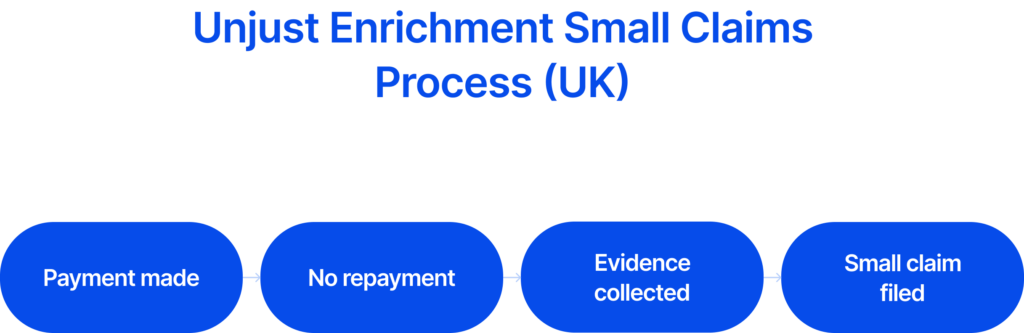
You can often bring an unjust enrichment claim whenever there is money owed without a contract and a clear failure to repay funds. Typical patterns include:
- Friend or family loan. You transfer £1,500 as money lent, with no agreement. The other person promises to “pay you back next month”, but does nothing. This is classic money owed, no agreement. It may be framed as an informal loan, no agreement or an unjust enrichment claim.
- Paying expenses for someone else. You pay a supplier invoice of £900 for a client who agrees to reimburse you. The job finishes. They refuse to pay. There is no contract money owed in writing, but there is a clear benefit conferred by unjust enrichment.
- Deposit or advance for goods and services. You pay a £600 deposit for work that never starts. Or you pay in full for goods that never arrive. The payment made but not returned is at the heart of the enrichment.
- Paying by mistake. You sent £750 to the wrong sort code. The recipient will not refund it. These mistaken payments are a textbook example of unjust enrichment under UK restitution law.
- Work done without proper payment. You do work worth £2,000 on an understanding of future payments. Where the court finds no physical contract, but still sees a contract implied by conduct or simple enrichment, you may rely on unjust enrichment to recover payment for that work.
In each case, there may be an absence of contract, but there is still a transfer of value and a failure to repay funds. The court looks at behaviour, not just paperwork. That is why implied agreements in the UK and a contract implied by conduct can sit alongside unjust enrichment.
Legal Test for Unjust Enrichment
To succeed in an unjust enrichment claim, you must address what the Supreme Court in Barton and others v Morris and another in place of Gwyn Jones [2023] UKSC 3 at [228] described as the three core elements: the defendant’s enrichment, enrichment at the claimant’s expense, and the unjust factor. Think of these as the essential pillars the court examines. In addition, modern analysis often acknowledges a fourth stage, whether any defences bar restitution, so if any of these components falter, the claim cannot stand. Here’s the legal test reframed with that full perspective:
Enrichment
You must show the defendant was enriched, usually meaning they received money or a valuable benefit. Enrichment can be direct (they got your money in their account or pocket) or indirect (they saved an expense by you paying on their behalf). In most small claims, it’s straightforward: you paid the defendant £X, or provided services worth £Y, so the defendant is richer by that amount or benefit. Evidence like bank statements or receipts can prove the enrichment. If there’s no enrichment, there’s no claim; the law isn’t punishing wrongdoing, only reversing unjust gains. So, identify clearly what benefit the defendant received.
Example: “Defendant received £500 from Claimant on [date]” or “Defendant obtained a service (free repair work) that would have cost £500.” That’s the enrichment.
At Your Expense
Next, the enrichment must have been acquired at the claimant’s expense. This links you to the benefit; essentially, your loss corresponds to their gain. In a no-contract money owed case, it usually means the money came out of your pocket or account. If you’re claiming £500 back, you need to show you were £500 poorer because of that transfer. This is usually easy: bank transfer records, PayPal receipts, or even a cash withdrawal and handover can show you the funds. If it’s a service or non-cash benefit, show the value and that you bore the cost (e.g. materials you paid for, hours of your labour).
The court wants to be sure you have a stake; unjust enrichment isn’t a penalty to disgorge ill-got gains generally, it’s specifically about returning your money or equivalent. So establish a clear money trail from you to the defendant.
Unjust
This is the heart of the claim: why was the enrichment unjust? Not every unpaid loan or benefit is unjust; there are many everyday enrichments the law leaves alone (like valid gifts or lawful transactions). You must point to a recognised unjust factor or circumstance that makes it unfair for the defendant to keep the benefit. Common unjust factors in money owed no agreement cases include:
- Failure of basis – you paid for goods or services that never arrived.
- Mistake – classic mistaken payments to the wrong account.
- No agreed terms – serious absence of contract, yet the other side treats the money as theirs.
- Unfair retention of money – the other party relies on technicalities despite a clear understanding that they would repay.
Under the restitution UK law, courts focus on specific “unjust factors” such as mistake, failure of consideration, or duress.
(Optional) Ask for Written Acknowledgement
This step is not always possible, but if the person has been communicative, try to get a written admission or acknowledgement of the debt. An acknowledgement can be as simple as a text or email reply saying “Yes, I know I owe you £X.” Why is this helpful? Because it practically eliminates disputes about whether it was a loan or a gift. It’s hard for them to later deny the debt if they admitted it in writing. Also, an acknowledgement can reset the limitation clock (but in small claims, you’re likely within 6 years anyway).
If the other person responds, ask them to confirm key facts in writing:
- They received the money
- They understand that there is money owed, but no agreement
- Any repayment plan or timeline
Even a short message such as “Yes, I will pay you back when I can” can help show a contract implied by conduct and reinforce the implied agreement in the UK that repayment was expected. Any admission like this becomes strong evidence of money owed, no contract.
Send a Reminder with Evidence
If they ignore the first message, send a reminder that pulls key pieces together:
- Attach or quote the bank transfer details
- Restate that this was money lent, no agreement
- Refer to earlier messages
- Restate your deadline
This reminder helps show the court you behaved reasonably. It’s also useful where the pre-action protocol debt may apply, for example, when a business is chasing an individual.
Issue a Letter Before Action (LBA)
If there is still a failure to repay funds, the next formal step is a letter before action. This is different from a polite reminder. It is a structured legal warning that you will start a claim if they do not pay.
A well-drafted letter before action should:
- Identify you and the debtor
- State the amount of money owed
- Describe the payment and why it is a benefit conferred by unjust enrichment
- Set out the legal basis (unjust enrichment and, if relevant, contract implied by conduct)
- List key evidence
- Give a final deadline (often 14 or 30 days)
- Warn that you will start an unjust enrichment small claim in the UK if they do not respond.
Where the Pre-Action Protocol for Debt Claims applies, the letter must include the prescribed information and enclosures. That said, the protocol is primarily designed for conventional debt recovery, such as claims arising from oral or written agreements between a business and an individual. It does not ordinarily apply to restitutionary causes of action in unjust enrichment, unless the claim can properly be characterised as a debt falling within that traditional framework.
CaseCraft.AI can generate a compliant letter before action, that reflects the latest protocol practice, including early 2025 updates on pre-action behaviour.
File a Small Claim If They Do Not Pay
If there is still a payment made but not returned after your LBA, you may need to issue proceedings.
Key points for unjust enrichment small claims:
- Most small claims in England and Wales are for amounts up to £10,000
- You pay an issue fee based on claim value. For example, a claim up to £300 has a fee of £35, while claims between £5,000.01 and £10,000 attract a £455 fee for starting the claim.
- There is a separate small claims hearing fee, which as of November 2025 ranges from £27 for claims under £300 to £181 for claims between £1,500 and £3,000.
Small claims timelines have been improving, but remain lengthy. As of mid-2025, the average small claim takes around 40-50 weeks to reach trial, down from a peak of over 54 weeks in 2024. However, there is significant regional variation, with London and the South-East experiencing longer delays.
When you file, you will need:
- The evidence relied on and a calculation of the money owed
- Your timeline and explanation of unjust enrichment
- Copies of your repayment request, no contract, and letter before action, no contract
CaseCraft.AI helps with all of this. The platform checks your eligibility, guides you through claim forms, and organises evidence into a court-ready bundle for an unjust enrichment small claim in the UK.
Evidence Needed for an Unjust Enrichment Claim
In money owed no agreement disputes, you win or lose on evidence, not on how unfair the situation feels.
Your bundle should include:
- Payment records – bank statements, card statements, PayPal or app screenshots showing the transfer.
- Message history – chats, texts, emails referring to the loan, deposit, or expense share.
- Intent or expectation of repayment – any wording that shows implied agreements, UK, or a contract implied by conduct.
- Recipient’s acknowledgement – any message accepting that there is no contract money owed or money lent, no agreement.
- Follow-up attempts – reminders, repayment request, no contract, and the letter before action, no contract.
- Timeline – a simple list of dates, payments, and key conversations.
Together, these documents form your proof of enrichment and help the court see the benefit conferred by unjust enrichment.
CaseCraft.AI’s own guidance on what counts as evidence in a money claim explains how to bundle documents, paginate them, and use a contents page so judges can navigate quickly.
Common Scenarios Where Unjust Enrichment Applies
Unjust enrichment appears in many everyday small claims. Here are a few patterns where there is often an absence of contract:
- Friend or family loans. Classic informal loan no-agreement situations. You transfer £500. There is no written loan document. Months later, there is still a payment made but not returned. The law treats this as money owed; no agreement if you can show an understanding that it was a loan.
- Business expenses paid for someone else. A director pays a supplier invoice from personal funds, expecting reimbursement. If the company refuses to repay, there is a clear benefit conferred by unjust enrichment and failure to repay funds.
- Deposits and advance payments. You pay a deposit for a builder who never turns up. There is minimal paperwork, but clear evidence of payment and expectation. This is often both a restitution claim and, in some cases, a contract implied by conduct.
- Goods or services were never delivered. You pay in full for goods that never arrive. If the seller keeps the cash, the payment made but not returned supports small claims.
- Overpayments and mistaken transfers. Many mistaken payments are caught by unjust enrichment. You send money to the wrong account or overpay an invoice. If the recipient knows and still refuses to refund, the court may order restitution.
- Voluntary payments with clear expectations. Some voluntary payments are gifts. Others are clearly loans or expense contributions. Where messages show repayment was expected, the court may treat voluntary payments as part of money lent, no agreement, rather than pure gifts.
Across these scenarios, judges look for consistent facts. Was there genuinely no contract money owed in law, or can they see implied agreements in the UK? Should they treat it as a straightforward debt, or as unjust enrichment? Often, the practical result is the same, repayment, but the legal route matters.
What You Can Claim?
In an unjust enrichment small claim UK, you normally ask for:
- The principal sum – the original amount of money lent, no agreement or other transfer.
- Interest – the court has discretion to award interest from the date of enrichment. For commercial debts between businesses, statutory interest of 8% plus the Bank of England base rate may apply under separate legislation.
- Court fees – issue fee and small claims hearing fee. These are usually added to what the defendant must pay if you win.
You generally cannot claim:
- compensation for hurt feelings
- damages for stress or inconvenience in ordinary small claims
- your own time spent preparing the case (except in very limited ways)
Your own time spent preparing the case is not generally recoverable. The main exception concerns loss of earnings for attending court, where only fixed amounts can be claimed. As a guide, employed individuals may recover up to £67 for a full day of unpaid leave, while self-employed individuals may claim up to £85.90 for a full day where attendance prevents them from working.
More important is the limitation period for unjust enrichment. In England and Wales, unjust enrichment claims are usually subject to a six-year period from when the unjust enrichment occurred, or from when a mistake could reasonably have been discovered.
In Scotland, similar claims (often called “unjustified enrichment”) are covered by a five-year prescription period for monetary obligations.
If the money owed dates back many years and falls outside the relevant limitation period, take advice before issuing a claim. If the claim is time-barred, the defendant will have an automatic defence, and the court is likely to dismiss the action.
How CaseCraft.AI Helps with Unjust Enrichment Claims?
CaseCraft.AI is built for small claims under £10,000 across the UK. It is particularly suited to cases with money owed, no agreement, or money lent, no agreement, where evidence is messy, and the law feels distant. The platform turns your facts into court-ready particulars for an unjust enrichment small claim UK, including references to unjust enrichment, restitution UK law, and any contract implied by conduct arguments, where helpful.
If you are facing money owed, no agreement, or money lent, no agreement and simple reminders have failed, gather your documents and run your case details through CaseCraftAI. It will help you move from vague complaints to a structured unjust enrichment small claim UK with a timeline, evidence bundle and compliant letters.
Disclaimer: This article is for general information only and does not constitute legal advice. Laws and procedures can change, and your circumstances may be different. You should seek independent legal advice if you need help with a specific case.
FAQ: Small Claims vs Mediation
Can I recover money without a written contract?
Yes. You can recover no-contract money owed if you show that the other person has been unjustly enriched at your expense. That often means proving a payment made but not returned, or money lent, no agreement, together with messages that show repayment was expected. The court then decides whether to treat your case as a contract dispute, unjust enrichment, or both.
What counts as unjust enrichment?
Unjust enrichment occurs when a clear benefit is conferred with no legal basis for retaining it. Typical examples include mistaken payments, deposits for work never done, informal loan no agreement cases and situations where there is an absence of contract but obvious unfairness. You must show enrichment, your expense, injustice, and no lawful defence.
Is a verbal agreement enough to prove repayment was expected?
A verbal agreement can matter, especially when backed by messages, transfers and behaviour that show implied agreements, UK or a contract implied by conduct. In many small claims, judges decide whether the parties acted as if there was a loan. If chats mention “I’ll pay you back” or “loan”, that can support either a contract claim or a restitution claim for unjust enrichment.
What evidence do I need if there is no contract?
You need to build strong evidence, money owed, no contract: bank statements, screenshots of transfers, emails or chats about repayment, and your repayment request, no contract and a letter before action, no contract. Put these into a simple bundle with a timeline. CaseCraft.AI’s evidence tools and guides can help you present this clearly for an unjust enrichment small claim in the UK.
Can I sue a friend or family member for money owed?
Yes, but it is a serious step. Many money-lending cases involve friends or relatives. Courts treat them like any other unjust enrichment small claims dispute. You must show a real expectation of repayment, not a gift. Before issuing, try structured reminders and a calm repayment request, no contract. If they still refuse and the sum is significant, a small claim may be your only route.
Does sending money by mistake qualify for unjust enrichment?
Yes. Many mistaken payments are treated as unjust enrichment. If you accidentally pay the wrong person and they know of the mistake but refuse to refund, the court can order restitution. The payment is a clear benefit conferred by unjust enrichment and usually a straightforward restitution claim, provided you act within the limitation period for unjust enrichment.