


Mould and Damp Claims: Housing Disrepair Compensation
Suffering from mould or damp in your rented home? Learn when landlords are responsible and how to claim housing disrepair compensation under small claims.



Get Clarity on Your Mould Damp Claim
If you are experiencing mould growth, persistent damp patches, or black spores on your walls or ceilings, you may have a housing disrepair mould claim. You might be entitled to compensation for mould in the UK, including mould in rented property, compensation for damaged belongings, rent reduction, and distress.
CaseCraft is built for the small claims process. It helps you gather evidence, draft repair requests and Letters Before Action, and prepare your housing disrepair compensation small claims paperwork so your mould damp claim is complete, compliant, and ready for court if needed.
When Is the Landlord Responsible for Mould and Damp?
Landlords are responsible for mould and damp when the problem comes from disrepair, structural issues, or poor ventilation, rather than normal day-to-day living. Under the Homes (Fitness for Human Habitation) Act 2018, landlords must keep the structure and exterior in repair, and ensure the property is free from serious damp and mould issues that affect health.
Leaks, Plumbing Faults, and Roof Problems
Your landlord usually carries mould damp landlord responsibility where the source is a leak or clear disrepair. If water is coming in from a cracked roof, a failed gutter, or a leaking pipe behind the wall, that is classic housing disrepair. In those situations, you are likely to have a mould damp claim and a strong housing disrepair mould claim, especially if damage has built up over time and the landlord has ignored your reports.
Rising Damp and Penetrating Damp
Where damp rises from the ground or soaks through external walls, it often points to structural failings. A missing or failed damp proof course can create rising damp landlord liability. Defective brickwork, pointing, or render can lead to penetrating damp liability if rainwater is allowed to seep through. In both cases, the landlord is expected to investigate and carry out proper remedial works. If they do not, you may be entitled to compensation for mould in the UK within the damp claim small claims limits.
Ventilation, Insulation, and Structural Defects
Mould that appears on cold external walls, around windows, or in corners often traces back to poor insulation or ventilation. If extractor fans are broken, trickle vents are missing, or the property design traps moisture, that is rarely just a “lifestyle” issue. These conditions can make the home fail fitness for human habitation standards and give you a basis for a housing disrepair mould claim. CaseCraft.AI helps you show how these defects support mould-damp landlord responsibility rather than shifting the blame onto day-to-day living.
Problems Present from the Start of the Tenancy
If mould patches, damp staining, or musty smells were there when you moved in, the landlord should have dealt with them before letting the property. Where the problem predates your tenancy, it is very hard for a landlord to argue that you caused it. That background strengthens both tenant rights mould damp and your argument for mould in rented property compensation when you later bring a mould damp claim.
Failures to Act After You Report Disrepair
One of the clearest patterns is the landlord ignoring repairs. Once you have reported damp or mould in writing, the clock starts. If your landlord does nothing, sends only superficial cleaners, or keeps cancelling appointments, that inaction becomes part of the claim. It supports both housing disrepair compensation and small claims, as well as the broader claim that the property has not been kept fit for human habitation.
When the Tenant May Be Responsible?
Sometimes, mould and damp are partly linked to how the property is used, and the court may decide responsibility is shared between landlord and tenant.
Everyday Behaviour and Moisture Build-Up
Tenant behaviour can increase moisture levels. Drying clothes on radiators, never opening windows, or blocking air bricks can all contribute to condensation and mould. In those cases, a court might say you share some responsibility. That does not remove your tenant rights mould damp, but it may reduce the value of your mould damp claim if lifestyle is the main cause.
Condensation, Damp, and Shared Responsibility
With condensation damp landlord responsibilities, the picture is often mixed. You may use the property in a normal way, yet still see heavy condensation because walls are cold, extraction is weak, or heating is inadequate. Where the building design or systems are part of the problem, landlords still have duties. CaseCraft helps you explain this balance so the court can see that the landlord’s responsibility has not been discharged simply because condensation is involved.
The Need to Investigate Structural Causes
Even when landlords suspect lifestyle factors, they should still investigate. That may mean inspecting fans, checking the roof and guttering, or arranging an environmental health damp inspection. Where they fail to look at possible structural or ventilation issues, they risk a finding of mould, damp, and landlord responsibility. In practice, that failure to investigate can tip a borderline case in favour of a housing disrepair mould claim and mould in rented property compensation.
Types of Mould and Damp Issues in Rented Homes
Mould and damp appear in different ways. Understanding what you are dealing with helps you frame your mould-damp claim and your black mould rented property claim. All of these can support a housing disrepair mould claim where the landlord has a duty of care. They can also cause mould damage to belongings, which you can claim back as part of mould in rented property compensation.
Common issues include:
- Black mould (toxic mould) on walls, ceilings, windows, and furniture
- Rising damp from ground level, often showing as “tide marks” on lower walls
- Penetrating damp from rain coming through the external walls
- Damp from leaking pipes behind walls or under floors
- Ceiling damp patches under bathrooms or roofs
- Bathroom and kitchen mould from poor extraction or failed fans
- Damp spreading from neighbouring flats or properties
- Damp causes paint to bubble, wallpaper to peel, or wood to rot
Your Rights Under UK Housing Disrepair Law
The law says your home must be fit for human habitation. If serious damp and mould are present, the property may be legally unfit.
Key points:
- The duty comes from section 9A of the Landlord and Tenant Act 1985, as amended by the Homes (Fitness for Human Habitation) Act 2018.
- Damp and mould are specific hazards considered when assessing fitness.
- If your home is unfit, you may have a housing disrepair mould claim and the right to compensation for mould in the UK.
Landlord Repair Obligations
Landlords must:
- Maintain the structure and exterior of the property
- Keep plumbing, heating, and hot water systems in repair
- Keep roofs, gutters, and external pipework in good condition
- Deal with damp and mould when linked to disrepair
If your landlord fails and you suffer health problems in the UK, damage to possessions, or loss of enjoyment, you can pursue housing disrepair compensation through small claims using the small claims track.
HHSRS Hazards Damp/Mould
Under the Housing Health and Safety Rating System (HHSRS), damp and mould are treated as serious hazards. In practice:
- Damp and mould growth are Category 1 hazards, which require local authorities to act where found.
- Councils can take enforcement action against landlords where an environmental health damp inspection finds dangerous conditions.
This strengthens tenant rights, mould damp and underpins many successful mould damp claim cases.
What Compensation Can You Claim for Mould and Damp?
Compensation covers both what you have lost and how mould has affected the value and use of your home.
Money You Can Recover
Official guidance says a mould damp claim or housing disrepair mould claim can cover four things: damage to belongings, financial loss, health problems, and inconvenience where your landlord has not done repairs. Housing Ombudsman data shows real awards for leaks, damp, and mould often sit in the hundreds to low thousands of pounds. For example, an order of £850 just for damp and mould failings, with average compensation across poor-condition cases around £947, which is consistent with typical mould in rented property compensation figures in housing disrepair compensation small claims.

How to Prove Landlord Liability for Mould and Damp?
To succeed with a mould damp claim or black mould rented property claim, you must show both mould damp landlord responsibility and your losses. CaseCraft.AI is designed to guide you through this evidence step by step.
Collect Evidence
Build a clear record before starting the damp claim small claims proceedings:
- Photographs over time, showing mould spread and worsening damp patches
- Short videos of leaks, dripping water, or damaged areas
- Humidity readings or cheap damp meter readings
- Doctor’s notes about health problems caused by mould (without relying on medical advice)
- Receipts for mould damage to belongings and cleaning costs
- Copies of leak reports and inspection notes
- Screenshots or copies of repair requests and responses
- Reports from contractors or surveyors
- Reports from any environmental health damp inspection carried out by the council
This evidence strengthens both tenant rights mould damp and landlord damp responsibility arguments.
Report the Problem in Writing
Courts expect you to give the landlord a fair chance to act. For a strong housing disrepair mould claim:
- Send a clear, dated written notice (email or letter)
- Describe where the mould or damp appears, and how long it has been present
- Refer to leaks, cold walls, or ventilation problems if you know them
- Ask for an inspection and repairs within a reasonable time
CaseCraft.AI can help you generate structured repair requests that later form part of your small claim file.
Get a Property Inspection
If your landlord does not respond, consider:
- Asking the local council for an environmental health damp inspection
- Instructing an independent contractor or surveyor, where affordable
Local authority officers assess HHSRS hazards, damp/mould, and must act where Category 1 hazards exist. This can support your mould damp claim and underline penetrating damp liability or rising damp landlord failures.
Document All Losses
Before issuing a damp claim, small claims proceedings:
- List every item affected and the cost of replacement
- Record dates of disruption and time off work, if relevant
CaseCraft.AI’s flows mirror this process, helping you turn raw evidence into a structured housing disrepair compensation small claims schedule
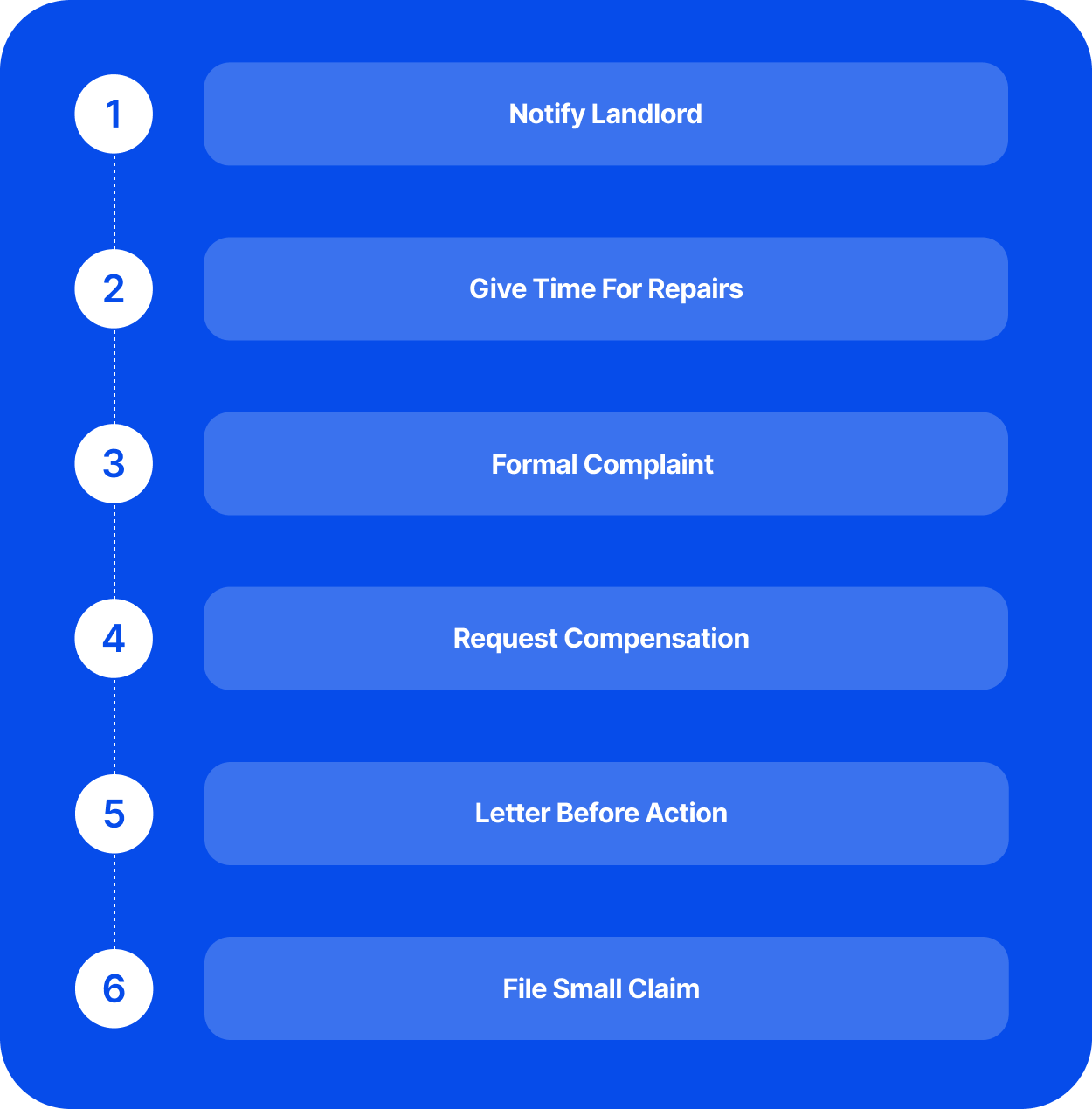
Step-by-Step: How to Bring a Mould/Damp Housing Disrepair Claim
Small claims in England and Wales usually cover sums up to £10,000, and CaseCraft.AI is built specifically for this range.
1) Notify the landlord (repair request)
2) Give reasonable time for repairs
3) Send a formal complaint
4) Request compensation
5) Issue a Letter Before Action
6) File a small claim
Common Mould and Damp Claim Scenarios
Many mould-damp claim cases fall into recurring patterns. Examples include:
- Black mould in a rented property claim after a roof leak in a bedroom
- Rising damp landlord failures in ground-floor flats with no damp-proof course
- Penetrating damp liability where external brickwork or pointing has failed
- Persistent bathroom mould after an extractor fan stopped working
- Ceiling patches left unresolved under a leaking shower or pipe
- Long-standing mould present from move-in, never properly treated
- Clothes, bedding, and soft furnishings ruined by mould spores
- Child asthma or other health problems caused by mould in the UK are linked to damp conditions
Each scenario can support mould in rented property compensation where evidence shows mould damp landlord responsibility, and the landlord ignores repairs despite clear reports.
Take Control of Your Housing Disrepair Mould Claim
If you are facing mould, damaged possessions, or health problems caused by mould in a rented home, you do not have to accept it as “just how it is”. You may have a strong mould damp claim for compensation for mould in the UK, and small claims offers a focused way to seek mould in rented property compensation under £10,000.
CaseCraft.AI is built around that exact space.
Note: The information provided herein is for general informational purposes only and should not be construed as legal advice.
Friendly Asked Questions
Is my landlord responsible for mould?
Your landlord is usually responsible for mould and damp that comes from leaks, faulty plumbing, structural defects, or poor ventilation, rather than everyday living. In those cases, mould damp landlord responsibility and landlord damp responsibility are engaged, and you may have a housing disrepair mould claim.
What if mould is caused by condensation?
Condensation often has more than one cause. Drying clothes indoors or not opening windows can contribute, but design faults, cold external walls, or inadequate fans may mean that condensation damp landlord duties still arise. Your mould damp claim can still succeed where structure, heating, or ventilation are part of the problem, and the landlord’s ignoring repairs has made matters worse.
Can I claim compensation for belongings damaged by mould?
Yes. If landlord failings caused the damp or mould, you can usually include mould-damaged belongings as part of mould in rented property compensation. Keep receipts, photos, and a list of affected items. These losses sit alongside rent reduction and distress within your damp claim, small claims schedule of loss in court.
How much compensation can I get for damp?
There is no fixed figure. Courts look at severity, duration, and impact. Awards in a mould damp claim often combine rent reduction, compensation for mould UK for distress, and mould damage to belongings. For many tenants, total housing disrepair compensation small claims values fall under £10,000 and fit the small claims track.
What evidence do I need?
For a strong housing disrepair mould claim, you should gather photos, videos, repair requests, responses, and any environmental health damp inspection reports. Records of health problems and cost lists of damaged items help quantify mould in rented property compensation.
Do I need a solicitor for a mould claim?
Not usually. Small claims are designed for people without lawyers, and CaseCraft provides structured guidance for small claims cases. Its tools help you frame tenant rights, mould damp arguments, set out landlord damp responsibility, and submit a compliant mould damp claim without paying traditional solicitor fees.
Case Study: Claim for Breach of Contract

A client paid £5,000 for a one-month agreement to use commercial premises but was denied access after just five days. The provider refused to refund the unused period.nnThe claim was filed for fundamental breach of contract and unjust enrichment. When the defendant failed to respond, the court issued a default judgment, granting full recovery including fees and interest.

CaseCraft.AI supports all common types of small money claims
From persistent damp patches to toxic mould growth, unsafe rental conditions can seriously harm your health and wellbeing. CaseCraft.AI helps you pursue fair compensation for mould and damp housing disrepair quickly and affordably, holding landlords accountable without legal complexity.
Don’t Wait – Get Started Today!
Take the first step toward a faster, easier small claims process with CaseCraft.AI.