

Noise Complaints: Take Legal Action for Persistent Noise Issues in the UK
Tired of persistent noise problems from neighbours or landlords? Learn your rights under UK law and how our small claims service helps resolve noise disputes and claim compensation.


What Counts as a Noise Complaint Under UK Law
A noise complaints UK case begins with understanding what legally counts as a noise nuisance. Under the EPA 1990, a statutory nuisance claim arises when noise unreasonably interferes with the use of a property or is likely to injure health.
Local councils must inspect their areas and, if satisfied that a nuisance exists or is likely to recur, serve an abatement notice. The Noise and Statutory Nuisance Act 1993 extends this duty to street noise from vehicles and loudspeakers.
What Counts as a Noise Complaint Under UK Law
A noise complaints UK case begins with understanding what legally counts as a noise nuisance. Under the EPA 1990, a statutory nuisance claim arises when noise unreasonably interferes with the use of a property or is likely to injure health.
Local councils must inspect their areas and, if satisfied that a nuisance exists or is likely to recur, serve an abatement notice. The Noise and Statutory Nuisance Act 1993 extends this duty to street noise from vehicles and loudspeakers.
Common Noise Issues
Excessive Neighbour Noise
- Loud music, barking dogs and DIY at night: repeated late‑night parties, amplified music, and constant barking can amount to a neighbour noise dispute if they materially interfere with the enjoyment of your property.
- General living noise vs unreasonable disturbance: occasional parties or daytime DIY usually do not qualify because the disturbance must be continuous or frequent. The council assesses the noise from the perspective of an ordinary, reasonable person.
Landlord/Tenant Disputes and Building Works
Persistent noise from a landlord’s building works, renovations or repairs conducted outside authorised hours can infringe a tenant’s quiet enjoyment rights. Tenants have an implied covenant of quiet enjoyment in their leases; the landlord must not disturb them or allow other tenants to disturb them. If building works cause significant disruption, the tenant may pursue a housing noise dispute.
Public Nuisances
Noise from bars, pubs, industrial premises or commercial activities can also lead to an environmental health noise complaint. Councils can serve notices on businesses, telling them what machinery may be used, the permitted hours and steps to minimise noise. Loudspeakers used at night in the street are generally prohibited.
Your Legal Rights Regarding Persistent Noise
Environmental Protection Act 1990
The EPA 1990 forms the backbone of nuisance law. Section 79 defines statutory nuisances, including noise that materially interferes with comfort or injures health. Local authorities have a duty to investigate complaints and, if satisfied a nuisance exists, must issue an abatement notice. Failure to comply is a criminal offence; councils can enter premises, seize noise‑making equipment and carry out works in default.
Section 82 gives individuals the right to take their own action at the magistrates’ court. This route is used when the council fails to act or when you wish to expedite the process. The court may order the person causing the noise to stop and prevent it from recurring.
Noise Act 1996 and Permitted Levels
The Noise Act 1996 provides councils with powers to deal with noise at night. Between 11 p.m. and 7 a.m., councils may issue a warning notice if noise exceeds permitted levels. The permitted noise level is 34 dBA if the underlying noise is no more than 24 dBA or 10 dBA above the background level if it exceeds 24 dBA. If the noise continues, councils can issue fixed penalty notices, fines of up to £110 for dwellings or £500 for licensed premises, and prosecute offenders.
Anti‑Social Behaviour, Crime and Policing Act 2014
Persistent noise can constitute anti‑social behaviour. The Anti‑Social Behaviour Act 2014 provides tools such as community protection warnings, fixed penalty notices, injunctions and closure orders. Councils and landlords may use these powers to tackle serious or ongoing persistent noise issues that impact the community. For example, they can apply for an injunction to prevent a loud neighbour from continuing disruptive activities or issue closure orders against premises that cause public nuisance.
Right to Quiet Enjoyment
Leaseholders have a contractual right to quiet enjoyment. Where the lease does not expressly include this covenant, the law implies it. Landlords must inform tenants about planned works that could cause noise and must take reasonable steps to minimise disturbance. Breaching the covenant can give rise to a legal action in the UK.
Housing Ombudsman
Tenants of social housing who suffer from unresolved noise problems can complain to the Housing Ombudsman Service. Shelter notes that the Ombudsman can investigate complaints about how a landlord has dealt with tenants’ behaviour, including noise nuisance. The Ombudsman can require landlords to apologise, pay compensation, carry out works or take other steps to secure redress. However, you must first exhaust the landlord’s internal complaints procedure and bring the case to the Ombudsman within 12 months of the final response.
Steps to Take Before Legal Action
Keep a Detailed Noise Diary
Councils often ask complainants to complete noise diaries. Preston City Council advises keeping a record of dates, times, the type of noise and its impact. This evidence strengthens your statutory nuisance claim by showing the frequency and severity of the noise and your attempts to resolve the issue. Include witness statements and any police incident numbers.
Communicate with the Noise Source
Try to resolve the problem directly with your neighbour or landlord. Explain how the noise affects you and agree on a solution. Document your conversations and keep copies of letters or messages. Maintaining civil communication can prevent escalation and may preserve neighbourly relationships.
Contact the Council’s Environmental Health Department
If the noise continues, submit an environmental health noise complaint to your local council. Provide your noise diary, recordings and witness evidence. Councils must investigate whether the noise amounts to a statutory nuisance and can monitor the noise using equipment. If they find a nuisance, they will serve an abatement notice.
Gather Professional Evidence
For complex cases, consider using a sound‑meter app or instructing an acoustic consultant to measure decibel levels. Video or audio recordings can support your compensation claim. Doctors’ letters may show the impact on your health. This evidence will assist the council, the Housing Ombudsman or a court in assessing your housing noise dispute.
Seek Mediation
Before pursuing litigation, mediation or dispute resolution services can help. Mediators facilitate negotiations between you and your neighbour, potentially avoiding the expense and stress of court. Some local councils provide mediation services or can refer you to providers.
When and How to Escalate a Noise Complaint
Housing Ombudsman and Alternative Dispute Mechanisms
If your landlord ignores your complaints or fails to comply with an abatement notice, you may complain to the Housing Ombudsman. The Ombudsman investigates failures by social landlords in dealing with noise and can order compensation or corrective actions. Private landlords who voluntarily subscribe to the scheme may also be subject to the Ombudsman’s jurisdiction.
Filing a Small Claims Noise Complaint
If the noise continues despite council enforcement or if you suffer financial loss or distress, you may claim compensation through the civil courts. Section 82 of the EPA 1990 allows individuals to apply to the magistrates’ court for an order requiring the person causing the nuisance to stop. For damages such as stress, lost sleep, reduced property value or costs incurred (e.g., hotel stays), you may use the small claims track of the County Court, provided your claim does not exceed the small claims court limit.

Community Trigger and Anti‑Social Behaviour Case Review
Under the Anti‑Social Behaviour Act 2014, residents can activate the Community Trigger (also known as the anti‑social behaviour case review) if they have complained to the council, police and/or housing provider at least three times about related incidents within six months and no effective action has been taken. This requires agencies to review the case and develop an action plan.
Evidence and Procedure
Before filing, send a letter of claim to the noise maker outlining your grievance, evidence and demand for compensation. If they do not respond within a reasonable time (usually 14 days), you may submit your claim online using CaseCraft.AI’s platform. At the hearing, you must prove that the noise constitutes a statutory nuisance and that you suffered loss. Courts consider the decibel level, frequency, duration and impact on your health and enjoyment.
Claiming Compensation for Persistent Noise
Types of Compensation
A claim for compensation in a noise UK action can seek:
- Stress and loss of amenity: Disturbance of sleep, anxiety or health issues caused by persistent noise issues.
- Breach of quiet enjoyment: Compensation for interference with tenancy rights.
- Loss of earnings or moving costs: If the noise forced you to relocate or affected your work (e.g., if you work from home).
- Property damage or remedial costs: Where vibrations or excessive noise damage fixtures or require acoustic improvements.

How CaseCraft.AI Helps with Noise Complaints
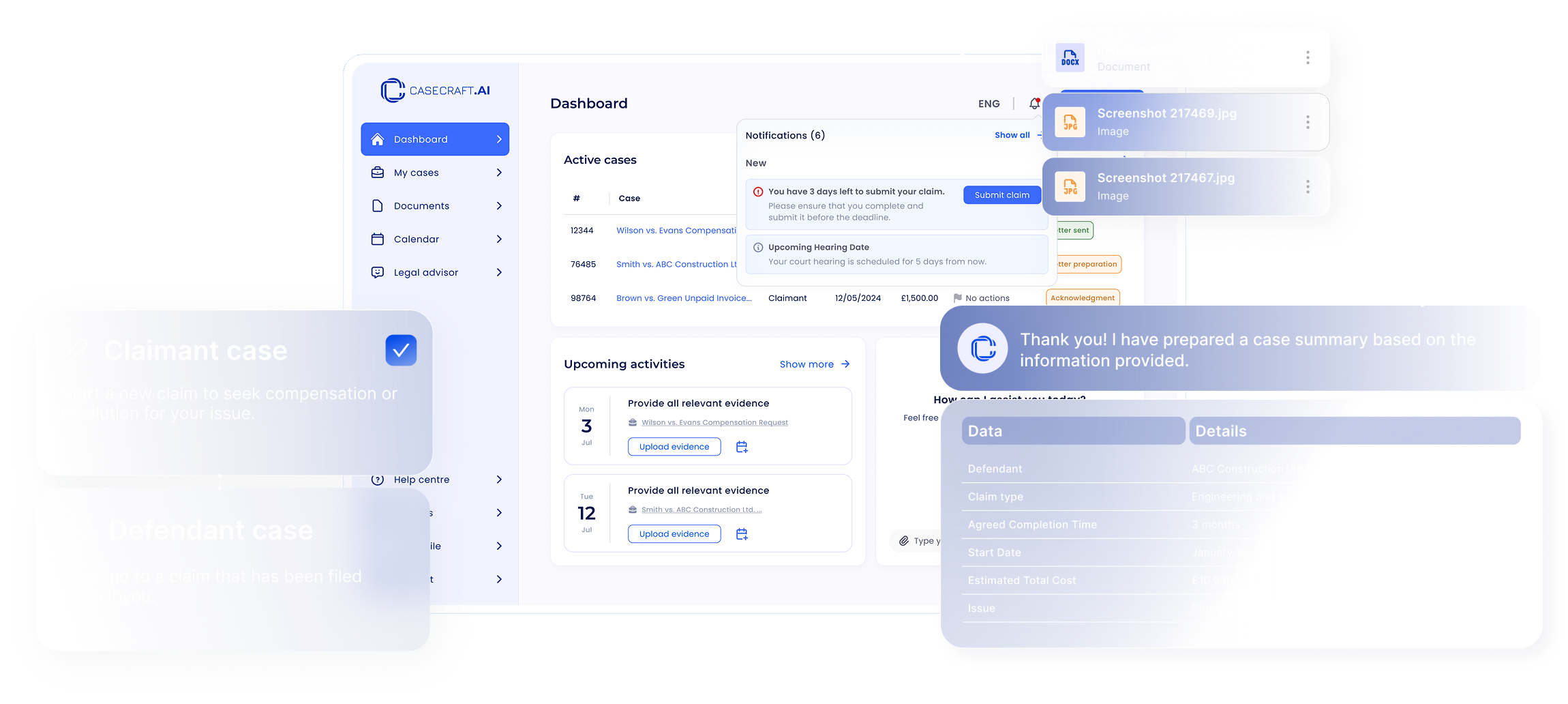
CaseCraft.AI is an AI‑powered platform designed to simplify small claims. It automates key legal tasks such as drafting court‑ready forms, organising evidence and guiding users through the claim process. CaseCraft.AI emphasises that it can turn your information into a legally sound claim that meets HMCTS standards. The platform allows you to:
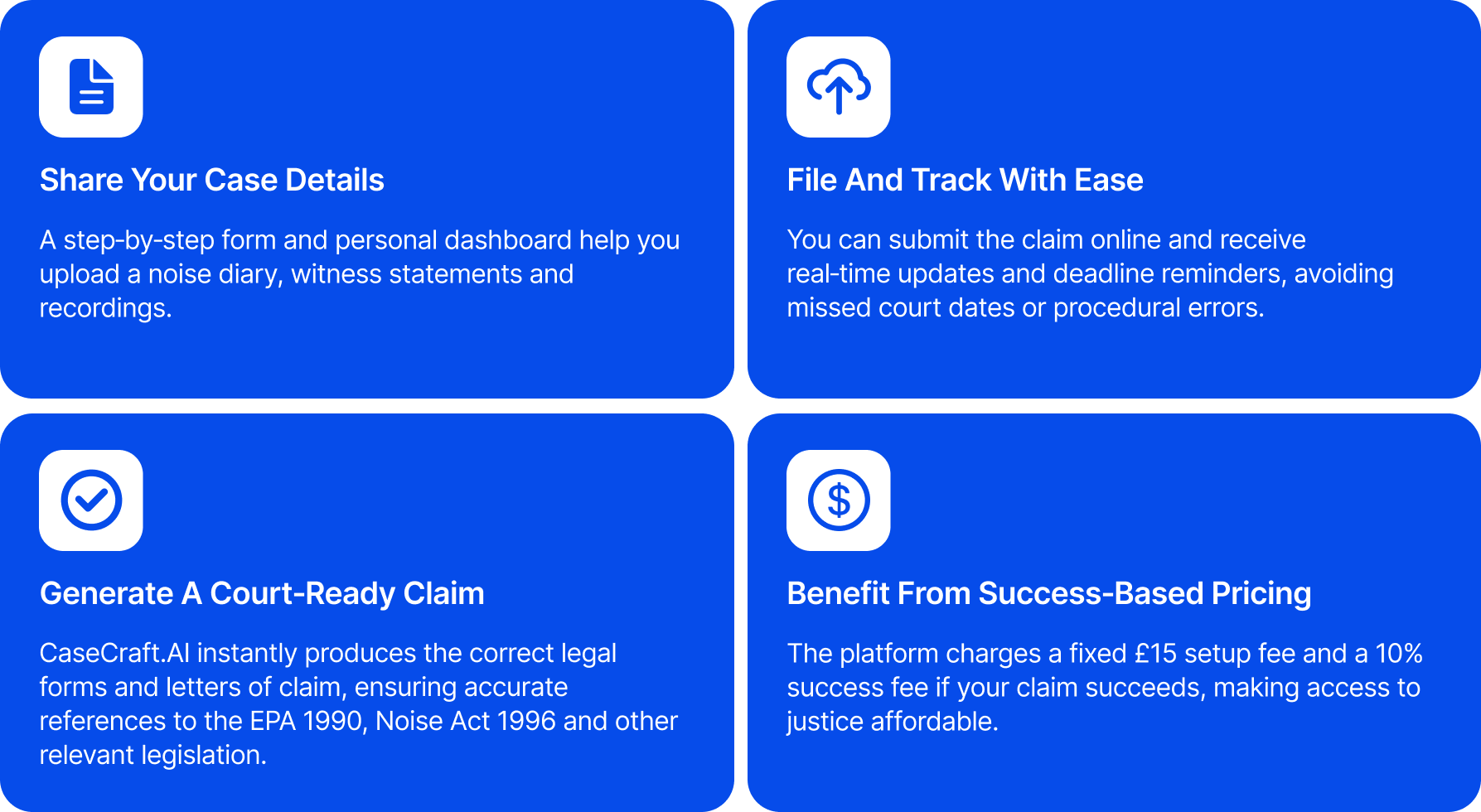
By using CaseCraft.AI, you gain legal support for noise disputes without the cost of hiring a solicitor. Its AI guidance replicates the expertise of a specialist, helping you navigate a housing noise dispute from evidence collection to final judgment.
Why Choose Us for Your Noise Dispute Claim
- Expert knowledge: Our team understands nuisance law and the nuances of noise complaints in UK cases. We stay up‑to‑date with the EPA 1990, Noise Act 1996, Anti‑Social Behaviour Act 2014 and Housing Ombudsman guidance, ensuring your claim is legally robust.
- Specialised in neighbour disputes: We have extensive experience handling neighbour noise disputes and housing noise disputes, including claims for breach of quiet enjoyment and statutory nuisance.
- Comprehensive service: CaseCraft.AI offers consultation, assistance in preparing your noise diary, drafting letters, negotiating with the other party, submitting an environmental health noise complaint, and representing you in small claims. We guide you through mediation, negotiation and, if necessary, court proceedings.
- Transparent pricing: You only pay a low fee to start your claim and a small percentage if you win. There are no hidden charges.
- Time and stress saving: Filing a legal action in the UK can be daunting. Our AI‑driven platform streamlines the process, allowing most users to file within minutes. We manage deadlines and paperwork so you can focus on your life.
- Data security: Your evidence, personal data and correspondence are stored securely. We comply with all data‑protection requirements.
Preventing Future Noise Issues
Preventing disputes is better than litigating them. Consider these tips:
- Record everything: Keep written records of conversations, emails and calls with your neighbour or landlord. Maintain your noise diary even after the issue is resolved.
- Communicate early: Discuss planned activities (parties, DIY) with neighbours and agree on acceptable hours. Notify tenants of building works in advance. Good communication can prevent excessive noise.
- Contact the council promptly: Do not wait months before making a council complaint. Early intervention increases the chance of a quick resolution.
- Soundproofing and property improvements: Landlords should maintain properties to reduce noise transmission. Tenants can request improvements if noise levels cause a nuisance.
- Check tenancy agreements: Ensure noise clauses are clear. Understanding your tenant rights helps avoid misunderstanding.
- Use mediation: Encourage mediation services to resolve disputes amicably before they become entrenched.
Common Examples of Noise Complaints in the UK
- Neighbour parties late into the night.
- Persistent barking dogs or loud pets.
- Unapproved construction or DIY outside permitted hours.
- Commercial noise from pubs, bars or industrial sites.
By recognising these patterns early and taking the steps outlined above, you can protect your health and your right to enjoy your home. Should you need to take legal action, CaseCraft.AI stands ready to assist you in making a small claims noise complaint or a statutory nuisance claim. Through our expertise and AI‑powered tools, we empower individuals to enforce their rights, secure fair compensation and restore quiet in their homes.
Friendly Asked Questions
What counts as a noise complaint?
Repeated or unreasonable disturbance: loud music, parties, barking dogs, DIY outside permitted hours, intrusive commercial noise (e.g., pubs), or disruptive building works.
Do I need to speak to my neighbour first?
Yes, keep it calm and factual. If it’s unsafe or ineffective, move straight to reporting the issue to your council’s Environmental Health team.
What should I record in a noise diary?
Dates, times, duration, type of noise, how it affected you (sleep, work, health), and any witnesses. Keep copies of emails, texts, and council correspondence.
When should I contact the council?
If the problem persists after a reasonable approach, contact Environmental Health. They can investigate, monitor, and issue abatement notices for statutory nuisance.
What are the “night hours”?
11 pm–7 am. Councils have extra powers at night and can issue warning notices if noise exceeds permitted levels.
Can I claim compensation?
Yes, in suitable cases via small claims (generally up to £10,000). Typical heads of loss include distress, interference with “quiet enjoyment”, and reasonable related costs.
Do I need a solicitor for small claims?
Not usually. Small claims are designed to be accessible without legal representation; good evidence and clear paperwork matter most.
How can CaseCraft.AI help?
We guide you step-by-step: build an evidence pack (including your diary), draft a Letter of Claim, generate court-ready forms, and file/track your claim online.
Case Study: Claim for Breach of Contract

A client paid £5,000 for a one-month agreement to use commercial premises but was denied access after just five days. The provider refused to refund the unused period.nnThe claim was filed for fundamental breach of contract and unjust enrichment. When the defendant failed to respond, the court issued a default judgment, granting full recovery including fees and interest.

CaseCraft.AI supports all common types of small money claims
From sleepless nights to constant disturbances — persistent noise issues can seriously affect your quality of life. CaseCraft.AI helps you take legal action quickly and affordably, without legal complexity.
Don’t Wait – Get Started Today!
Take the first step toward a faster, easier small claims process with CaseCraft.AI.