




1. Service triggers the clock. The claim form (N1) is deemed served on the second business day after posting. For email or personal service, it is deemed served on the same business day. Deemed service marks day 0 of your response timeline.
2. You have 14 days to acknowledge and 28 days to defend. File an Acknowledgement of Service (Form N9) within 14 days of deemed service. Acknowledging extends your total response period to 28 days. Submit your Defence (Form N9B) within those 28 days to avoid a default judgment.
3. Extensions and missed deadlines. Under CPR 15.5, both parties may agree in writing to extend the defence period by up to 28 additional days. If you’ve already missed the deadline, act fast, file your defence immediately if no judgment has been entered. If judgment has been issued, apply to set it aside using Form N244.
Introduction
When a court claim arrives through your letterbox, the clock starts ticking. Every day counts because missing the response deadline can lead to a default judgment, leaving you saddled with costs and a county court judgment that sticks to your credit record. Yet most people have never heard of Form N9 or the Civil Procedure Rules. They simply open the envelope, panic, and leave the paperwork on the kitchen table. Meanwhile, the calendar keeps turning.
In this guide, we demystify the small claims response deadline. We break down the 14‑day acknowledgement period and the 28‑day defence deadline, explain how the date of service is calculated, and show you how to avoid default judgment under the Civil Procedure Rules Part 12. The piece is written for non‑lawyers dealing with small claims in England and Wales in 2025. It uses official sources and legal rules, but it is explained in plain English with examples, timelines and practical tips.
Definition Box: Small Claims Response Deadlines
| Element | Time limit & notes |
| Deemed service date | A claim form served by post is deemed served two business days after posting. Email or personal service is deemed served the same business day if sent before 4.30 pm. |
| Acknowledge (Form N9) | File within 14 days of deemed service. Doing so gives you 28 days from service to file a defence. |
| Defence (Form N9B) | File within 28 days after service if you acknowledged, or within 14 days if you did not. |
| Extension (CPR 15.5) | Parties may agree in writing to extend the defence deadline by up to 28 further days and must notify the court. |
| Default judgment | Granted, if no acknowledgement or defence is filed and the time limit has expired. |
| Set aside | If judgment is entered, apply promptly using Form N244 to ask the court to set it aside. |
Understanding the Court Response Deadline
Before we dive into forms and time limits, it helps to understand why there is a court claim time limit at all. Civil justice aims to resolve disputes efficiently. Once a claim is issued, the defendant is expected to respond promptly. The response deadline is set by Part 15 of the Civil Procedure Rules. If you ignore the papers, the claimant is entitled to a default judgment (i.e. a judgment without trial). That judgment can damage your credit rating and can be enforced through bailiffs or orders against your bank accounts.
Why the Response Deadline Exists
The response deadline is not there to trip you up; it is there to ensure that cases move forward fairly and that both sides know where they stand. The rules require claimants to serve the claim form (N1) and accompanying particulars on the defendant. Service must be effected by an authorised method under Part 6. Once served, the claim form is deemed served on the second business day after completion of service. If service is by email, fax or personal delivery before 4.30 pm on a business day, the document is deemed served that same day. Deemed service matters because it triggers the countdown for your response.
How Service Dates Are Calculated
You may receive papers by post, email, DX (document exchange) or hand delivery. The Civil Procedure Rules provide a table of deemed service dates. For the post, the claim is deemed served two business days after posting. For documents left at your address before 4.30 pm on a business day, service is deemed that day; otherwise, it is the next business day. For email and fax sent before 4.30 pm, service is deemed that day. In other words, if the claim form arrives on a Friday, the deemed service date is the following Tuesday (assuming no bank holidays). Mark this date because your 14‑day and 28‑day deadlines run from it.
Example Timeline
Suppose a claim form is issued on 1 March 2025 and posted the same day. Deemed service is 3 March 2025 (two business days later). By 17 March (14 days after deemed service), you must file an acknowledgement of service if you intend to defend or need extra time. If you do so, you then have until 31 March (28 days after deemed service) to file your defence. Missing either date opens the door for the claimant to apply for default judgment.
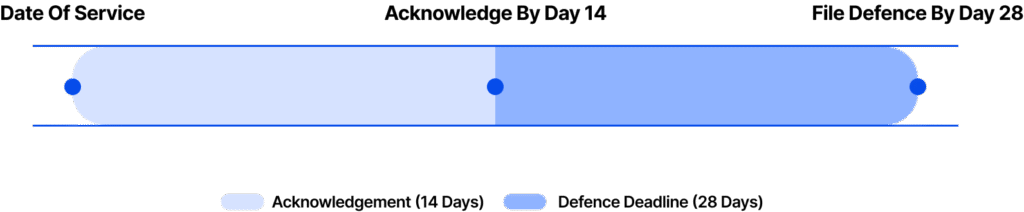
The simple timeline above shows the key dates: date of service at day 0, acknowledgement deadline at day 14 and defence deadline at day 28. Keeping these dates in mind will help you stay on track.
The 14‑Day Rule: Acknowledging the Claim (Form N9)
Receiving a claim form can feel intimidating, but the first step is straightforward. Acknowledgement of service, known as Form N9, lets the court know you have received the claim and plan to respond. This acknowledgement is not your defence; it simply buys you time. Under CPR 15.4, you must respond within 14 days of the date of service. The government’s N1C states that if you need longer than 14 days to prepare your defence, you should submit an acknowledgement of service.
What Is Form N9?
Form N9 is included in the response pack you receive with the claim. It asks for your details and whether you intend to defend all, defend part, or contest jurisdiction. The form must be filed at the County Court Business Centre (CCBC) or via the court’s online system. The official N9 notes emphasise that if you file an acknowledgement but do not file a defence within 28 days of the date of service, judgment may be entered against you.
How to File an Acknowledgement
You can acknowledge in several ways:
- Online – Log into the CaseCraft.AI platform or the official court portal and complete the electronic Form N9. This is the fastest method and generates a digital record of submission. If you use CaseCraft.AI, the platform guides you through the steps and confirms when the acknowledgement is filed.
- By post – Complete the paper Form N9 and send it to the CCBC. Use recorded delivery so you can prove when you posted it.
- In person – Some courts accept hand‑delivered forms. If you choose this route, ask for a receipt from the court office.
After you file, the court sends a copy to the claimant. If you miss the 14‑day window, you may still file an acknowledgement, but the claimant can request default judgment once the period expires. Therefore, act quickly.
Why File an Acknowledgement?
The benefit of acknowledging is that it automatically extends your time to submit a defence. Without an acknowledgement, your defence would be due within 14 days of service. Filing Form N9 gives you 28 days from the deemed service date. This extra fortnight is invaluable when gathering evidence and seeking advice. You can also indicate on the form that you are contesting the court’s jurisdiction, which stops the clock while the jurisdiction issue is resolved.
The 28‑Day Rule: Filing Your Defence (Form N9B)
Once you have acknowledged service or decided to defend immediately, the next step is to file your defence. This is where you respond point‑by‑point to the claimant’s allegations. Under CPR 15.4, if you do not file an acknowledgement, your defence must be filed within 14 days of service. If you have acknowledged, the period extends to 28 days after service of the particulars of the claim. This is why the 14‑day acknowledgement period and the 28‑day defence deadline are often referred to together as the small claims response deadline.
What Is Form N9B?
Form N9B (or N9D for unspecified claims) is the Defence and Counterclaim form. It requires you to explain why you dispute the claim and to provide any counterclaim you may have. The N9 guidance instructs defendants who wish to dispute a specified amount to send the defence form within 14 days. If you have acknowledged service, you still need to file the defence by day 28; otherwise, the claimant may request default judgment.
What Should a Valid Defence Contain?
A well‑structured defence should:
- Address each allegation – Admit or deny each numbered paragraph of the particulars of the claim. If you cannot admit or deny, explain why.
- State the legal basis of your defence – For example, if you allege the contract is void, cite the relevant statutory provision.
- Provide supporting evidence – Attach copies of emails, invoices or contracts that support your version of events. CaseCraft.AI’s platform allows you to upload and categorise evidence so it is ready for court.
- Include a statement of truth – You must sign that the facts stated are true; if you lie, you risk contempt of court.
If you plan to make a counterclaim, you can include it in the same document. Ensure you pay any additional court fees required.
What Happens After Filing?
Once your defence is filed, the court will notify the claimant. Both parties may then be required to complete a directions questionnaire to help the judge allocate the case to the appropriate track (small claims, fast track or multi‑track). If the case remains in the small claims track, you will often be invited to a mediation appointment as part of the Small Claims Mediation Service. CaseCraft.AI will alert you when a mediation session is scheduled and allow you to track progress.
Calculating Your Deadline Correctly
Missing a deadline often happens because of a simple miscalculation. Use this step‑by‑step guide to determine your due dates accurately:
- Locate the issue date and method of service. Check the claim form for the issue date and note how it was sent (post, email, DX or personally delivered).
- Determine the deemed service date. For post and DX, add two business days. For documents left at your address before 4.30 pm, take the same business day; otherwise, use the next business day. For email or fax, if sent before 4.30 pm on a business day, the document is deemed served that day.
- Add 14 days for the acknowledgement deadline. Count 14 calendar days from the deemed service date. If the last day falls on a weekend or public holiday, the deadline moves to the next working day.
- Add 28 days for the defence deadline. If you filed an acknowledgement, your defence is due 28 days after the deemed service date. If you did not acknowledge, your defence is due 14 days after service.
- Check for bank holidays. Deadlines that fall on Christmas Day, Good Friday or other bank holidays roll to the next working day. Always double‑check the court calendar.
- Document the dates. Write them on a calendar, set phone reminders and tell someone you trust. Missing a date can be costly.
Weekend and Holiday Adjustments
Civil Procedure Rule 6.14 states that the claim form is deemed served on the second business day after posting. Business days exclude Saturdays, Sundays and bank holidays. So if a claim is posted on a Thursday, the deemed service date is the following Monday (assuming no bank holiday). Counting forward 14 days leads to the Monday two weeks later. It’s safer to assume you have slightly less time than more, especially around public holidays.
What If You Miss the Deadline?
Sometimes life gets in the way, you move house, travel abroad, or the claim form simply gets lost under a pile of mail. If you fail to file an acknowledgement or defence before the deadline, the claimant may apply for default judgment. Under Part 12, the court may enter judgment without a trial if the defendant has not filed an acknowledgement or defence and the time limit has expired. Once a default judgment is entered, the claimant can enforce it by instructing bailiffs, securing a charging order or applying for an attachment of earnings.
Acting Before Default Judgment Is Entered
All is not lost if you realise the deadline has passed but the claimant hasn’t yet requested judgment. A late defence can still be filed as long as the claimant hasn’t made the application. In other words, you can file your defence “out of time” and, provided it is on the court file before the claimant’s request is processed, default judgment will be refused. Therefore, if you are only a few days late, submit your defence immediately and contact the court to check whether judgment has been entered.
Setting Aside Default Judgment
If a default judgment has already been entered, you may apply to set it aside. You must act promptly and have a good reason. According to HMCTS guidance, you use Form N244 (application notice) to ask the court to set aside or vary a judgment. Common grounds include:
- You were never served with the claim form. Perhaps it went to an old address or was otherwise not received. You will need to explain why you didn’t receive it and provide evidence.
- You have a real prospect of successfully defending the claim. The court has discretion under CPR 13.3 to set aside if there is a defence with a reasonable chance of success.
- Some other good reason. This could include administrative errors or circumstances where the claimant misled the court.
Include in your N244 application an explanation of why you didn’t respond, details of your defence, and evidence of how the judgment is affecting you. You will usually have to attend a hearing. A consent order signed by both parties can speed up the process, but it is still the judge’s decision whether to set aside the judgment.
What Happens if You Do Nothing?
If you ignore a default judgment, it will remain on your credit report for six years. The claimant may take enforcement action, such as sending bailiffs or applying for a charging order on your property. The judgment will make it difficult to obtain credit, secure housing or even some jobs. That is why acting promptly, either to file a defence or to apply to set aside, is crucial.
Can You Extend the Response Deadline?
Sometimes 28 days isn’t enough to collate evidence, obtain expert reports or negotiate a settlement. The Civil Procedure Rules recognise this and allow limited flexibility. Under CPR 15.5, the defendant and claimant may agree in writing to extend the time for filing a defence by up to 28 further days. This extension is often called a “mutual extension” or “buffer period”. To use it effectively:
Seek written consent. Contact the claimant (or their solicitor) and ask for a 28‑day extension under CPR 15.5. Explain why you need more time, e.g. to obtain specialist reports.
Notify the court. The defendant must inform the court in writing that an extension has been agreed. Without notification, the court may treat your defence as late.
Plan ahead. You cannot ask for repeated 28‑day extensions. After the first extension, any further delay requires a court order. Courts are reluctant to grant further extensions without good reason.
The parties can agree to extend the time for service of a defence by a further 28 days, but any further extension will require the court’s permission. Do not assume that an informal agreement over the phone is enough; always obtain written confirmation.
Practical Tips for Meeting Court Deadlines
The best way to avoid a default judgment is to plan ahead. Here are some practical tips, drawn from legal practice and common sense:
- Open mail immediately. Treat any letter marked “court” or “claim” as urgent. Note the issue date and method of service.
- Record key dates. Write down the deemed service date, the 14‑day acknowledgement deadline and the 28‑day defence deadline. Use digital calendars, reminders and sticky notes.
- File the acknowledgement online as soon as possible. Do not wait until day 13 to file Form N9. The sooner you file, the less likely you are to forget.
- Start drafting your defence early. Gather evidence, witness statements and legal arguments while there is still time. If you leave it until day 27, you may miss something crucial.
- Keep proof of submission. Save screenshots of online submissions, obtain a certificate of posting for postal submissions and keep any court acknowledgements.
- Consider mediation. Many small claims settle at mediation. The CaseCraft.AI platform notifies you of mediation appointments and tracks progress. Settlement avoids the need for a contested hearing.
- Seek advice. If you are unsure about legal arguments, speak to a solicitor. Court staff can explain the procedure, but cannot give legal advice.
Disclaimer: This article provides general information for educational purposes only and does not constitute legal advice. For guidance on your specific case, consult a qualified solicitor or legal professional.
FAQ: About Court Claim Deadlines
How long do I have to respond to a court claim in the UK?
You must either file an acknowledgement of service within 14 days of the deemed service date or file your defence within the same 14‑day period. Filing an acknowledgement extends your total time to 28 days. The clock starts from the date the claim form is deemed served, which is usually two business days after posting.
What happens if I miss the 14‑day or 28‑day deadline?
If you miss the deadline, the claimant may apply for default judgment. However, if they haven’t yet applied, you can still file a late defence. Once a default judgment is entered, you must apply promptly using Form N244 to have it set aside.
Can I get more time to file my defence?
Yes. Under CPR 15.5, the defendant and claimant can agree to extend the defence deadline by up to 28 additional days. The agreement must be recorded in writing and notified to the court. Further extensions require a court order.
How do I calculate my response deadline?
Determine the deemed service date, count 14 days for the acknowledgement deadline and 28 days for the defence deadline. Exclude weekends and bank holidays when calculating the deemed service date. Use reminders to ensure you meet the dates.