

Spinal Cord Injury Claims
Claim compensation for minor spinal injuries with CaseCraft.AI. Simple small claims guidance, secure tools, and clear next steps.


What Is a Spinal Cord Injury?
The spinal cord is a bundle of nerves encased by the spine. Twenty‑four vertebrae (from the neck to the lower back) protect this cord and enable your body to send signals between the brain and the rest of the body. When a vertebra breaks or dislocates and presses on the cord, messages cannot travel properly, leading to paralysis or sensory loss.
Medical professionals classify injuries as complete or incomplete. A complete injury means there is no sensation or movement below the level of the damage; an incomplete injury leaves some function.
Injuries are also described by the region of the spine affected – cervical, thoracic, lumbar or sacral. Cervical injuries (neck level) are often the most severe because they can affect breathing and movement of all four limbs. Thoracic injuries occur in the upper back and mainly affect the chest and lower trunk. Lumbar and sacral injuries in the lower back can impact walking, bladder/bowel control and sexual function. The medical complexity of a spinal injury underpins why compensation is available even for smaller claims: proper diagnosis and rehabilitative support cost time and money, and injuries can lead to lifelong consequences.
What Is a Spinal Cord Injury Claim?
A spinal cord injury claim is a legal action seeking monetary compensation when negligence has caused or significantly contributed to the injury. In England and Wales, such claims may be brought via the Small Claims Track if the value of general damages does not exceed £1,500 for non-RTA personal injuries, or £5,000 for whiplash or similar injuries arising from road traffic accidents (for incidents occurring on or after the respective dates stated above). Claims exceeding these thresholds will be allocated to the Fast or Multi-Track depending on their value and complexity.
The aim is never to profit, but to restore you, to the degree possible through compensation, to the position you would have occupied but for the injury.
Importantly, personal injury damages are split into general and special damage.
- General damages compensate for pain, suffering and loss of amenity, the things you cannot easily quantify, such as losing the ability to enjoy hobbies.
- Special damages compensate for financial losses like lost earnings, travel to medical appointments, equipment, care and home adaptations. These heads of loss are discussed in more detail below.
What Does Spinal Cord Injury Compensation Cover?
Compensation aims to fund both recovery and adaptation. It can cover a wide range of needs, including:
- Rehabilitation therapies – specialist physiotherapy, occupational therapy, speech and language therapy, psychological counselling, and structured pain management programmes.
- Home adaptations – ramps, stair lifts, accessible bathrooms, widened doorways, specialist beds and hoists, or in some cases, the purchase of alternative accommodation better suited to mobility needs.
- Equipment and mobility aids – long-term provision such as manual or powered wheelchairs, adaptive technology, mobility supports, and modified vehicles.
- Care and support – costs of professional carers, contributions for family members providing daily care, case management services, and respite care.
- Medical and healthcare costs – private medical treatment, ongoing consultations, and prescriptions are not fully funded by the NHS.
- Travel and associated expenses – journeys to hospital or rehabilitation appointments, plus adjustments for holidays or leisure activities that require accessible facilities.
While small claims will not result in million‑pound settlements, understanding what may be covered helps ensure you claim for everything you are entitled to.

Common Causes of Spinal Cord Injury
Spinal cord injuries can occur in many situations, but some scenarios appear regularly in case law and statistics:
1. Falls and trips – slip‑and‑fall accidents at work, on poorly maintained public pavements or in shops can lead to spinal fractures. Even a seemingly minor fall can damage the vertebrae if the force is concentrated in the wrong place.
2. Road traffic accidents – collisions involving cars, lorries or motorcycles are a significant cause. Whiplash and high‑energy impacts can dislocate vertebrae or bruise the cord.
3. Sports and recreational injuries – activities like rugby, diving or skiing carry risk, especially when adequate safety equipment or supervision is lacking.
4. Workplace accidents – manual handling incidents, falls from height or being hit by moving objects can injure the spine. Workplaces that fail to provide proper training or equipment may be liable.
5. Faulty or defective products – defective safety equipment, malfunctioning seats in vehicles or substandard medical devices may cause catastrophic back injuries.
How Home Adaptations Are Covered in a Spinal Injury Claim?
Responsibility for adapting your home falls to the party whose negligence caused your injury, through their insurer. Successful claims include special damages that reimburse or advance payment for required adaptations. In cases where liability is disputed or not yet resolved, you might be able to access funds through state benefits (such as a Disabled Facilities Grant) or by funding works yourself and reclaiming the cost later. CaseCraft.AI’s platform guides users on capturing receipts and submitting evidence so that even low‑value claims properly include the cost of essential modifications. For serious injuries that exceed the small claims limit, you may need a solicitor to secure interim payments from the defendant’s insurer to cover adaptation costs while the case is ongoing.
Every injury is different, but common home adaptations include:
- Access adaptations: Installing ramps, handrails, widened doorways and step‑free entrances for wheelchair or walking aid users.
- Bathroom adjustments: Wet rooms, walk‑in showers, lowered sinks, adapted toilets and non‑slip flooring to enable independent washing.
- Kitchen modifications: Height‑adjustable work surfaces, pull‑out shelves and accessible storage to aid cooking and domestic tasks.
- Mobility aids: Stair lifts, through‑floor lifts or hoists to move safely between floors; height‑adjustable beds and specialist chairs.
What Are the Different Levels of Payouts for Spinal Cord Injuries?
Most serious spinal cord injuries fall well beyond the small-claims track and must be handled by specialist solicitors. CaseCraft.AI is designed for lower-value claims, where the injury is less severe but still disruptive to daily life.
Within the small-claims track (up to £1,500 for non-RTA injuries and £5,000 for whiplash-related RTAs), compensation may apply to:
- Minor spinal or back injuries – soft-tissue damage, sprains, or less serious fractures that heal within months or a few years.
- Ongoing discomfort – cases where pain or limited mobility persists for a short period but does not require lifelong care.
- Restricted daily activities – claims recognising the impact of short-term adaptations, physiotherapy, or time off work.
These awards are modest compared to major spinal injury claims, but they can still make a meaningful difference, helping to cover medical treatment, travel to appointments, or short-term rehabilitation.
Financial Loss in Spinal Injury Claims
Beyond pain and suffering, spinal injuries often produce significant financial loss:
- Loss of earnings: Many claimants cannot return to work for months or years. Compensation should cover wages lost during recovery and future loss if your career prospects are permanently altered. Self‑employed claimants should collect accounts, tax returns and evidence of lost contracts.
- Care costs: Professional care or support from family members has a financial value. Even if a family member looks after you unpaid, the court may compensate their time using commercial care rates.
- Medical expenses: Private treatment, mobility aids, prescriptions, therapy and specialist consultations all create costs that are recoverable.
- Adaptation and equipment costs: As discussed above, modifications to the home and vehicles are reimbursable.
- Miscellaneous expenses: Travel to appointments, parking charges, increased heating costs (due to inactivity), and additional holiday costs when accessible accommodation is required.
Maintaining receipts and accurate records is essential, especially for small claims where the judge will expect proof of every penny claimed. CaseCraft.AI’s “My Documents” vault allows claimants to upload invoices and receipts securely and link them to particular losses. The platform also sends smart deadline alerts so you don’t miss limitation dates or court deadlines.

Step‑by‑Step Guide to the Process
Initial assessment:
Decide whether you have grounds for a claim. Did someone owe you a duty of care? Did they breach that duty and cause your injury? For small claims, ensure that the value does not exceed the legal limits. CaseCraft.AI’s questionnaire helps filter out non‑viable claims and provides guidance on whether you need legal representation.
Record the accident:
Report workplace accidents in the accident book, call emergency services if needed and gather witness details.
Medical diagnosis:
Seek immediate medical care and keep records of all diagnoses, scans and treatments. A comprehensive medical report is essential to link your symptoms to the accident and determine prognosis.
Gather evidence:
This might include witness statements, CCTV footage, photographs of defects, incident reports and maintenance logs. For workplace claims, retain copies of training records and risk assessments.
Calculate damages:
Keep receipts for medical costs, travel, equipment and lost earnings. Write down how the injury affects your daily activities and hobbies for general damages. CaseCraft.AI’s dashboard includes templates for listing losses and automatically generates a schedule of damages.
Check limitation date:
Generally, you have three years from the date of injury to issue a claim. Exceptions apply if you did not discover the injury immediately (the clock starts when you become aware), if you were under 18 at the time (the limitation runs from your 18th birthday), or if you lacked mental capacity until you regained capacity. Using CaseCraft.AI, you receive reminders as the deadline approaches.
Letter of claim:
Write to the defendant detailing the accident, injuries and compensation sought. The defendant (usually an insurer) has a period to investigate and respond.
Negotiate settlement:
Many spinal injury claims settle without going to trial. In small claims, the court encourages mediation or early settlement. CaseCraft.AI’s platform provides template letters and step‑by‑step guidance on how to negotiate or respond to offers.
Hearing:
Attend court or an online hearing with your evidence. Prepare to explain your losses clearly. CaseCraft.AI’s checklists ensure you have all documents organised and accessible.
Judgment and payment:
If the judge finds in your favour, the defendant must pay the amount awarded. For small claims, it is unlikely that you will recover legal costs, so using an affordable self‑help platform like CaseCraft.AI protects your finances.
How to Make a Spinal Injury Claim at Work
What Evidence Is Needed for a Spinal Injury at Work Claim
Evidence must show three key things: that an accident occurred, that it arose out of your employment and the extent of your injury. Essential documents include:
- Incident reports filed with your employer, recording the date, time and circumstances of the accident;
- Witness statements from colleagues or bystanders describing what happened and linking the accident to workplace conditions;
Medical records including emergency treatment notes, GP or hospital records, imaging reports and physiotherapy notes; - Training and risk assessment records to show whether your employer failed to provide proper instruction or safe equipment;
- Photographs or CCTV footage of the scene and any hazards;
- Receipts and invoices proving your expenses.
What To Do After a Spinal Injury at Work
If you sustain a spinal injury at work:
- Get urgent medical attention – your health and safety are paramount.
- Report the accident to your employer – ensure it is recorded in the accident book and inform your trade union representative if you have one.
- Document everything – take photographs, ask colleagues to write down what they saw, and keep a diary of your symptoms.
- Seek legal advice or use CaseCraft.AI – for small claims, the platform will help you organise evidence and submit your claim. For high‑value claims, consult a specialist solicitor.
- Notify any relevant insurance – some employers or individuals hold legal expenses insurance that may cover your fees.
- Focus on rehabilitation – attend all medical appointments and follow your clinician’s advice. Records of your recovery will demonstrate your commitment to getting better and support your claim for treatment costs.
Are There Any Time Limits?
Time limits are strict in personal injury cases. Under the Limitation Act 1980, most claimants have three years from the date of injury to issue court proceedings. If the injury is not immediately apparent, the three‑year period runs from the date you first knew (or ought reasonably to have known) that the injury was significant and attributable to the defendant’s act or omission – the “date of knowledge”. For children, a litigation friend (usually a parent) can claim at any time until the child turns 18; once they turn 18, they have until their 21st birthday. There is no time limit for those who lack mental capacity until they regain capacity.
Why Choose CaseCraft.AI for Small Claims?
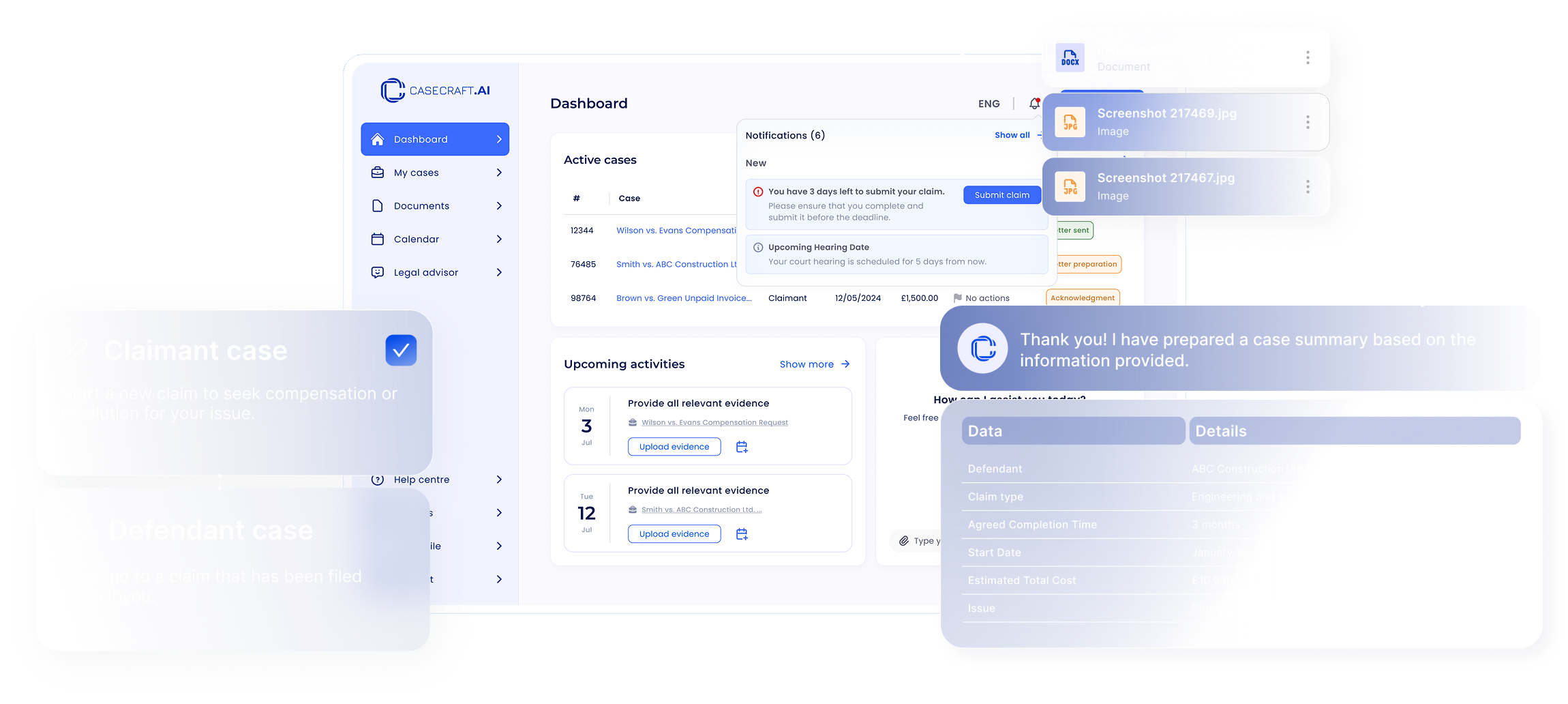
Small claims courts were designed to be user‑friendly, but the reality is that legal paperwork and procedure remain daunting. CaseCraft’s mission is to bridge this gap. The platform combines the expertise of seasoned lawyers with artificial intelligence to make the process accessible and understandable for non‑lawyers. Features include:
- AI‑powered guidance – the platform suggests the correct claim path, assists with evidence preparation and drafts documents that mirror the court’s expectations.
- Intuitive dashboard – manage multiple claims, track progress, upload documents, and view deadlines in one place.
- Smart deadline alerts – automated reminders ensure you do not miss limitation dates or court directions.
- Secure data handling – industry‑standard encryption protects your data in transit and at rest.
- Transparent pricing – a £15 processing fee up front and a 10 % success fee only if your claim is successful.
- Document automation – forms are auto‑filled and letters generated using the information you provide, reducing time and stress.
- Expert‑built – designed by lawyers and tested by legal clinics and law students, the tool reflects real court requirements and practice.

Case Study: Claim for Breach of Contract

A client paid £5,000 for a one-month agreement to use commercial premises but was denied access after just five days. The provider refused to refund the unused period.nnThe claim was filed for fundamental breach of contract and unjust enrichment. When the defendant failed to respond, the court issued a default judgment, granting full recovery including fees and interest.

CaseCraft.AI supports all common types of small money claims
From workplace accidents to road collisions — spinal cord injury claims seek to restore what’s been lost and secure your future care. CaseCraft.AI helps you build a strong claim quickly and affordably, without legal complexity.
Don’t Wait – Get Started Today!
Take the first step toward a faster, easier small claims process with CaseCraft.AI.