

Start a Small Claim Against a Business (UK)
Learn how to start a small claim against a business in the UK. Step-by-step guide to evidence, costs, deadlines, and filing with CaseCraft.AI.


When Can You Start a Small Claim Against a Business?
You can bring a small claim against a business or trader when they owe you money, breached a contract or supplied faulty goods or services. Typical scenarios include:
- Unpaid invoices or withheld wages.
- Goods not delivered or delivered late.
- Services performed poorly or not at all, and deposits were kept unfairly.
- A business refuses to refund you after cancelling a service.
Legally, your claim must be worth £10,000 or less. Claims between £10,001 and £ 25,000 go to the fast track; anything above £25,000 uses the multi‑track. The defendant must be a business, trader or organisation with a UK address for service. You must also attempt to resolve the dispute first. The Practice Direction on pre‑action conduct says you should write to the business with concise details of the claim, including the basis of your claim, a summary of facts and how you calculated the amount owed. Giving the business at least 14 days to respond is considered reasonable.
Before suing, check that your claim is still within the six‑year limitation period for breach of contract or negligence. Time limits run from the date of the breach or when payment became due.
Identify the Right Business
It’s vital to sue the correct legal entity. The defendant’s registered name and service address may differ from their trading name. For limited companies, serve documents at the registered office listed at Companies House. For sole traders, name both the individual and the trading name (e.g., “John Smith trading as QuickFix Plumbing”). Suing the wrong entity can lead to your claim being dismissed, and you could be liable for the other side’s costs.
Pre‑Action Protocol
Most small claims against a business are governed by the Practice Direction – Pre-Action Conduct and Protocols, rather than a specific “business pre-action protocol”. Where no dedicated protocol applies, the court expects parties to exchange sufficient information and make genuine attempts to resolve the dispute before proceedings are issued.
A letter before action (or “letter of claim”) should set out the legal basis of the claim, a brief summary of the facts and evidence, the remedy sought, and a reasonable deadline for response or payment. Failure to comply can lead to procedural or cost sanctions.
The Pre-Action Protocol for Debt Claims is narrower and applies only where a business is seeking payment from an individual, including a sole trader, not to business-to-business claims unless the debtor is a sole trader. CaseCraft.AI automatically generates compliant letters before action, helping ensure your claim meets the correct pre-action requirements.
Who Counts as a “Business” for Small Claims?
When you start a small claim against a business, you can bring a claim against most traders that operate commercially. This includes limited companies, LLPs, sole traders, partnerships, online retailers, professional service firms, commercial landlords and suppliers who provide goods or services for payment.
Before you file, you must confirm the business’s registered address.
Step-by-Step: How to Start a Small Claim Against a Business
When you start a small claim against a business, the court expects you to follow a clear legal sequence. Each stage below builds on the one before it, and missing a step can weaken your case, delay your claim or prevent you from enforcing payment later.
Try to Resolve the Dispute First
Courts expect parties to behave reasonably. Start with a written complaint explaining what went wrong and what you want, whether it’s a refund, replacement or payment. Include invoice numbers, contract details and evidence. Give a clear deadline (usually 14 days) for the business to respond. This step is part of the pre‑action protocol, and failure to follow it can lead to cost sanctions. Use different communication methods (email and phone) and keep records of all correspondence.
Issue a Letter Before Action
If informal communication fails, you must send a formal letter before taking action or continuing with a UK business dispute. This letter must state the business’s full legal name and registered address, explain what went wrong, set out how much you are claiming and how you calculated the figure, summarise the evidence you will rely on, and give the business a clear deadline for payment of at least 14-30 days, longer time frames for more complicated cases.
CaseCraft.AI prepares compliant letters before action automatically, ensuring your claim follows court rules, sets out the legal basis of your case, and formally warns the business that small-claims proceedings will begin if payment is not made.
Gather Evidence
|
Evidence type |
What it proves |
|
Invoices and receipts |
What the business charged, what was owed, and when payment was due |
|
Contracts or terms and conditions |
That a binding agreement existed, and what each side agreed to |
|
Emails, messages and letters |
What was promised, and the steps you took to resolve the dispute |
|
Photographs or videos |
Faulty goods, poor workmanship or incomplete services |
|
Delivery records |
When goods should have arrived and whether deadlines were missed |
|
Bank statements |
Payments made, missing payments or partial refunds |
|
Website screenshots or adverts |
Misleading descriptions, prices or service claims |
File the Claim Online
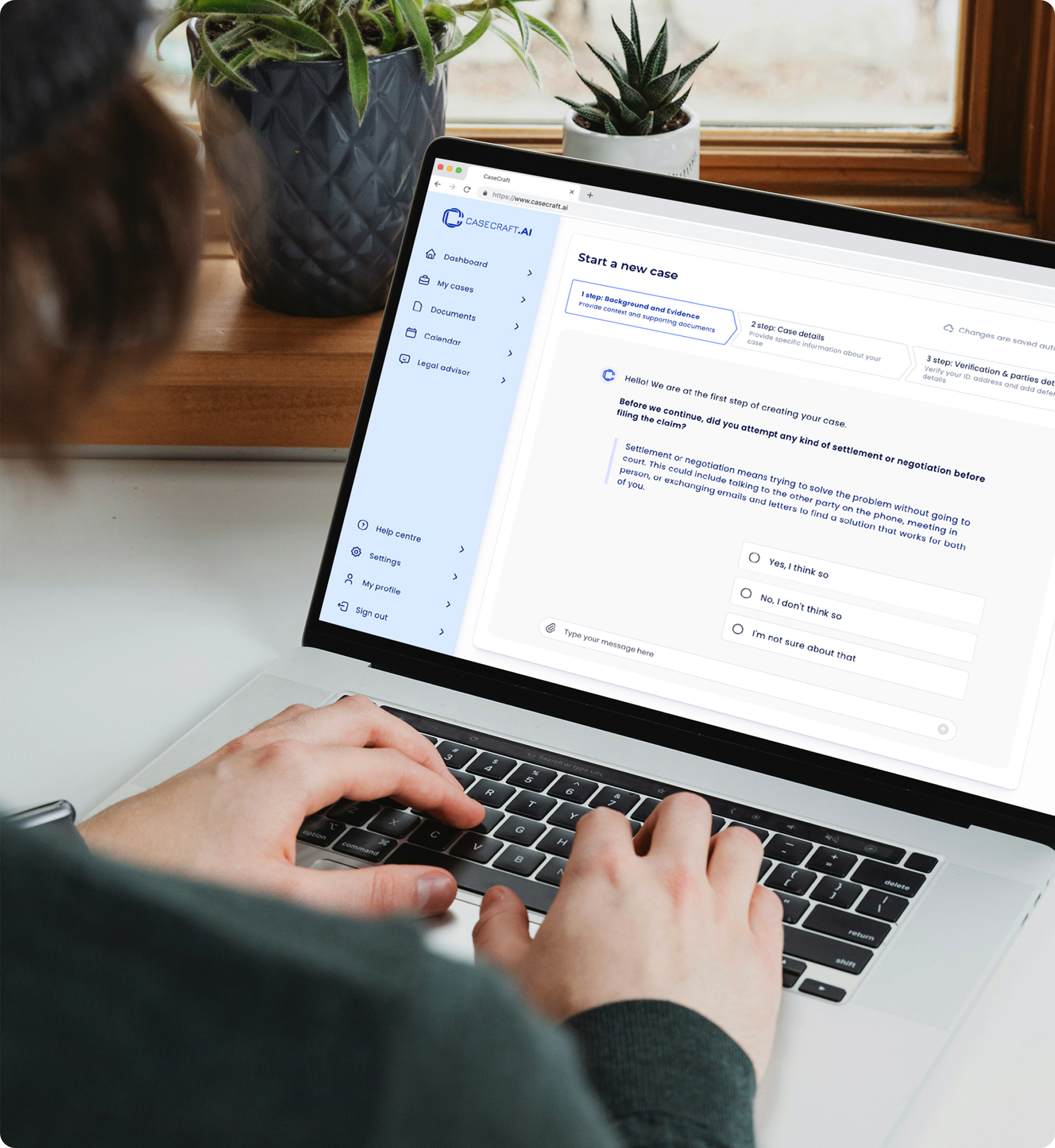
You can file your case through CaseCraft.AI as part of a small claims business dispute. From July 2025, eligible money claims must be submitted online, and paper forms are no longer accepted. You will need the business’s details, a short description of your claim, the amount you are claiming, and a payment method for the court fee. CaseCraft.AI prepares the court forms for you and calculates the correct fee so your claim is filed without errors.
Court fees vary by claim value. For example, claims up to £300 cost £35 to file; claims between £500 and £1,000 cost £70; claims between £5,000.01 and £10,000 cost £455. You pay the fee when filing, but can recover it if you win. CaseCraft.AI completes the court forms for you and calculates the correct fee.
Note: CaseCraft.AI takes a 15% success fee only if you win. This makes it cost‑effective compared with hiring a solicitor.
Wait for the Business’s Response
After you file, the court sends a copy of your claim to the business, and they have 14 days to reply. The business may admit the claim and pay in full, dispute the claim, accept part of the claim and offer a partial payment, or submit a counterclaim saying that you owe them money. If the business does not respond at all, you can ask the court for a default judgment, which allows the court to order payment without a hearing. CaseCraft.AI monitors deadlines and notifies you when to take action, reducing the risk of missing key dates.
Mediation
For claims up to £10,000, the court will refer parties to the Small Claims Mediation Service. For claims up to £10,000, if the defendant disputes your claim, you will be required to attend mediation. The service is free and conducted by telephone. A mediator will speak to each party separately for up to an hour and try to help you reach a settlement. Many disputes are settled at this stage, saving time and avoiding a hearing. If mediation fails, the claim proceeds to a hearing.
Court Hearing
If mediation doesn’t resolve the dispute, the case is listed for a hearing. Small‑claims hearings are informal; a district judge reviews the evidence and listens to both sides before making a decision. The court may ask you to complete a directions questionnaire and pay a hearing fee. Cases allocated to the small‑claims track (under £10,000) usually last less than six months. Official statistics show the median time from claim to hearing was 40.6 weeks in April–June 2025, and 39 weeks in July–September 2025. These figures show that the court is working through claims faster than in 2024.
During the hearing, you can present your evidence and question the business’s witnesses. The judge usually gives a judgment on the day. If you win, the order will specify the amount the business must pay, including any interest and court fees.
Enforce the Judgment
|
Enforcement method |
What it does |
When to use it |
|
Warrant of control (bailiffs) |
Bailiffs write to the business, then visit to seize goods if payment is not made |
When the business has physical assets and is ignoring payment requests |
|
High Court enforcement |
High Court Enforcement Officers use stronger powers to recover money |
For judgments over £600 where fast action is needed |
|
Third-party debt order |
Freezes money held in the business’s bank account |
When you know the business holds funds in a bank account |
|
Charging order |
Secures the debt against the business’s property or land |
When the business owns property but has not paid |
|
Attachment of earnings |
Deductions are taken directly from wages (sole traders) |
When the debtor pays themselves a regular salary |
Common Business Small Claims Scenarios
Small‑claims courts handle a wide range of business disputes. Common scenarios include:
- Unpaid invoice by a client: A freelancer or small business completes work, but the client refuses to pay. You can sue a business in small claims court to recover the outstanding amount, plus interest.
- Retailer refusing a refund: A company refuses to refund you for faulty goods or cancelled orders. You can file a claim against the retailer in the UK if the value is under £10,000.
- Faulty goods sold by a company: You buy equipment that does not work. After giving the business a chance to repair or replace it, you can sue the company.
- Builder or contractor breach: A contractor fails to complete work on time or to the agreed standard. You can start a small claim against a company or sole trader to recover the cost of repairs or a refund.
- Service delivered late or not at all: A service provider misses deadlines or fails to deliver what was agreed. You can claim compensation for the delay or non-delivery.
- Subscription overcharging: A subscription provider continues to take payments after cancellation. You can claim back the overcharged amounts.
- Business-to-business payment disputes: One company fails to pay another for goods or services supplied. A limited company dispute in the UK can be resolved in small claims if the value is under £10,000.
- Deposit not returned: A business keeps your deposit without justification. You can bring a small claim to recover the deposit and any related losses.
How Much Does It Cost to Sue a Business?
You pay a court filing fee based on the amount you’re claiming. The table below summarises common fees for small claims (England & Wales). Fees are recoverable if you win.
|
Claim amount |
Court filing fee* |
|
Up to £300 |
£35 |
|
£300.01–£500 |
£50 |
|
£500.01–£1 000 |
£70 |
|
£1,000.01–£1,500 |
£80–£205 (sliding scale) |
|
£3,000.01–£5,000 |
£205 |
|
£5,000.01–£10 000 |
£455 |
|
£1,500.01 to £3,000 |
£115 |
|
Above £10,000 |
5% of claim value |
These fees are for issuing the claim. Hearing fees may apply if the case goes to trial. CaseCraft.AI’s processing fee is small; the remainder is a 15% success fee payable only if you win.
How Long Does a Small Business Claim Take?
The overall timeline depends on how quickly each stage is completed:
- Pre‑action correspondence: 14–30 days for the business to respond.
- Response period after filing: The business has 14 days to reply.
- Mediation: Usually scheduled within 2–6 weeks after a defence is filed.
- Hearing: Small‑claims hearings are typically held within 3–6 months. Official statistics show the median time from claim to hearing fell to 40.6 weeks in April–June 2025, and 39 weeks in July–September 2025.
- Enforcement: If necessary, enforcement can take another 2–8 weeks, depending on the method used.
CaseCraft.AI tracks these milestones and sends reminders so you never miss a deadline.
What You Can Claim Against a Business?
When you sue a business, you can recover:
- Money owed – unpaid invoices, withheld wages or refunds
- Cost of repairing or replacing faulty goods.
- Refunds for undelivered services or cancelled contracts.
- Additional financial losses caused by the breach (e.g., the cost of hiring another contractor).
- Statutory interest – depends on the nature of the claim. Where the claimant is also a business, the Late Payment of Commercial Debts (Interest) Act 1998 applies. In those cases, interest can be claimed at 8% above the Bank of England base rate, rather than a flat 8%. Businesses may also recover fixed compensation for late payment, with the amount depending on the size of the debt.
- Court fees and fixed costs are recoverable if you win.
You cannot claim for emotional distress or punitive damages; small claims are only for financial loss.
Mistakes to Avoid When Suing a Business
Avoid these common pitfalls:
- Suing the wrong entity: Use Companies House to verify the correct legal name and address.
- Incorrect addresses: Papers must be served at the registered office or principal place of business.
- Skipping the letter before action: Courts can penalise you for ignoring pre‑action protocols.
- Insufficient evidence: Keep contracts, invoices and communications to prove your case.
- Overclaiming: Claim only for actual losses; inflated claims can lead to cost penalties.
- Missing deadlines: Respond promptly to court letters and questionnaires.
Why Use CaseCraft.AI?
CaseCraft.AI is an AI-powered platform built by legal professionals to simplify the small-claims process and help you start a small claim against a business quickly and accurately. It checks company money claim details to ensure you sue the correct legal entity, generates compliant letters before action to meet the business pre-action protocol, and organises your documents into a court-ready evidence bundle.
You pay a small processing fee and only a 15% success fee if you win, with no solicitor needed, and your data is protected with bank-grade encryption.
Start your small claim today. Check the business, prepare your evidence, and generate your legally compliant claim in minutes with CaseCraft.AI.
Friendly Asked Questions
Can I sue a company in small claims court?
Yes. If a company owes you money or damages and the claim is under £10,000, you can sue the business in the small‑claims court. You must follow the pre‑action protocol by sending a letter before action, and provide evidence of the debt.
Do I need a solicitor to sue a business?
No. The small‑claims process is designed to be used without solicitors. You prepare the claim forms yourself or use an AI‑powered tool like CaseCraft.AI to automate documents and track deadlines. Using CaseCraft.AI saves legal fees and ensures compliance with court rules.
What if the business ignores my claim?
If the business does not respond within 14 days of being served, you can apply for a default judgment. The court will order the business to pay without a hearing. You can then enforce the judgment using bailiffs, High Court enforcement, third‑party debt orders or charging orders.
How do I find the correct business name?
Search Companies House for the company’s registered name and registered office. For sole traders, name the individual and the trading name. Serving papers at the correct address is essential. CaseCraft.AI integrates with Companies House to ensure accuracy.
Can I sue a sole trader?
Yes. You can bring a small claim against a sole trader for money owed or damages, provided the claim is under £10,000. Name the sole trader and their trading name (e.g., “Sarah Jones trading as Flower Design”). Serve documents at their place of business or home address.
Can I claim interest and fees?
Yes. You can add statutory interest of 8% per year to the amount owed. Court fees and certain fixed costs can also be claimed and recovered if you win. CaseCraft.AI calculates interest and includes it in your claim.
Case Study: Claim for Breach of Contract

A client paid £5,000 for a one-month agreement to use commercial premises but was denied access after just five days. The provider refused to refund the unused period.nnThe claim was filed for fundamental breach of contract and unjust enrichment. When the defendant failed to respond, the court issued a default judgment, granting full recovery including fees and interest.

CaseCraft.AI supports all common types of small money claims
From unpaid invoices to breached contracts or services not delivered, disputes with businesses can drain time, money, and peace of mind. CaseCraft.AI helps you start a small claim against a business efficiently and affordably, guiding you through the process without complex legal procedures.
Don’t Wait – Get Started Today!
Take the first step toward a faster, easier small claims process with CaseCraft.AI.