

Supply Disputes: Small Claims for Faulty or Delayed Deliveries in the UK
Supplier delivered faulty or delayed goods? Learn your rights under UK contract law and how our small claims service helps resolve supply disputes and recover compensation.


What Are Supply Disputes?
A supply dispute arises when a supplier fails to deliver what was promised. In commercial contracts, this can include:
- Delayed delivery – equipment or raw materials arrive late, causing knock‑on delays and losses in production or projects.
- Faulty deliveries – goods are damaged, defective or not fit for their stated purpose. The Sale of Goods Act 1979 implies that goods must be of “satisfactory quality”, including freedom from minor blemishes and fitness for the intended purpose.
- Partial deliveries or shortages – only part of the order is delivered, forcing the buyer to source substitutes at additional cost.
- Non‑conforming goods – the product delivered does not match the description or specification set out in the contract or purchase order.
- Unpaid invoices – in supply chains, disputes also arise when customers do not pay for goods or services on time. The Late Payment of Commercial Debts Act allows creditors to charge interest and claim fixed compensation on overdue invoices.
For SMEs, these problems disrupt cash flow and customer relationships. Understanding your legal rights helps you negotiate a remedy or pursue a supply dispute claim in the small claims court.
Common Types of Supply Disputes in the UK
Business‑to‑Business Contracts
Commercial supply agreements between manufacturers, wholesalers and retailers frequently give rise to disputes. Typical issues include defective machinery, late delivery of parts, or supplies that do not meet agreed specifications. Because these are B2B transactions, the Sale of Goods Act 1979 and SGSA 1982 continue to govern the implied terms.
Retailer vs. Supplier Disputes
Retailers rely on suppliers to deliver stock on time and to the agreed quality. Delays can cause lost sales, while faulty products can damage customer trust. When suppliers breach their obligations, retailers can reclaim losses and may seek compensation for faulty supply or late delivery through the small claims track.
Late Payment and Unpaid Invoices
SMEs often supply goods or services only to be kept waiting for payment, an invoice dispute in all but name. Late payment legislation allows them to charge interest and claim fixed sums. Filing a small claims business dispute can also recover the unpaid amount and encourage timely payment in future.
Poorly Performing Services
IT support, logistics, construction and other service providers must exercise reasonable care and skill. When projects run over schedule, are negligently executed or deviate from scope, the client can seek a partial refund or damages for breach of contract.
Supply Chain Issues Caused by Third Parties
Sometimes delays occur because a supplier’s own suppliers fail to deliver. Although frustrating, buyers can usually claim against their direct supplier. Clear contract terms and service‑level agreements (SLAs) help to allocate this risk.
Legal Rights under UK Supply and Contract Law
Sale of Goods Act 1979 and Consumer Rights Act 2015
The Sale of Goods Act 1979 (SGA) continues to apply to business‑to‑business (B2B) contracts and older consumer purchases. The Act implies terms into contracts that goods must:
- Match their description and correspond with any sample or model shown.
- Be of satisfactory quality, meaning they must be safe, durable, free from minor defects and fit for their intended purpose.
A House of Commons briefing explains that these implied terms allow buyers to return a defective product or claim damages if it fails to meet the standard. Buyers have six years in England and Wales (five years in Scotland) to bring contractual claims for faulty goods. Where goods were bought after 1 October 2015 by a consumer, the Consumer Rights Act 2015 (CRA 2015) provides similar protections but is outside the scope of typical B2B supply disputes.
Supply of Goods and Services Act 1982
For contracts made before the CRA 2015 came into force or for B2B service contracts, the Supply of Goods and Services Act 1982 (SGSA) implies that service providers will perform their services with reasonable care and skill and within a reasonable time if no completion date is fixed. Goods supplied under the contract must be of satisfactory quality and fit for purpose. If these terms are breached, the customer may terminate the contract or claim damages. Unlike consumer law, these rights cannot be excluded from B2B contracts and apply even where the agreement is unwritten.
Late Payment of Commercial Debts (Interest) Act 1998
Late payment of invoices is a significant problem for SMEs. The Late Payment of Commercial Debts Act 1998 gives suppliers a statutory right to interest and compensation when another business pays late. A government‑backed resource on the Pay On Time site notes that the Act allows creditors to claim interest at 8% above the Bank of England base rate on overdue payments and to add fixed compensation of £40 on debts under £1,000, £70 for debts between £1,000 and £9,999 and £100 on debts over £10,000. Amendments in 2002 enabled businesses to recover reasonable debt‑recovery costs, and changes in 2013 introduced payment terms of 60 days for private companies and 30 days for public sector buyers.
Civil Procedure Rules and the Small Claims Track
Claims for faulty deliveries, unpaid invoices, poor workmanship, or an unpaid supply contract claim often fall below £10,000. Under the Civil Procedure Rules, these cases are normally allocated to the small claims track. Rule 26.9 and Part 27 provide that the small claims track is the default route for claims with a financial value not exceeding £10,000. Personal injury and housing disrepair claims have lower thresholds, but most commercial supply disputes are well within the £10,000 limit. The small claims track is designed to be accessible without solicitors; legal costs recoverable from the losing party are limited, making it cost‑effective for SMEs.
Steps to Take Before Legal Action
Before launching a small claims supply dispute, businesses should follow good practice. Courts expect parties to attempt resolution and may penalise unnecessary litigation.
Check the contract and invoices
Review the purchase order, supply agreement and any terms and conditions to confirm what was promised and whether deadlines were binding. The implied terms under the SGA 1979 and SGSA 1982 apply unless expressly excluded in a B2B contract.
Collect evidence of breach
Keep delivery notes, photos of defective goods, copies of email correspondence and records of financial losses. Evidence is essential to demonstrate breach and quantify your claim.
Calculate your losses
Consider the cost of replacement goods, any consequential losses caused by delays and statutory interest under the Late Payment Act. Keep receipts and records to justify your figures.
Send a formal complaint or ‘letter before claim
The Civil Procedure Rules require you to notify the other party of the dispute and give them a chance to put things right. Set out the facts, the legal basis for your claim and the remedy sought (e.g., refund, replacement or compensation). Give a reasonable deadline for a response and state that you will issue proceedings if the matter is not resolved.
Consider mediation or negotiation
Court action should be a last resort. Many suppliers will negotiate a replacement delivery, credit note or partial refund to preserve the relationship. For disputes under £10,000, free or low‑cost mediation services are available, and from 2024, mediation is mandatory for most small claims.
When to Use Small Claims Court for Supply Disputes
The small claims court (part of the County Court) is appropriate where:
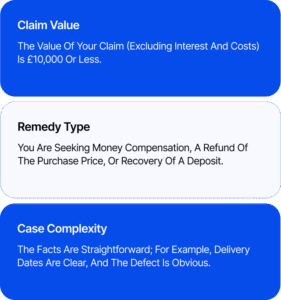
- Claim Value. The value of your claim (excluding interest and costs) is £10,000 or less.
- Remedy Type. You are seeking money compensation, a refund of the purchase price, or recovery of a deposit.
- Case Complexity. The fact are straightforward; for example, delivery dates are clear, and the defect is obvious.
5How CaseCraft.AI Helps Resolve Supply Disputes
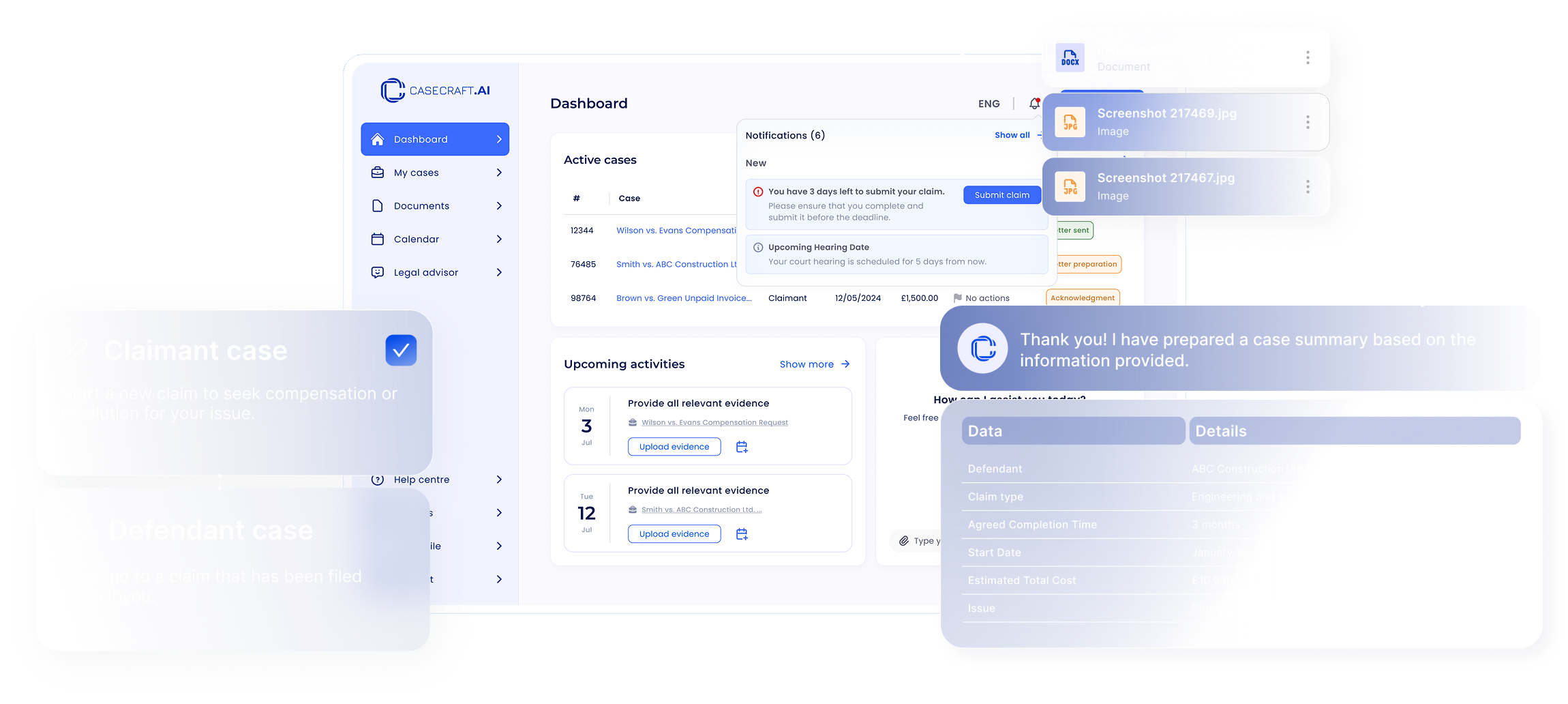
CaseCraft.AI is a UK‑based platform that uses artificial intelligence to simplify the small claims process. Its website explains that the service automates legal tasks, from drafting court‑ready documents to tracking deadlines. Users answer simple questions about their case, and the system handles paperwork and compliance checks. Key features include:
- Eligibility check. Casecraft.AI’s built‑in tool confirms whether your dispute qualifies for the small claims track within minutes.
- Wide range of claim types. The platform supports disputes over unpaid invoices, contract breaches, defective goods and professional service disputes.
- Fixed fee and success‑based pricing. Users pay a £15 setup fee and a 15% success fee only if their claim succeeds. There are no subscriptions or hidden charges.
- No legal expertise required. The platform is designed for non‑lawyers; it offers plain‑English explanations and step‑by‑step guidance so that you can manage your claim from start to finish.
- Pre‑action letters and settlement offers. CaseCraft.AI prepares pre‑action letters, structured settlement offers and evidence packs to help reach an out‑of‑court resolution.
- Out‑of‑court settlement support. The platform helps prepare settlement offers and encourages negotiation before commencing proceedings.
- Enforcement assistance. If you win but the defendant doesn’t pay, CaseCraft.AI provides guidance on enforcement actions such as using bailiffs, charging orders or attachment of earnings.
- Security and compliance. Data is secured with bank‑grade encryption, and the platform is regulated by the Solicitors Regulation Authority.
These features make CaseCraft.AI attractive for SMEs that need to bring a claim for faulty goods delivery, delayed delivery compensation or recover an unpaid commercial invoice without spending on legal fees.
Why Choose CaseCraft.AI for Your Supply Dispute Claim
CaseCraft.AI offers several advantages over traditional approaches:
- Expertise in commercial small claims. The platform’s templates and guidance are tailored to common disputes such as unpaid B2B contracts, faulty deliveries and breach of contract claims. You do not need to search for the correct form or worry about procedural pitfalls.
- Time savings. The automated system prepares court‑ready documents in minutes. You can file your claim online without printing or posting forms, and the platform tracks deadlines so you never miss a filing date.
- Transparent costs. With a low processing fee and a success‑based commission, you only pay when your claim succeeds. This removes the uncertainty of hourly legal rates and helps SMEs manage cash flow.
- Support from start to finish. CaseCraft.AI guides you through the evidence gathering, pre‑action protocols, claim filing and enforcement stages. If the other side proposes a settlement, the platform can calculate whether the offer is fair.
- User‑friendly interface. The questions are written in plain English, and the system supplies examples, making the process accessible even if English is not your first language.
By combining these features, CaseCraft.AI acts almost like a virtual paralegal, letting you focus on running your business while the platform handles the procedural and administrative aspects of the small claims supply dispute.

Preventing Future Supply Disputes
While small claims court offers a remedy, prevention is better than a cure. SMEs can reduce the risk of disputes by:
- Drafting clear contracts. Include detailed specifications, delivery dates, price terms and quality standards in your contracts. Incorporate service‑level agreements (SLAs) and payment terms that state when invoices are due and what happens if they are late.
- Including penalties and interest clauses. Specify that late payments will attract interest at the statutory rate plus fixed compensation, as allowed by the Late Payment Act.
- Maintaining good communication. Keep a record of all correspondence with suppliers. Confirm changes to orders in writing and circulate meeting notes after discussions.
- Choosing reliable suppliers. Conduct due diligence on potential suppliers. Check references, financial stability and track record before signing contracts.
- Monitoring performance. Regularly review delivery times, quality and service levels. Address issues promptly rather than letting them fester.
Real‑Life Examples of Supply Disputes We Handle
At CaseCraft.AI, we assist numerous SMEs with resolving supply disputes. Examples include:
- The engineering business awaits critical components. A small engineering firm ordered specialised parts, but delivery was delayed by three weeks, causing project overruns. The firm used CaseCraft.AI to send a pre-action letter and subsequently filed a small business claim for late delivery, seeking compensation for lost profit and additional labour costs. The supplier settled before the hearing.
- Boutique retailer delivered sub‑standard stock. A retailer received a consignment of handbags that were poorly stitched and not as described. Under the Sale of Goods Act, the goods were not of satisfactory quality. CaseCraft.AI’s system helped the retailer prepare a faulty deliveries claim and request a refund plus damages. The claim was settled through mediation.
- Consultant owed unpaid fees. An independent consultant provided marketing services to another business, but the invoice remained unpaid. By using CaseCraft.AI to claim statutory interest and compensation under the Late Payment Act, the consultant recovered the debt along with £70 compensation for debt recovery costs.
- Supplier breach of contract (delivery specification). A café ordered bespoke furniture but received tables of the wrong dimensions. The café documented the discrepancy, notified the supplier and used CaseCraft.AI to file a breach of contract claim. The court awarded a refund plus costs for sourcing replacement furniture.
Resolve Supply Disputes Fast with UK Law and CaseCraft.AI
Legal help for supply disputes is an unavoidable part of doing business, but UK law provides robust remedies. The Sale of Goods Act 1979 and Supply of Goods and Services Act 1982 ensure that goods and services meet a minimum standard. The Late Payment of Commercial Debts Act 1998 allows businesses to recover interest and compensation on overdue invoices. For claims under £10,000, the small claims track offers a low‑cost route to justice with simplified procedures.
Digital platforms like CaseCraft.AI make the process even more accessible by automating paperwork, offering plain‑language guidance and charging only when you win. By understanding your rights, documenting breaches and using modern tools, SMEs can resolve supply disputes efficiently, recover their losses and focus on growth.
Friendly Asked Questions
What exactly is a “supply dispute” in UK small claims?
What claim values qualify for the small claims track?
In England & Wales, money claims up to £10,000 normally go to the small claims track (with special caps for PI and housing disrepair).
Is mediation now compulsory before a small-claims hearing?
Yes. For money claims up to £10,000 issued on/after 22 May 2024, parties are automatically referred to a free, one-hour Small Claims Mediation Service session.
What can I claim for a faulty or delayed delivery?
You can seek the price/refund for faulty goods, reasonable repair/replacement costs, and other foreseeable losses flowing from breach; for services, the benchmark is “reasonable care and skill” and performance within a reasonable time if none is fixed.
How does CaseCraft.AI fit into the small-claims process?
CaseCraft.AI guides you end-to-end with eligibility checks, pre-action letters, document generation, and evidence packs, and charges a £15 setup and a 15% success fee only if you win, no separate hearing fee.
Case Study: Claim for Breach of Contract

A client paid £5,000 for a one-month agreement to use commercial premises but was denied access after just five days. The provider refused to refund the unused period.nnThe claim was filed for fundamental breach of contract and unjust enrichment. When the defendant failed to respond, the court issued a default judgment, granting full recovery including fees and interest.

CaseCraft.AI supports all common types of small money claims
From late deliveries to faulty goods or cancelled orders supply disputes can disrupt your business and cost you money. CaseCraft.AI helps you recover losses through small claims quickly and affordably, ensuring every step is compliant and hassle-free.
Don’t Wait – Get Started Today!
Take the first step toward a faster, easier small claims process with CaseCraft.AI.