

Taxi Accident Compensation Claims Guide
Learn how taxi accident claims work in the UK, eligibility rules, compensation examples, and when to seek legal advice.


What Is A Taxi Accident Claim?
When lawyers talk about how to make a taxi accident claim, they’re simply describing a process that helps to put you back, financially speaking, where you were before the crash. You might be a passenger, the driver of the cab, a pedestrian or even another motorist. You need to show two key things: that someone owed you a duty of care and that their breach of that duty caused your injury.
Imagine your taxi driver checks a text message and rear‑ends a parked car; by failing to pay attention, they have broken their duty. If you injure your neck in the resulting collision, you have a valid claim.
Types of Compensation
Compensation is split into two broad categories:
- General damages recognise the pain, suffering and loss of enjoyment you experience after an accident. These are the intangible parts of your life, sleep disrupted by headaches, hobbies you can’t enjoy and time lost with family.
- Special damages, on the other hand, reimburse you for measurable losses such as medical expenses, lost wages, taxi fares you can’t cover due to injury and the cost of repairing or replacing damaged property. When you hear about people receiving large payouts, it’s often because their special damages include long‑term care or future loss of earnings.
Different Types of Claims
- Passengers – Taxi drivers must take reasonable care of their passengers. If your driver was speeding, running red lights, driving while tired or otherwise acting negligently, you can bring a taxi passenger accident claim. Likewise, you can claim if another vehicle collides with your taxi.
- Drivers – Taxi drivers can also be victims. If another motorist hits you, you can make a taxi driver accident claim. If the at‑fault driver flees the scene or has no insurance, compensation may come from the Motor Insurers Bureau (MIB).
- Pedestrians and cyclists – Anyone injured by a negligent taxi driver, whether you were on foot, on a bike or driving another car, can pursue compensation. Even if you were partly at fault, you may still recover something; courts often apportion blame and reduce awards accordingly.
- Seatbelt issues – Not wearing a seatbelt doesn’t bar you from claiming. Courts usually reduce awards by 15% to 25% depending on how much a seatbelt would have reduced your injuries. This deduction reflects contributory negligence, not an outright ban on recovery.
Small‑Claims Eligibility
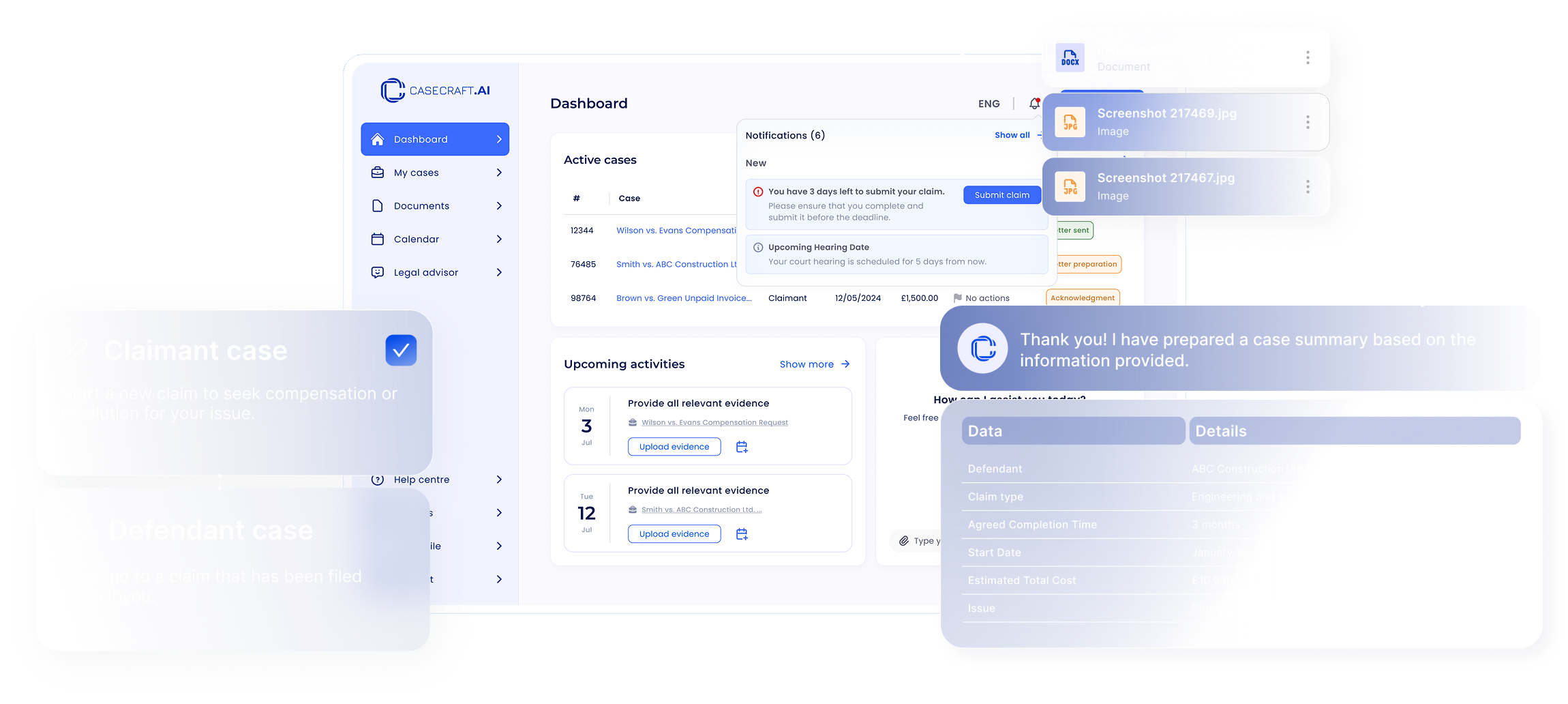
Reforms introduced on 31 May 2021 changed how smaller road‑traffic injury claims are handled. Small‑claims cases are designed to be simple; you usually cannot claim back your legal fees, and you may not need a solicitor. CaseCraft.AI’s dashboard can help you organise your documents, keep track of deadlines and understand the procedure. Just remember that even in small claims, you must provide evidence of your injuries and losses. Without medical reports and receipts, you won’t succeed.

Common Causes Of Taxi Accident Claims
Accidents rarely occur in a vacuum. They are usually the product of human error, mechanical failure or hazardous road conditions. Understanding why your accident happened helps identify who is liable and what evidence you’ll need.
Driver error
The most common cause of taxi accidents. Speeding, using a mobile phone, driving under the influence, fatigue and ignoring traffic signs all increase crash risk. Many cabbies work long hours, which can lead to lapses in concentration and slower reaction times.
Vehicle malfunction
Taxis rack up high mileage. Worn tyres, faulty brakes or neglected maintenance can cause a vehicle to lose control. When mechanical issues contribute to a crash, the taxi company may share liability for failing to keep its fleet roadworthy.
Poor road conditions
Potholes, uneven surfaces, ice, rain and obscured signage create dangerous environments. If a local authority knew about a hazard and failed to fix it, it could be held responsible.
Other motorists
Not every taxi crash is the driver’s fault. Another driver may run a red light, swerve into your lane or tailgate. In those cases, injured passengers and taxi drivers can claim against the other driver’s insurer.
Specific Accident Scenarios
Collision With A Taxi Where The Third‑Party Vehicle Driver Is At Fault
If another motorist slams into your taxi, your claim is usually against that driver’s insurance. Examples include drivers pulling out without looking, weaving between lanes or braking suddenly. When the at‑fault driver is uninsured or disappears after the accident, the MIB steps in to compensate victims.
Road Traffic Collisions Where The Taxi Driver Is Liable
When a taxi driver causes an accident by speeding, texting or driving recklessly, injured passengers, pedestrians and other road users have a right to compensation. If poor maintenance contributed, for example, if the taxi had bald tyres or faulty brakes, the company that operates the vehicle may also be liable.
Taxi Passenger Injuries Due to Not Wearing Seatbelts
Most passengers are required to wear seatbelts by law, and if they do not, then it may affect a claim. Not wearing a seatbelt does not prevent you from making a claim. Courts typically apply a deduction of 15% – 25% of your compensation if evidence shows that a seatbelt would have avoided or reduced your injuries.
Taxi Passenger Injury Caused by Losing Grip on the Road
On occasion, a taxi may be unable to grip the road due to wet leaves, oil or ice. If a taxi is speeding too fast for the conditions or ignoring the conditions, at times, a driver may be liable. If the surface of the road is dangerous and the authority is aware of and has negligently failed to repair the situation, there may be ground for a claim against the body charged with repairing the road. Fleet operator liability also exists under the Road Traffic Act 1988 (section 40A) and common law. If vehicle maintenance was negligent, the hirer/operator may be vicariously liable.
Pedestrian Struck By A Taxi
Pedestrians are some of the most vulnerable road users. Taxi drivers need to be prepared for people crossing at junctions, getting out from behind parked cars or navigating busy high streets. If a driver does not keep a proper lookout, exceeds the speed limit while passing crossings, or drives too close to the pavement, they will be liable for any injuries caused to a pedestrian. Even if you were jaywalking or crossing against the light, you may still receive reduced compensation because drivers owe a higher duty of care to pedestrians.
Hit And Run Accidents
If you’re involved in a road accident, whether it causes injury, property damage, or involves livestock, you must stop, share your details, or, if that’s not possible, report to the police within 24 hours per Section 170 of the Road Traffic Act 1988.
Failing to stop or report is no minor slip; courts can hand down up to six months in jail, large fines, add 5–10 penalty points to your licence, and potentially disqualify you from driving.
Not stopping raises red flags about your intentions, drugs, drinking, or worse. The law takes it as a serious breach of responsibility.
Money‑Only Claims vs Personal‑Injury Claims
It’s easy to confuse a taxi accident claim with other types of disputes, especially if you’ve come across CaseCraft.AI. It is designed for money-only claims such as unpaid invoices, consumer disputes or damaged property. The Money Claims Map confirms that personal-injury cases require medical evidence and expert valuation, so they fall outside their self-service model. Think of it this way: if a builder hasn’t paid you for materials, that’s a money claim. If you’ve got whiplash after a taxi crash, that’s a personal injury claim. You need more than a digital form; you need evidence, witness statements and often the guidance of a solicitor.
While CaseCraft.AI’s platform can help you organise documents and understand the basic court process, it cannot lodge or argue a taxi accident claim on your behalf. For injury matters, you should speak to a specialist solicitor or legal adviser. They can give nuanced advice, calculate compensation based on your specific injuries and negotiate with insurers.
Time Limits
In England as well as Wales, a personal injury claim usually has a three-year limit from the accident date for a start to court action. This time frame might be extended in some instances, like being a minor when it occurred (time begins at age 18) or lacking mental ability (time stops until ability returns).
For most adults injured in a taxi-related road-traffic accident on or after 31 May 2021, you can use the Official Injury Claim (OIC) portal to pursue a small-claims process if:
- The injury element of your claim is valued at £5,000 or less.
- The total amount of your losses is £10,000 or less than that amount, with injury included, along with other costs.
Some claimants do not meet the OIC route criteria. This includes anyone classed as a vulnerable road user for sure. A pedestrian, a cyclist, a motorcyclist, a horse rider or a mobility scooter user are examples of this. In these cases, the personal injury small-claims limit remains £1,000. You still may recover certain legal costs when your case proceeds beyond the small-claims track.
Common Injuries From Taxi Accidents and Compensation
Taxi accidents can cause a wide range of injuries. Recovery time, as well as the severity of the injuries, will dictate the scope of your compensation.
- Whiplash – For most taxi-related road traffic accidents, compensation for whiplash is set by law under the Whiplash Injury Regulations. The exact amount depends on how long symptoms last and whether there’s a minor psychological injury alongside the physical one. As of 31 May 2025, all tariff bands have been increased by 15%. For the current official table of amounts, see the Ministry of Justice whiplash tariff.
- Soft tissue injuries – Sprains, strains and bruises to muscles and ligaments can be painful and disabling. Compensation reflects the pain and disruption to your daily routine. Short-term cases may fall under small-claims, but longer-lasting injuries may exceed the £5,000 personal injury cap.
- Psychological trauma – Apart from physical injuries, many individuals experience anxiety, depression, or post-traumatic stress after a serious accident.
There are a number of factors that can determine the final figure: how serious and long‑term your injuries are, how your earning capacity has been affected, whether you need continuing care, and whether you contributed to your injuries by not wearing a seatbelt. A solicitor will take these into account and negotiate with the insurers to obtain a settlement that is pertinent to you.
The small-claims track for most road-traffic accidents only covers injury claims worth £5,000 or less (with total damages under £10,000). More serious injuries, like fractures, significant head trauma, or severe PTSD, are not small-claims matters and usually require specialist legal representation.
Considerations Influencing Compensation
Compensation is not determined in a vacuum. Lawyers will consider a number of issues:
- Severity of injury – The more severe or permanent the injury, the higher the compensation.
- Loss of income – If you have had to take time off work and cannot return to the same job, this increases the value of your claim.
- Cost of medical treatment – Costs for surgery, physiotherapy, medication and travel to appointments are added to your special damages.
- Care provided by family and friends – You can value the time your loved ones spent caring for you and include this in your claim.

Taxi Accident Compensation Calculator
You may be interested in using an online compensation calculator. They provide estimations based on the type of injuries sustained and how long the injuries have lasted, but this information will not consider the particulars of your case. These calculators will use generic terms – such as a calculator that uses contributory negligence, long-term care, or psychological effects – which an online calculator will not assist you with.
Online calculators can only be used as a guide – if you want a more accurate compensation range, seek the advice of a professional who is familiar with the current Judicial College Guidelines, and they can explain the guidelines in your case.
Making A Claim For A Taxi Accident: Step By Step
No two case situations are ever the same; however, most taxi accident claims follow a similar process. We have provided you with this practical step-by-step guide:
1 – Take Care of Your Health
If anyone is seriously injured, move to safety and summon emergency services. If your injuries are not serious, go to see your GP or go to the hospital. Medical notes and expert reports will be the backbone of your claim.
2 – Collect Evidence
If you collect strong evidence, you will have a stronger claim. Try to collect as much evidence as possible.
- Photographs of the scene, showing damage to the vehicle, road conditions and weather, any skid marks, and traffic signs.
- Contact and insurance details from the taxi driver and any other drivers.
- Names and numbers for witnesses and the attending police officers.
- Medical reports, receipts for treatment, taxi fares and repair bills.
- Dash‑cam or CCTV footage, if available.
3 – Contact the Taxi Company and Insurers
Inform the taxi operator and your own insurer about the accident as soon as possible. If you take too long to report the accident, you are likely to breach your policy terms and endanger your claim.
4 – Determine How You Want to Pursue Your Claim
Next, you will need to determine which option best fits your situation:
- Small-claims court – The small-claims track is likely to be appropriate if your total losses are less than £10,000 and the injury element is below £5,000. You normally do not have to recover your legal costs, but there are platforms like CaseCraf.AI that will assist you in document preparation and tracking dates.
- Personal injury claim with a solicitor – If you have a higher-value case or there are more complex elements, you may want to instruct a solicitor. Many solicitors work on a no-win, no-fee basis, and you will not have to pay anything unless your claim is successful.
- MIB claim – Claims via the Motor Insurers’ Bureau must be lodged within three years of the accident, which aligns with the general personal injury claim timeframe. In cases involving an untraced driver, you must report the accident to the police within 14 days of it occurring (unless there’s a valid reason you couldn’t). Missing either deadline could result in your claim being rejected.
5 – Negotiate and Settle
With liability being established, the insurer for the other party will often put forward an initial offer. Do not accept the first number without knowing both your injuries and future needs, and how to assess claims. A solicitor can determine whether offers are too low and negotiate a fair and reasonable settlement for you. Most claims settle without the need for court.
6 – Attend Court, if Needed
If you are unable to agree on a settlement, the case may proceed to a hearing. Don’t panic, the majority of personal-injury hearings are not complicated at all. The judge must assess the evidence and determine liability and damages. You will not be left alone to navigate this process; your solicitor will do the questioning, submissions, and questions for you.
Can a Taxi Driver Claim Accident Compensation?
Yes. Taxi drivers injured through someone else’s negligence can bring a taxi driver accident claim. They claim against the at‑fault driver’s insurer, or through the MIB if that driver is uninsured or untraceable. If you drive a cab, collect as much evidence as possible: dash‑cam footage, passenger details, photos of the scene and a copy of the police report.
Notify your insurer promptly and seek legal advice before dealing with the other party’s insurer. Your passengers may need to make separate claims against the same at‑fault driver.
Moving Forward After a Taxi Accident
Cabs are meant to be stress-free; however, accidents can cause a typical cab ride to become something that changes a person’s life. Using digital tools like CaseCraft.AI is great when you are looking to document your paperwork for small money disputes, but it cannot replace access to professional advice for serious personal injuries. Understanding who is liable, how to gather the best evidence, and being aware of your time limits are all vitally important to engage in a successful personal injury claim.
Take care of your health, gather what you need to gather and do not worry about consulting a solicitor. With support, you are able to recover compensation for the impact on you personally, emotionally and financially.
Case Study: Claim for Breach of Contract

A client paid £5,000 for a one-month agreement to use commercial premises but was denied access after just five days. The provider refused to refund the unused period.nnThe claim was filed for fundamental breach of contract and unjust enrichment. When the defendant failed to respond, the court issued a default judgment, granting full recovery including fees and interest.

CaseCraft.AI supports all common types of small money claims
From minor collisions to serious passenger injuries — taxi accident claims aim to secure fair compensation for the harm and losses you’ve suffered. CaseCraft.AI helps you manage every step quickly and affordably, without legal complexity.
Don’t Wait – Get Started Today!
Take the first step toward a faster, easier small claims process with CaseCraft.AI.