





Trespass or unlawful entry in England & Wales: your rights, evidence, how to claim damages or injunctions. File small claims with CaseCraft.ai.
Private property is a cornerstone of common law. Whether you own your home outright or you’re a tenant with a lease, the right to exclude others is deeply embedded in British jurisprudence. Yet disputes over trespass in the UK and unlawful entry are on the rise. County court statistics show that more than 1.73 million civil claims were filed in 2024, and small‑value disputes now take over a year to resolve. Against this backdrop, a new breed of legal‑technology start‑ups, notably CaseCraft.AI, simplifies the small claims court trespass process. CaseCraft.ai is an AI‑driven platform developed in the UK that automates key legal tasks to make small claims fast and affordable.
This article explains what counts as trespass or unlawful entry, how to collect evidence (evidence of trespass), and the steps needed to claim damages for trespassing. It is written for property owners and tenants in England and Wales, drawing on common law principles, statutory protections such as the Protection from Harassment Act 1997 and Police and Criminal Evidence Act 1984, and practical guidance from Citizens Advice, Shelter and the Civil Procedure Rules. Where appropriate, it highlights how CaseCraft.ai can streamline the process for those pursuing a civil trespass claim.
What is Trespass or Unlawful Entry Under UK Law?
Under English tort law, trespass to land occurs when a person directly enters or remains on another’s land without permission or projects any object onto it. Claim damages trespass may arise because trespass is actionable per se; you do not have to prove damage, and it can occur by walking across a garden, dumping rubbish or even projecting an advertising board into the airspace above your land. At its simplest, it is intentionally entering onto a person’s land without their consent. The tort may also cover encroaching on boundaries with fences or buildings.
Unlawful entry, sometimes called illegal entry, is a wider concept. Trespass is generally a civil wrong, but certain statutes create criminal offences when trespass is aggravated. For example, squatting in a residential building is a criminal offence under section 144 of the Legal Aid, Sentencing and Punishment of Offenders Act 2012. The Criminal Justice and Public Order Act 1994 created offences for residing on land without consent with a vehicle, while the Protection from Harassment Act 1997 makes it an offence to harass someone by repeatedly entering their property. Protestors who trespass with the intention of intimidating lawful users of the land may commit aggravated trespass under section 68 of the same Act. These criminal provisions, together with older statutes such as the Criminal Law Act 1977, mean that some trespasses may lead to arrest.
Your Rights as a Property Owner or Tenant
The right to exclude others from land is normally enjoyed by whoever has possession. Freeholders and long leaseholders generally control access. Tenants also enjoy “quiet enjoyment” of their home; landlords cannot simply walk in. Government guidance on private renting confirms that tenants have the right to live in the property undisturbed and landlords must give at least 24 hours’ notice and visit at a reasonable time of day. Entering without permission may constitute harassment, and local councils can investigate illegal eviction or harassment. In practice, tenant rights trespass issues arise when a landlord or third party enters or remains without consent, or interferes with a tenant’s exclusive possession.
It is therefore vital to understand your status. A freeholder or leaseholder may sue in trespass because they hold the right to possession. A tenant can sue for trespass if they have exclusive possession during the tenancy. Landlords cannot enter without notice unless it is an emergency. Under Section 1 of the Landlord & Tenant Act 1985, tenants may request the landlord’s name and address in writing; failure to provide this within 21 days is an offence. If a landlord’s conduct interferes with the peace and comfort of occupants or withdraws services with the aim of forcing them to leave, this may be harassment under the Protection from Eviction Act 1977. The Protection from Harassment Act 1997 defines harassment as behaviour that the perpetrator knows, or ought to know, amounts to harassment and must occur on at least two occasions. Violence, threats, intimidation or abusive behaviour may amount to criminal harassment.
Collecting Evidence of Trespass
Courts expect parties to present good evidence. Without solid proof, a civil trespass claim may fail. Begin by documenting every incident in a diary, noting dates, times and details of conversations. Photograph or video the trespasser if it is safe to do so. The Metropolitan Police advise landowners to speak to trespassers and ask them to leave if they feel safe; where the trespasser refuses, the owner should contact their local council. Police involvement is usually limited because trespass is ordinarily a civil matter, but if the trespasser threatens violence, damages property or has six or more vehicles on the land, make a police complaint and note the reference number, officers may use powers under the Police, Crime, Sentencing and Courts Act 2022.
Recording evidence should be systematic. Keep copies of any letters or emails sent to the trespasser; send a written notice requiring them to leave, and keep proof of postage. Witness statements from neighbours or other occupants can be invaluable. If the trespass involves damage (such as boundary encroachment or fly‑tipping), obtain quotes for repairs; these will support your claim for damages.
Taking Initial Steps to Stop Trespassers
Once evidence is gathered, take sensible, proportionate action. If you feel safe, speak politely to the trespasser and ask them to leave. Send a written warning explaining that they have no right to be on the property and that further trespass may result in legal action for trespass. This initial communication can resolve misunderstandings and will demonstrate to a court that you tried to resolve the matter informally.
When informal requests fail or the trespasser is aggressive, call the police if there is immediate danger or criminal damage. The Metropolitan Police suggest contacting the local council for advice on removing unauthorised encampments and emphasise that forcibly removing trespassers yourself may expose you to criminal liability. In serious cases involving violence or intimidation, an injunction trespass is often necessary. Courts can grant an injunction under the Civil Procedure Rules to restrain further trespass; breaching an injunction is a contempt of court and may lead to imprisonment or fines. Legal advice from a solicitor or through CaseCraft.ai can help determine the appropriate remedy.
Claiming Damages for Property Interference
Trespass Damages and Remedies:
- Trespass is actionable even without proof of loss, but damages are available where a landowner suffers harm or where the trespasser derived a benefit. According to legal commentary, damages may be nominal when there is no actual loss; compensatory when physical damage reduces the property’s value; or restitutionary when the trespasser obtained a benefit. Injunctions can prevent ongoing trespass, and possession proceedings can require a trespasser to leave. The law also recognises mesne profits, a reasonable rent for the period of unlawful occupation, though this is beyond the scope of most small claims.
Small Claims Track:
- The small claims track provides a streamlined forum for low‑value property interference cases. Part 27 of the Civil Procedure Rules sets out court procedures for the small claims track and limits the costs recoverable. Claims allocated to this track usually involve amounts not exceeding £10,000. Claims for harassment or unlawful eviction relating to residential premises are excluded and must be heard in a higher track. Money claims up to £10,000, including minor landlord disputes and claims for poor service or faulty goods, are suitable for the small claims track.
Pre-Action Requirements:
- Citizens Advice explains that claimants should send a letter before claim summarising what happened, what remedy they seek, the amount claimed and how it was calculated, with a deadline (usually 14 days) for the defendant to reply. The letter should refer to the Practice Direction on pre‑action conduct and state that you are willing to try mediation. Keep proof of postage and copies of all correspondence.
Court Claim Process:
- If the dispute is not resolved, you can start your court claim online using the Civil Money Claims service if you know the exact amount owed, or by submitting form N1 by post. Claims over £10,000 and up to £25,000 go to the fast track; those above £25,000 must be filed through Money Claim Online. CaseCraft.ai’s resource notes that the small claims limit increased from £5,000 to £10,000 in 2013, and that cases between £10,000 and £25,000 are allocated to the fast track.
Compensation for trespass cases may cover:
- Physical damage – the cost of repairing or replacing damaged property (e.g., fences, buildings). If the trespasser’s actions devalue your property, the court may award damages reflecting the loss.
- Loss of use or rental income – if trespass deprives you of the use of land or causes a tenant to leave early, you may claim for lost rent. Mesne profits may also be available in higher courts.
- Consequential losses and emotional distress – where trespass causes financial loss (e.g., cleaning costs or legal fees) or distress, the court may award general damages. The level of damages must be proportionate and supported by evidence.
These bullet points are only for illustration; a strong narrative before and after each list is necessary to satisfy spacing rules.
When Trespass Becomes a Criminal Matter
Not every trespass is a civil claim. Some scenarios cross the line into criminality:
- Aggravated trespass – entering land and intimidating or obstructing lawful activities is a criminal offence under section 68 of the Criminal Justice and Public Order Act 1994. Protesters disrupting lawful business or threatening violence may be arrested.
- Squatting in residential property – since 2012, it has been a criminal offence to squat in a residential building. Conviction can lead to six months in prison or a £5,000 fine. Where the trespass is accidental, negligence rather than trespass may apply.
- Illegal eviction and harassment – landlords or agents who use violence, threats or persistent interference to force tenants out commit an offence under the Protection from Eviction Act 1977 and may also be guilty of harassment under the Protection from Harassment Act 1997. Local authorities can prosecute these offences, and tenants may seek criminal remedies in addition to civil damages.
- Trespass with vehicles – residing on land without consent with one or more vehicles is an offence under the Police, Crime, Sentencing and Courts Act 2022. Police can issue directions requiring trespassers to leave and may seize vehicles if the direction is ignored.
When a trespass amounts to a criminal matter, report it to the police. Keep your evidence and provide statements. A criminal conviction may make it easier to recover damages in a civil claim, but the thresholds and procedures differ.
Escalating Through Civil Courts
If informal resolution fails, you may need to sue. Part 55 of the Civil Procedure Rules governs possession claims against trespassers, while Part 27 governs small claims. A possession claim is appropriate when you want a trespasser removed from your property. Shelter explains that a possession claim against squatters must be started in the county court where the property is located. The claimant must file Form N5 (claim form) and Form N121 (particulars of claim), identifying the property, stating their interest in it (freeholder, leaseholder, etc.), explaining how and when the trespasser occupied without consent, and confirming that the defendant is not a tenant. If the trespassers are unnamed, the claim should be brought against “persons unknown”. Witness statements and all supporting documents must be served with the claim; the court then fixes a hearing date.
At the hearing, the judge may make a possession order requiring the trespasser to leave immediately. If the order is ignored, court bailiffs will enforce it. Costs are limited in small claims, but in possession proceedings (which are typically in the fast track), the court has wider discretion. Where the dispute concerns boundary ownership or nuisance rather than simple trespass, the court may direct the case to the multi‑track. This increases complexity and risk; legal advice is recommended.
Preventing Future Trespass or Unlawful Entry
Practical measures can reduce the risk of future trespass and demonstrate to a court that you have taken reasonable steps to protect your property. These include:
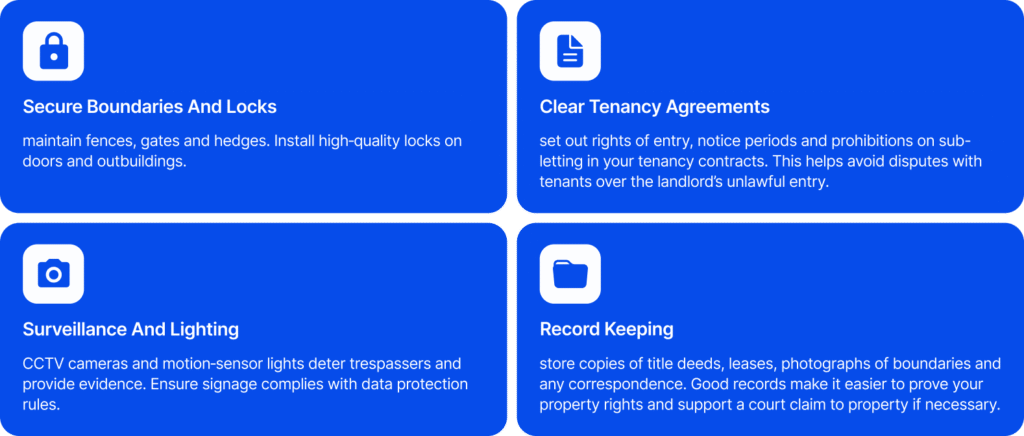
Implementing these measures not only improves property protection but can also demonstrate to insurers that you take risk management seriously.
Common Trespass Disputes in the UK
Trespass disputes take many forms. Typical scenarios include:
- Landlord entering without notice – tenants complain that landlords or agents attend the property without 24 hours’ notice. Such interference may be harassment if persistent.
- Boundary disputes – neighbours may encroach by building walls or fences across the boundary. Evidence of the legal boundary and a clear survey are essential.
- Protesters and aggravated trespass – landowners affected by protests may seek injunctions against activists obstructing lawful activities.
- Squatters and unauthorised encampments – squatters occupying residential property commit an offence. Possession proceedings under Part 55 and interim possession orders are the usual remedies.
- Fly‑tipping and nuisance – dumping rubbish or allowing animals to stray onto land constitutes trespass or nuisance. Local authorities may assist with removal and enforcement.
Identifying the type of dispute helps determine the appropriate remedy, whether damages, an injunction, or a possession order.
Conclusion
Trespass and unlawful entry can be distressing, but the law offers clear remedies. Determine whether you are dealing with a civil trespass or a criminal offence, gather evidence, and use polite warnings before escalating. When necessary, seek legal advice, issue injunctions or possession proceedings, and claim damages in the appropriate court. The small claims court provides a swift, low‑cost forum for property interference claims up to £10,000, and modern platforms like CaseCraft.ai now automate much of the process. By understanding your property rights and following proper procedures, you can protect your home or land and recover compensation when trespass occurs.
Disclaimer: This content is for general information only and is not legal advice. Always seek professional guidance for your case.
FAQ: Trespass or Unlawful Entry
What is the difference between trespass and unlawful entry?
Trespass is a civil tort that occurs when someone intentionally enters or remains on land without consent. Unlawful entry refers to situations where trespass is also a criminal offence, such as squatting in a residential property or aggravated trespass.
Can my landlord enter my home without permission?
Generally no. Landlords must give at least 24 hours’ notice and visit at a reasonable time. Entering without consent can amount to harassment and may give rise to damages or criminal penalties.
How do I stop someone from trespassing on my land?
Speak to them if safe and issue a written warning. Collect evidence, then seek an injunction if necessary. For squatters, start possession proceedings under Part 55 of the Civil Procedure Rules.
What damages can I claim for trespass in the UK?
Damages may include the cost of repairing damage, loss of rent or profits, and compensation for distress. Nominal damages are available even without loss. Courts can also grant injunctions and possession orders.