




• Credibility and judgment: In a small claim, the judge decides whose story is more believable. A false witness statement or exaggerated claim can ruin your credibility. Judges often reject dishonest evidence and may decide against you.
• Serious consequences: False statements verified by a statement of truth can lead to contempt proceedings. Penalties range from fines to imprisonment; recent cases include an eight‑week sentence and a six‑month sentence for lying in a witness statement. The Civil Procedure Rules warn that contempt proceedings may be brought against anyone who verifies a document “without an honest belief in its truth”.
• Practical response: If the defendant lied in a small claims court, do not simply shout “lie to the court”. Identify contradictions, gather documents and send proof to the court and the other side. Tools like CaseCraft.AI help you organise evidence chronologically and build a factual response.
People often search “what happens if you lie in small claims court uk” after spotting inconsistencies in a claim or defence. The short answer is that dishonesty rarely goes unnoticed. Small claims courts decide cases on the balance of probabilities; the judge looks at documents, witness statements and behaviour to decide whose account is more credible.
If you lie or exaggerate in a claim or defence, the judge may dismiss your case, order you to pay costs, and, in serious situations, refer the matter for contempt of court proceedings. The Civil Procedure Rules (CPR) attach a statement of truth to witness statements and claim forms; by signing it, you confirm that you believe the facts are true and you understand the risk of contempt for false statements.
This comprehensive guide explains why honesty matters, how courts deal with lies, and what steps to take when the defendant lied small claims court. It also shows how the CaseCraft.AI platform simplifies evidence gathering and helps you respond to dishonesty while staying within the £10,000 claim limit
What counts as lying in small claims court?
A lie is not the same as a mistake or a different memory. In a civil proceeding, the court distinguishes between:
- Knowingly false statements: deliberately inventing facts or fabricating documents, such as creating fake invoices or denying an obvious relationship with a witness. These are the most serious and can trigger committal proceedings.
- Exaggerations: overstating damage or injury. For instance, in North Bristol NHS Trust v White, the claimant exaggerated her injuries and received a six‑month custodial sentence.
- Errors and misremembered details: minor inconsistencies often arise when witnesses remember events differently. Judges expect honest mistakes and usually deal with them by asking questions rather than punishing people.
- Hiding information: failing to disclose relevant documents or omitting material facts can undermine credibility. If deliberate, it may be treated as dishonesty.
Lying in small claims court UK covers all of these. The key question is whether you made a false statement verified by a statement of truth without an honest belief in its truth.
What is a statement of truth, and why does it matter?
Every claim form, defence and witness statement in civil proceedings must include a statement of truth. Practice Direction 22 explains that the prescribed wording is:
“I believe that the facts stated in this [document] are true. I understand that proceedings for contempt of court may be brought against anyone who makes or causes to be made a false statement in a document verified by a statement of truth without an honest belief in its truth.”
For witness statements, the wording is similar and must be in the witness’s own language. By signing, you certify that you genuinely believe the statement. Rule 32.14 of the CPR reinforces this: proceedings for contempt of court may be brought against anyone who makes a false statement in a document verified by a statement of truth without an honest belief. The statement of truth underscores the seriousness of civil evidence; it reminds parties that dishonesty is punishable and that even a small claim can lead to criminal‑style sanctions.
Note: Rule 32.14 applies to documents prepared in anticipation of, or during, proceedings. Pre-action statements fall under the court’s separate inherent jurisdiction.
Who can sign it?
Only the person making the statement or a senior authorised individual in a company can sign on behalf of a party. Lawyers can sign but must confirm the client’s belief and explain the consequences. The statement must be dated and include the signatory’s printed name.
What can happen if you lie in a small claims case?
There are immediate and long‑term consequences when someone lies in small claims court. We break them down below.
The judge may reject your evidence
Small claims judges focus on credibility. Judges often read evidence before the hearing and use the hearing to ask each side questions on points of disagreement. If a witness statement contains false statements or the evidence appears inconsistent, the judge may treat the witness’s entire testimony as unreliable. Because civil cases are decided on the balance of probabilities, one falsehood can tip the scales. In practice, dishonesty might mean losing even when other points are valid.
You could lose the claim or defence
Dishonesty can cost you the case. If the judge believes that your evidence is unreliable, they may prefer the other party’s version of events and dismiss your claim. Even if the lie concerns only part of the case, the judge could find that the whole claim lacks credibility. You may then have to pay the other side’s costs and possibly pay any money claimed.
There can be costs and consequences
Costs are limited in small claims, but dishonesty can increase them. Successful claimants can recover the court fee, reasonable travel expenses and up to £95 in lost wages for attending court, plus up to £750 for expert reports. If you lose, you may be ordered to reimburse the defendant’s similar expenses. Judges sometimes award additional costs against a party who has behaved dishonestly or wasted the court’s time.
In serious cases, contempt proceedings may follow
If a false statement is verified by a statement of truth, the other party or the court can initiate contempt proceedings. Part 81 of the CPR explains that contempt applications may result in a fine, imprisonment or confiscation of assets. The same rules state that the court may punish a contemnor by a fine or imprisonment when satisfied beyond a reasonable doubt of the contempt.
Is lying in small claims court the same as perjury?
Perjury is a criminal offence under the Perjury Act 1911, committed when a witness lies under oath in judicial proceedings. In civil cases, dishonesty is typically dealt with through contempt rather than a perjury prosecution. In small claims and other civil proceedings, dishonesty is often addressed through contempt of court rather than criminal prosecution. While both involve sanctions, the procedure and burden of proof differ.
Contempt proceedings require proof beyond a reasonable doubt that the statement was false, interfered with justice and was not believed to be true by the maker. Unlike perjury, contempt is handled within the civil justice system and can be initiated even at the pre‑action stage
What if the defendant lied in small claims court?
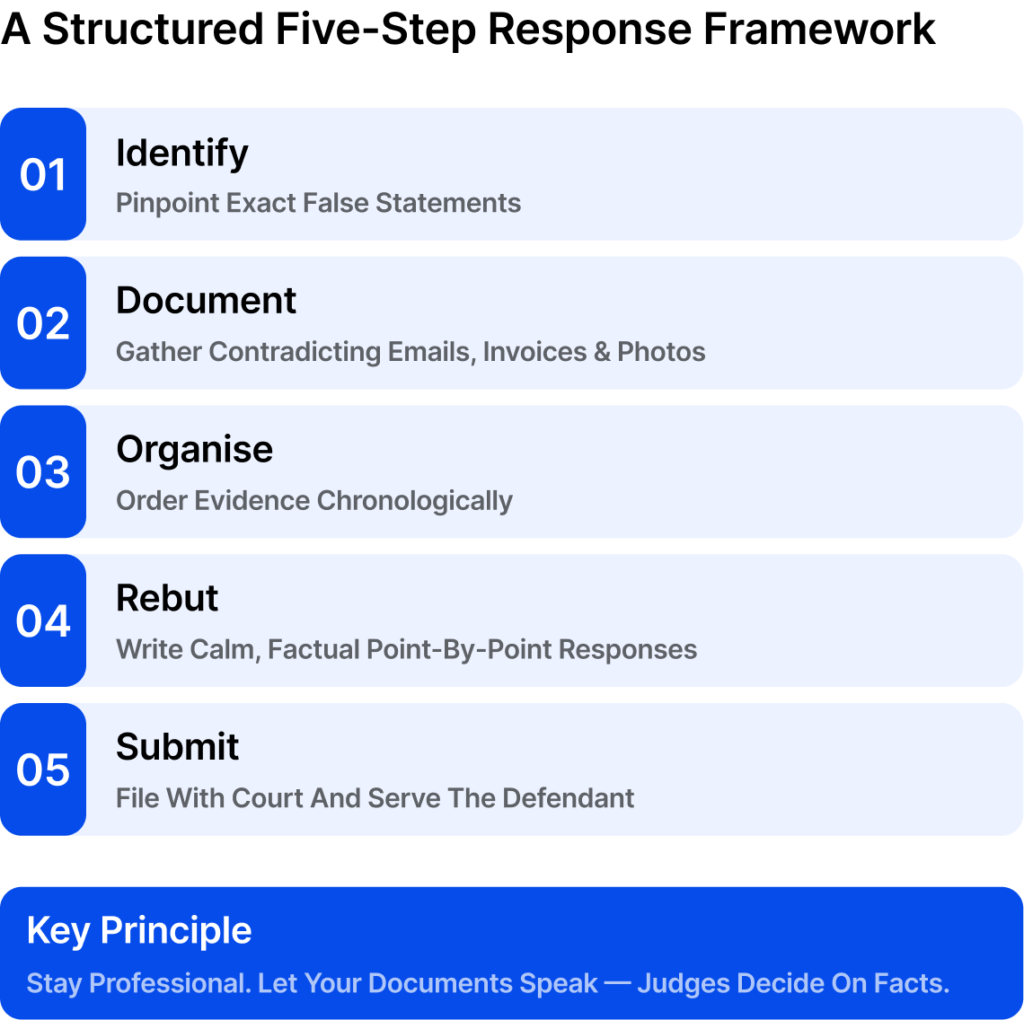
Many litigants search “defendant lied small claims court” because they feel wronged by untrue statements. The best response is evidence, not accusation. Here’s a practical approach:
- Identify specific false statements. Highlight the exact paragraphs or sentences in the defendant’s witness statement or defence that you believe are wrong. Keep your critique factual; avoid emotive language like “lying in court”.
- Gather documentary evidence. Find emails, invoices, photos, bank statements or messages that contradict the false assertions. Courts favour documentary evidence; ensure each document shows the date, sender and recipient.
- Organise evidence chronologically. It is recommended to place originals in date order and make notes on key points. CaseCraft.AI’s platform automatically groups documents by category and arranges them chronologically.
- Prepare a rebuttal. Write a short, calm explanation for each disputed point, attaching your supporting documents. Avoid speculation; stick to facts.
- Send your evidence to the court and the other side. You must follow court directions on deadlines and formats. When you receive the defendant’s evidence, you should send any proof that shows they are wrong to both the court and the defendant.
- Consider witness statements. If someone else witnessed events, ask them to provide a statement of truth. CaseCraft.AI prompts you to collect witness contact details and can auto‑generate statement templates.
- Stay professional. Judges frown on personal attacks. Focus on the evidence and let the court decide. If the dishonesty is severe and proven, consider seeking legal advice about making a contempt application under Part 81.
How judges usually deal with lies in a small claim
Judges do not automatically refer every lie to the Attorney General. Small claims hearings are designed to be informal. The judge’s priority is to resolve the dispute fairly and efficiently. They will usually:
- Read the claim, defence and witness statements ahead of the hearing.
- Use the hearing to cross‑examine both sides on disputed facts.
- Assess credibility and consistency of evidence. A witness who contradicts their own documents will struggle.
- Decide the case based on the balance of probabilities.
- Only consider contempt proceedings if the falsehood is material, deliberate and interferes with justice.
This means that many minor inaccuracies are addressed through questioning rather than punishment. However, repeated or intentional falsehoods risk severe sanctions.
Examples of false statements that can cause serious trouble
To make this guide concrete, here are real and hypothetical examples of false statements that have led to consequences:
- Fake invoices: Creating a fabricated invoice to support a claim can lead to dismissal and potential contempt proceedings. A false invoice is a false document and suggests deliberate fraud.
- False witness identity: The Court of Appeal ruled in Jet2‘s favour, establishing that dishonesty in pre-action statements can constitute contempt even before proceedings formally begin.
- Exaggerated injuries: Exaggerating personal injury in a witness statement can result in six months in prison.
- Altering screenshots: Changing timestamps or message content may amount to forging evidence. Judges compare metadata and may order expert reports.
- Denying a relationship: Lying about knowing a witness to avoid credibility issues can be punished. In one case, a defendant denied knowing a key witness and still received eight weeks’ imprisonment.
Can you report someone for lying in small claims court?
Yes, but caution is needed. Not every lie warrants an application. Contempt applications are serious and require permission if they involve knowingly making a false statement. To succeed, you must show that the statement was false, that it interfered with the administration of justice and that the maker knew it was false. You must also follow strict procedural steps, including filing a Part 23 application supported by affidavit evidence. Courts can punish contempt by fines, confiscation of assets or imprisonment.
If you suspect serious dishonesty, seek legal advice before applying. Often the judge will deal with the matter within the small claim. For minor exaggerations, focus on disproving the lie and winning the case.
What to do before the hearing if you think the other side has lied
Follow this checklist to prepare:
- Review the defendant’s evidence. Make notes on each point you dispute and gather proof.
- Organise originals. Put receipts, photos and statements in date order and label them.
- Prepare questions. Think about what you would ask the defendant if cross‑examination is permitted.
- Notify witnesses. Tell witnesses when to attend and arrange interpreters or accessibility support if needed.
- Create a chronology. A simple timeline (e.g., contract signed in January 2025, goods delivered in February 2025, invoice unpaid by March 2025) helps the judge follow your story
- Use a platform like CaseCraft.AI. It groups your evidence by category, labels files and automatically generates a court‑ready bundle. The platform prompts you to upload missing documents and ensures you meet deadlines.
How CaseCraft.AI can help you respond to lies
CaseCraft.AI is built specifically for UK small claims and handles claims up to £10,000. Here’s why it’s valuable when facing dishonesty:
- Auto‑generated legal forms: The platform instantly produces the correct claim or defence forms and helps organise your evidence.
- Fast filing: Most users file claims in under 15 minutes. This saves time when responding to a defence that contains false statements.
- Step‑by‑step AI guidance: CaseCraft.AI walks you through each step, helping you prepare evidence, track deadlines and even send settlement offers.
- Success‑based pricing: You pay 10% only if you win. This reduces financial risk, especially when dealing with a defendant lied small claims court scenario.
- Court‑ready claims: CaseCraft.AI turns your information into a claim that meets HMCTS standards and is ready to file.
- Evidence organisation: The platform automatically groups documents by category and arranges them chronologically. It also prompts you to add witness details and can auto‑generate statements.
- Secure and compliant: CaseCraft.AI uses bank‑grade encryption and UK‑based servers and complies with UK GDPR. It is not a law firm but works with regulated lawyers.
- Affordable and accessible: You don’t need a solicitor; the platform is designed for non‑lawyers and explains each step in plain English.
- Next‑step guidance: If the defendant fails to pay after judgment, CaseCraft.AI guides you through enforcement options.
These features make it much easier to handle a situation where someone has lied in court. You can focus on facts while the platform handles the procedural complexities.
Next steps
Lying in small claims court is risky. Judges decide cases on credibility, and a single lie to the court can ruin your chances. Signing a statement of truth is not a formality; it is a solemn promise that your evidence is honest. False witness statements can lead to dismissal, adverse costs or even imprisonment. If you believe the defendant lied in small claims court, focus on evidence, contradict their claims with documents, timelines and witness statements, and avoid emotional accusations.
CaseCraft.AI makes this easier. With auto‑generated forms, chronological evidence organisation, and success‑based pricing, you can prepare a robust case quickly.
Start organising your small claim with CaseCraft.AI and prepare a clear, evidence-based case.
Note: The information in this guide is for educational purposes only. It is not legal advice and should not be relied on as a substitute for professional legal guidance. If you need advice about your specific small claims court case, consult a qualified legal professional.
FAQ
What happens if you lie in small claims court UK?
If you sign a document containing false statements verified by a statement of truth without an honest belief, you risk contempt proceedings. In practice, the judge may dismiss your claim or defence, award costs against you and refer serious cases for punishment.
Is lying in a witness statement UK contempt of court?
Yes. Lying in a witness statement verified by a statement of truth is a type of contempt of court. Part 81 allows courts to punish contempt with fines, imprisonment or confiscation of assets. Recent cases show that custodial sentences are imposed when false statements interfere with justice.
What is a statement of truth?
A statement of truth is a declaration that the facts in a document are true and that you understand contempt proceedings may follow if they are false. It must be signed and dated by the party or their authorised representative.
Defendant lied in small claims court. What should I do?
Identify the false statements, gather documentary evidence, organise it chronologically and send your proof to the court and the defendant. Use a tool like CaseCraft.AI to build a clear evidence bundle and consider legal advice if the dishonesty is serious.
Can you go to prison for lying in civil court?
Yes. Committal proceedings for contempt of court can result in imprisonment. Courts have imposed sentences ranging from eight weeks to six months for false witness statements. However, only serious, deliberate dishonesty is likely to be punished in this way.
Is lying in court always perjury?
No. In civil cases, it is usually dealt with as contempt rather than the criminal offence of perjury. The process is different, but both can involve imprisonment.