




1. You have enforceable rights. The Landlord and Tenant Act 1985 and the Homes (Fitness for Human Habitation) Act 2018 require landlords to keep the structure, exterior, plumbing, electrics and heating in good repair. These duties can’t be contracted out; if ignored, you may claim compensation.
2. Safety and deposits matter. Landlords must provide safe gas, electrical and fire systems and register your deposit with an approved scheme within 30 days. At the end of the tenancy, your deposit must be returned within 10 days of agreeing to deductions; failure to comply can trigger a claim of up to three times the deposit.
3. Small claims offer accessible justice. If repairs aren’t made or a deposit is withheld, you can pursue compensation through the small claims court. Claims under £10,000 typically fall within the small claims track, but for personal injury and housing disrepair, the limit is £1,000. With detailed evidence and a letter before action, services like CaseCraft.AI can help file your claim quickly and cost‑effectively.
Introduction
Tenants across the United Kingdom often feel powerless when a rented home deteriorates, a deposit goes missing, or a landlord refuses to fix basic problems. Many renters aren’t aware that detailed legal protections exist, and that enforcing them is usually simpler, cheaper and faster than you think.
The Landlord and Tenant Act 1985 is the foundation stone of tenant protection in England and Wales; it sets minimum standards for property condition, imposes repair obligations on landlords and underpins modern housing safety laws. If you know your rights, you can compel repairs, recover deposits and even claim compensation through the small claims court.
This guide explains those rights, outlines your landlord’s legal duties, and shows you how to take action if things go wrong. It covers the Landlord and Tenant Act 1985, the Homes (Fitness for Human Habitation) Act 2018, the Housing Act 2004 and recent updates such as Awaab’s Law and the Renters’ Rights reforms expected to take effect from 2025. You’ll learn how to identify hazards, report disrepair, protect your deposit, and, if necessary, bring a claim. It’s comprehensive yet written for real people, avoiding jargon and focusing on practical steps.
Overview of the Landlord and Tenant Act 1985
The Landlord and Tenant Act 1985 sets out key protections for tenants across England and Wales. It applies to most residential leases under seven years and overrides any contract terms that weaken a landlord’s legal duties.
At its core is Section 11, which requires landlords to:
- Keep the structure and exterior of the property in good repair, including walls, foundations, drains and external pipes.
- Maintain and ensure proper working order of water, gas, electricity, sanitation, heating and hot water systems.
- Provide at least 24 hours’ written notice before entering the property for inspections or repairs.
- Carry out work within a reasonable time once notified of a problem.
Tenants, in turn, must allow reasonable access for inspections and repair works.
Strengthening Legislation
Later laws have expanded these protections:
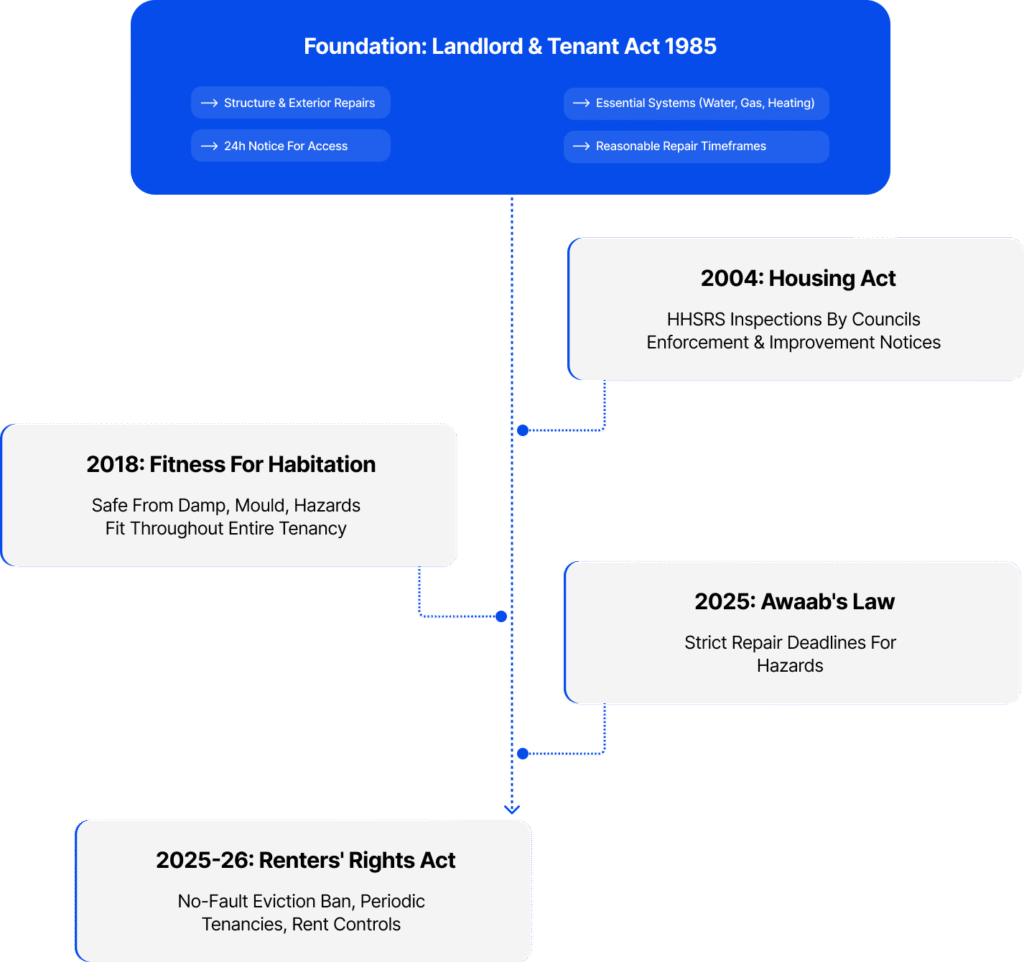
- Homes (Fitness for Human Habitation) Act 2018 — ensures properties are safe and “fit for human habitation” throughout the tenancy, covering issues such as damp, mould, overcrowding and unsafe water or heating.
- Housing Act 2004 — introduced the Housing Health and Safety Rating System (HHSRS), which local councils use to inspect properties and enforce standards. Councils can issue improvement notices, carry out emergency works, or even ban unsafe lettings.
- Awaab’s Law (2025) — compels social landlords to fix serious health or safety hazards within strict time limits.
- Renters’ Rights Act 2025 (part of the Renters’ Reform) — expected to abolish no-fault evictions, convert most tenancies into periodic agreements, and limit unjust rent increases. The Act has received Royal Assent but is not yet in force, with implementation planned for 2026.
Key Tenant Rights Under the Act
Before diving into specific rights, remember that they all stem from the principle of habitability. Under landlord responsibilities in the UK, every landlord must provide and maintain a home that is safe, structurally sound, and equipped with essential services.
If those conditions aren’t met, you have several remedies, through your local council, deposit protection schemes, or the small claims court. Always keep written evidence of requests, inspections, and correspondence to support your case.
Right to a Safe and Habitable Property
A rented home must be free from serious hazards. Section 11 obliges landlords to keep the structure and exterior in repair. The Homes (Fitness for Human Habitation) Act adds that properties must be fit for habitation, meaning no damp, mould, infestation, inadequate heating or other conditions that make the property unfit to live in. Under the HHSRS, councils assess 29 hazards, including damp, carbon monoxide, excess cold or heat, gas leaks and unsafe electrics. If an inspector finds a Category 1 hazard (a serious risk to health), the council must issue a remedial notice and can prohibit the property from being let.
Common hazards that tenants should watch out for include:
- Persistent mould and condensation
- Faulty gas boilers or carbon monoxide leaks
- Exposed electrical wiring or damaged sockets
- Structural cracks, subsidence or defective roofs
- Inadequate heating, water supply or sanitation
If you encounter these issues, report them in writing to your landlord. If there’s no response within a reasonable timeframe, contact your local council’s Environmental Health department. They can inspect the property and require the landlord to carry out repairs.
Making a housing disrepair claim may also be appropriate when the defects cause personal injury or property damage, especially if the landlord ignored earlier complaints. CaseCraft.AI’s housing disrepair claim tool can help gather evidence, draft letters and prepare a claim within the small‑claims limit.
Right to Timely and Effective Repairs
Section 11 sets out a clear repair duty but also recognises practical realities. Under the landlord duty of care in the UK, property owners are responsible for maintaining a safe and habitable home once they’re aware of an issue. Landlords aren’t liable until they know about the problem (except for communal areas) and have a reasonable time to fix it. Tenants should therefore send a dated, written notice describing the defect and keep copies. The landlord must then arrange professional repairs, not patch‑jobs or temporary fixes, for the structure, drains, gutters and installations. They can’t avoid responsibility by placing repair duties on tenants.
Write to your landlord as soon as the issue arises. Specify the defect, its impact (for example, no heating during winter) and request a response within 14 days. For urgent risks such as gas leaks or electrical faults, contact the relevant emergency services and inform your landlord immediately. Keep photographs, receipts (if you bought portable heaters), and logs of every communication.
If the landlord fails to act, you can pursue a housing disrepair claim for compensation, including the cost of alternative accommodation, damage to belongings, and inconvenience. In small claims, tenant compensation for repairs and damages must each be under £1,000 to remain on the small‑claims track.
Right to Privacy and Proper Notice
Tenants are entitled to the quiet enjoyment of their home. Under landlord access rights, a landlord or authorised contractor may enter the property only at reasonable times of day and with at least 24 hours’ written notice. Entry without consent, intimidation or persistent unannounced visits may amount to harassment. Exceptions apply for emergencies such as burst pipes or gas leaks, where immediate access is necessary. Your landlord must schedule appointments at reasonable times and respect your convenience; you’re not obliged to accept late‑night or early‑morning visits.
If your landlord repeatedly enters without notice or refuses to respect your quiet enjoyment, document every instance and write a formal complaint. Unlawful entry can be grounds for injunctions, damages or even criminal penalties under harassment laws. In many cases, simply reminding the landlord of their legal obligation resolves the issue. Services like CaseCraft.AI can generate tailored letters citing relevant statutes to reinforce your position.
Right to a Protected Deposit
For most assured shorthold tenancies, landlords must place the tenancy deposit into a government‑approved scheme within 30 days of receiving it. The main schemes in England and Wales are the Deposit Protection Service, MyDeposits and the Tenancy Deposit Scheme. Your landlord must also give you written information about the scheme, the amount protected and how to contact the scheme’s dispute resolution service. At the end of your tenancy, the deposit must be returned within 10 days of both parties agreeing on the deductions.
If your landlord fails to protect the deposit within 30 days, does not provide the required information or registers the deposit late, they lose the right to evict you under Section 21, and you may claim compensation worth one to three times the deposit amount.
To claim, gather evidence such as your tenancy agreement, proof of payment and searches of the deposit schemes; send a letter before action demanding payment and warning of court proceedings. If the landlord doesn’t settle, file a claim using the Part 8 claim form; court fees are payable but recoverable if you win. CaseCraft.AI’s deposit dispute tool can guide you through this process, generate the pre‑action letter and calculate potential penalties.
Right to Challenge Unfair Charges and Deductions
Landlords can only deduct from your deposit amounts that reflect unpaid rent or actual damage. Reasonable wear and tear, such as faded paint, worn carpets or minor marks. Cannot justify deductions. Ask for an itemised list of any proposed deductions and photographic evidence.
If you disagree, use the dispute resolution service offered by the deposit scheme; decisions are binding and usually cost‑free. For unprotected deposits or unreasonable deductions, you can file a small‑claims action seeking the return of the deposit and compensation. The court may award up to three times the deposit and order the landlord to register the deposit properly.
Landlord Obligations Under UK Law
Landlords’ responsibilities extend beyond the basic repair covenant. Failure to comply can lead to fines, rent repayment orders or civil liability. Key statutory repair duties include:
- Maintain structure and exterior. As noted, Section 11 requires landlords to keep the dwelling’s structure, exterior and essential installations in repair.
- Ensure water, gas and electrical safety. Landlords must have all gas appliances and flues checked annually by a Gas Safe registered engineer and provide tenants with a copy of the safety record within 28 days. They must also ensure that electrical systems and supplied appliances are safe.
- Provide adequate heating and sanitation. Homes should have reliable heating and hot water; bathrooms and kitchens must be in working order. Local authorities can take action if properties lack basic amenities or are excessively cold or damp.
- Comply with fire and carbon monoxide regulations. Landlords must provide smoke alarms on each storey and carbon monoxide alarms in any room with a solid fuel appliance, and ensure escape routes and furnishings meet fire‑safety standards.
- Protect deposits and supply prescribed information. Deposits must be registered with an approved scheme and returned promptly at the end of the tenancy.
Landlords who ignore these duties may face enforcement. Councils can issue improvement notices requiring repairs, prohibition orders banning the letting of unsafe premises or emergency remedial action where the council carries out works and recovers the cost. Tenants or councils can also apply for rent repayment orders to recover up to 12 months’ rent when landlords commit offences such as unlawful eviction, harassment or breaching improvement notices. Persistent non‑compliance may lead to civil claims or criminal prosecutions.
Remedies Available to Tenants
When landlords fail to meet statutory obligations, tenants aren’t powerless. Several routes exist to enforce rights, recover losses and ensure tenants’ right to repairs. Choose the path that best fits your circumstances and evidence.
Reporting to the Local Council
Your local council’s Environmental Health department enforces housing standards under the Housing Act 2004. If you discover a serious hazard or repeated disrepair, you can request a council inspection. Officers use the HHSRS to assess hazards; if they find a Category 1 hazard, they must act by serving an improvement notice, carrying out emergency remedial action or issuing a prohibition order that restricts occupation. Category 2 hazards also allow for enforcement at the council’s discretion.
Councils can order landlords to remove health risks, make necessary repairs and, in extreme cases, prevent further letting. Keep copies of your complaints and any correspondence with the council.
Compensation and Small Claims
For monetary losses or inconvenience, small‑claims actions provide an accessible route to justice. The small‑claims track generally covers claims up to £10,000. However, housing disrepair claims have specific allocation rules: if you’re claiming both repairs and damages (such as alternative accommodation costs or damaged belongings), each component must be valued at £1,000 or less to remain on the small claims track. Personal injury claims also have a £1,000 limit.
If you’re seeking a court order for the landlord to carry out repairs (called “specific performance”) and either the cost of repairs or the value of damages exceeds £1,000, your claim will be allocated to the fast track instead. Within the small claims limits, you can seek compensation for:
- Cost of alternative accommodation when a property is uninhabitable.
- Damage to belongings caused by damp, leaks or other disrepair.
- Loss of amenity or distress, such as living without heating or hot water.
- Illness or medical expenses resulting from hazards like mould (subject to the £1,000 limit).
- Return of unprotected deposits and penalties up to three times the deposit amount.
Services like CaseCraft.AI simplify this process by guiding you step‑by‑step, drafting pre‑action letters, generating witness statements and completing the correct court forms. Their platform is designed specifically for small claims tenant disputes, including deposit disputes, housing disrepair and property damage claims, and charges a modest setup fee plus a success‑based commission only if you win. That means you can enforce your rights without costly legal fees.
Terminating the Tenancy
In extreme cases, you may wish to end the tenancy due to serious disrepair or persistent breaches. Tenants can normally serve notice to quit at the end of a fixed term or break clause; however, if a property is unfit for habitation or the landlord has fundamentally breached the contract, you might be entitled to terminate early. Seek advice from a housing adviser or solicitor before doing so, as ending a tenancy wrongly can lead to liability for rent.
Alternatively, you can ask the court to reduce the rent or award damages without leaving. The Renters’ Rights Act 2025 will further strengthen tenants’ ability to challenge unjust rent increases and end tenancies on fair grounds; it shall be implemented in 2026.
How to Enforce Your Tenant Rights (UK)
Practical enforcement often follows a predictable sequence. By following these steps, you’ll build a persuasive case and increase your chances of a favourable outcome:
1. Document the issue. Take photographs or videos of the defect or hazard, record dates and keep receipts. Use a smartphone to capture time‑stamped evidence of damp, leaks or safety breaches. Services like CaseCraft.AI allow you to upload and organise this evidence securely.
2. Notify your landlord in writing. Send a clear, dated letter or email explaining the problem and requesting repairs or repayment. Keep copies and proof of delivery.
3. Allow reasonable time for repairs. What counts as “reasonable” depends on the urgency of the issue; emergency hazards should be addressed immediately, while minor repairs may allow a few weeks.
4. Escalate to authorities if unresolved. If the landlord ignores your notice, contact the local council for an HHSRS inspection. For gas, electrical or fire safety breaches, inform the appropriate regulators.
5. Send a letter before action. For deposit issues or compensation claims, outline what you’re seeking, cite the relevant legislation and set a deadline. This shows the court you tried to settle before litigating.
6. File a small‑claims or tribunal application. CaseCraft.AI automates claim preparation, ensures compliance with court rules and even drafts statements of truth.
7. Prepare for the hearing and mediation. If the claim is defended, be ready to attend mediation or a brief court hearing. Bring organised documents and be concise in explaining how the law supports your claim.
For more details on preparing evidence, read our guide on what counts as evidence. The earlier you organise your file, the easier it is to make a persuasive case.
Bringing It All Together: How CaseCraft.AI Helps
Navigating housing law and small claims can be daunting, but modern technology has made it far more accessible. CaseCraft.AI is a UK‑based platform built specifically for small claims. It automatically generates legal forms, drafts tailored pre‑action letters and helps you organise evidence with clear timelines. You can file a claim online in minutes, track deadlines and negotiate settlements, all without paying expensive hourly fees. The pricing is simple: a small £15 setup fee and a 10% success fee only if you win.
If you’re facing a difficult landlord, don’t suffer in silence. Use the law and modern technology to enforce your rights, claim what you’re owed and hold negligent landlords accountable. Start your claim today by exploring CaseCraft.AI’s small‑claims services, or go straight to the deposit disputes and negligent landlord repair obligations pages for more specialist guidance. Justice is more accessible than you might think; you just need to take the first step.
Note: This guide provides general information about UK tenant rights. It is not legal advice and does not create a solicitor-client relationship. Laws change, and every situation is different. For advice about your specific circumstances, consult a qualified solicitor.
FAQ: Tenant Rights Under the Landlord and Tenant Act
What are my rights under the Landlord and Tenant Act 1985?
You have the right to live in a home that is safe, structurally sound and free from serious hazards; to receive timely repairs of the structure, plumbing, electrics and heating; to have your deposit protected and returned promptly; and to enjoy privacy without unlawful entry. These rights apply to most residential tenancies and cannot be waived by contract.
What repairs must my landlord carry out?
Landlords must keep the structure and exterior in repair (including walls, floors, roofs and drains) and ensure the proper working order of installations for water, gas, electricity, sanitation, space heating and hot water. Under the Homes (Fitness for Human Habitation) Act, they must remedy damp, mould and other hazards that make the property unfit to live in.
Can I claim compensation for poor housing conditions?
Yes. If your landlord ignores repair notices or fails to fix hazards, you can seek compensation for alternative accommodation, damage to belongings, illness and inconvenience. For housing disrepair claims, the small claims track applies when both the cost of repairs and the value of other damages are estimated at £1,000 or less. If you’re also asking the court to order repairs (specific performance) and either amount exceeds £1,000, your claim moves to the fast track. Personal injury claims have a separate £1,000 limit. Keep detailed evidence and send a letter before filing your claim.
What if my landlord fails to protect my deposit?
If your deposit isn’t registered with an approved scheme within 30 days or the required information isn’t provided, the landlord cannot serve a Section 21 notice, and you can claim compensation of one to three times the deposit. Send a pre‑action letter and, if needed, file a Part 8 claim. The court may order the landlord to pay the penalty and return the deposit.