



1. Confusing terminology: Penalty Charge Notices from councils and Parking Charge Notices from private operators share the PCN acronym, but have totally different rules.
2. Time pressure: You get 14 days to keep a discount and 28 days to challenge, but many people lose that window and face higher costs.
3. Enforcement fears: Private fines feel intimidating yet are just civil invoices; councils can send bailiffs, but only after proper procedure. Knowing when to appeal or pay stops unnecessary escalation.
Getting a parking ticket can ruin your day in seconds. One photo. One envelope. One demand for £60 or £100. Most drivers pay because they assume they have no choice. That assumption costs people millions every year.
But here’s the part many motorists miss: not every parking ticket carries the same legal weight. A council-issued Penalty Charge Notice and a private parking fine may use the same “PCN” acronym, yet they operate under completely different rules. One is backed by statutory enforcement. The other depends on contract law and strict procedural compliance. That difference changes everything.
If you want to challenge a penalty charge notice, timing matters. You usually have 28 days to act, and just 14 days if you want to keep the reduced payment window open. Miss those deadlines and your options narrow fast. Use them properly, and many parking tickets can be reduced, cancelled, or successfully appealed before they ever escalate.
This guide explains exactly how to challenge a PCN, when an appeal against PCN decisions actually works, and whether small claims court is ever worth considering. It also covers private parking fines, TfL tickets, UK supermarket parking fines, POPLA appeals, and the mistakes that weaken a parking violation dispute before it even starts.
What Is a PCN and Does the Type Change Everything?
The first thing you need to do when you get a penalty charge notice is to read the document carefully. Not all parking tickets are created equal. Councils, Transport for London (TfL) and other public authorities issue Penalty Charge Notices (PCNs) under statutory powers. These are public law penalties. Private car parks issue Parking Charge Notices, confusingly abbreviated the same way, under contract law, which means the parking operator must prove you agreed to its terms.
Public PCNs
Council tickets are regulated under the Traffic Management Act. They’re enforceable through the courts and, ultimately, bailiffs. You will see wording like “Penalty Charge Notice” and the logo of a local authority or TfL. The law gives you 28 days from the date on the notice to challenge the charge, and if you lodge an informal challenge within 14 days, you preserve a 50% discount if the appeal fails. The notice will show the alleged contravention code (for example, parking in a restricted street), the place and time, and photographs. Mistakes in the contravention code or unclear signs are common grounds for cancelling a council PCN.
Private Parking Fines
Fines on supermarket car parks, hospital grounds, retail parks and residential roads are different. When you enter a privately managed car park, you form a contract with the operator based on the displayed terms. If you breach those terms, the operator can issue a Parking Charge Notice. This is not a criminal penalty. It’s an invoice that the operator may enforce through the County Court under contract law. Operators must usually be members of an accredited trade association, such as the British Parking Association (BPA) or the International Parking Community (IPC), to access keeper data from the DVLA. If they are not accredited, they cannot pursue you through the official channels.
Because these tickets are contractual, you have more leverage than you might think. The Protection of Freedoms Act 2012 introduced keeper liability, meaning the registered keeper can be held liable if the driver is not identified, but only if strict procedural rules are followed. Signs must be clear, entry and exit times must be recorded accurately, and the operator must allow a consideration period (to read the terms) and a 10‑minute grace period before issuing a fine. Failure to meet these conditions can make the charge unenforceable.
In June 2024, the BPA and IPC published a new Private Parking Code of Practice, which came into force on 1 October 2024. Existing sites have until 31 December 2026 to bring their signage and procedures into full compliance. The code introduces a mandatory 10‑minute grace period, consistent signage and an Appeals Charter that requires operators to cancel or reduce tickets for mitigating circumstances.
Non‑compliant operators risk expulsion from their trade association. This means that by 2026, private parking fines should be fairer and clearer than before, but the onus remains on motorists to know their rights and challenge unfair tickets.
How to Challenge a PCN: The Formal Appeal Process Explained
The process for challenging a PCN from a council or TfL is straightforward but time‑sensitive. Your goal is to demonstrate that the penalty was wrongly issued or that there were mitigating circumstances. Here’s how it works.
- Informal challenge (within 14 days): When you receive the PCN, write to the issuing authority explaining why you dispute it. Grounds include incorrect contravention codes, unclear or missing signage, a valid permit not recognised, or circumstances beyond your control (e.g., a medical emergency). The authority must consider this challenge. If they reject it, they still give you time to pay at the discounted rate if you challenge within 14 days.
- Notice to Owner (NtO): If you neither pay nor challenge the PCN within 28 days, the authority sends a Notice to Owner, giving you a further 28 days to submit a formal representation. This step is critical: failing to respond makes the charge payable in full and may lead to enforcement.
- Formal representation: A formal appeal should reference the evidence: photographs, witness statements, copies of permits or tickets, and any statutory guidance. Challenge the validity of the signage, the length of any grace period (10 minutes for many car parks) and any errors on the ticket. You can also cite the Traffic Penalty Tribunal (TPT) or London Tribunals’ decisions as supportive precedents.
- Independent adjudication: If your formal representation is rejected, you receive a Notice of Rejection. At this point you may appeal to an independent adjudicator: outside London, this is the Traffic Penalty Tribunal (TPT), and in London it’s the Environment and Traffic Adjudicators (ETA) at London Tribunals. You must appeal within 28 days. The adjudicator’s decision is binding on the authority, and there is no fee for the motorist. Many motorists win at this stage because authorities often drop weak cases rather than incur further costs.
- Enforcement: Only if you ignore all correspondence does the council register the debt with the Traffic Enforcement Centre, obtain a court order and instruct bailiffs. Until then, you can still challenge the charge.
TfL Penalty Charge Notice: Why London Is Different
PCNs issued by Transport for London cover red routes, congestion charges and low‑emission zones. The procedure is similar but has a few quirks. You have 28 days to make a representation. TfL encourages drivers to use its online portal and notes that submitting a representation suspends the discount period, meaning you won’t lose the discount if your appeal is rejected. If TfL rejects the representation, you receive a Notice of Rejection with a form to appeal to the London Tribunals. Because TfL issues millions of tickets, it sometimes misidentifies contraventions or fails to serve notices correctly. Always check the details on a TfL ticket and gather evidence immediately.
Private Parking Fines: Different Rules, and Why You Have More Power Than You Think
When dealing with private parking fines, you’re negotiating a contract rather than paying a public penalty. Private parking operators rely on the Protection of Freedoms Act 2012, which allows them to pursue the registered keeper only if they follow strict rules. Where no Notice to Driver was placed on the vehicle (e.g. ANPR enforcement), the operator must send a Notice to Keeper within 14 days of the parking event. Where a windscreen ticket was issued, different timescales apply. If they fail, the keeper has no liability.
Your Rights and Levers
- Contractual terms: The operator must display the terms prominently at the entrance and around the car park. Hidden small print or poorly lit signs invalidate the contract. Under the forthcoming Private Parking Code of Practice, the industry must use clear signage and provide a 10‑minute grace period across all sites. If you overstay by a few minutes, cite the grace period.
- Fair amount: The new code proposes capping most private parking fines at £50 with a 50% discount if paid within 14 days. Operators who charge more may be acting outside the code. According to the Independent, a record 11.1 million private parking tickets were issued on private land in the year to March 2023, totalling £1.1 billion. This scale shows how lucrative private parking has become and why you should scrutinise each charge.
- Appeal stages: If you decide to appeal against a PCN from a private car park, the first step is an internal appeal to the operator. If rejected, the operator must provide a ten‑digit code so you can appeal to POPLA (Parking on Private Land Appeals) if they are members of the BPA. POPLA is independent; its decisions are binding on the operator, and it is free for motorists. Operators belonging to the IPC use the Independent Appeals Service (IAS). Follow the instructions in the rejection letter to submit your case.
- Supermarket parking fines: Many complaints relate to UK supermarket parking fines. These sites often use automatic number plate recognition (ANPR) to enforce strict time limits. Check whether the camera captured your entry and exit correctly and whether there were any technical issues. If you shopped and have a receipt, present it as evidence. Major supermarket chains sometimes cancel tickets as a goodwill gesture, especially for loyal customers. Always speak to the store manager before paying.
- Debt recovery: Private operators sometimes threaten debt collectors. Remember that until a court order is obtained, these firms have no power to enforce payment. They may add supposed “administration fees”, but these are rarely recoverable. If the operator sues you in the County Court, they must prove you breached a contract, and the sum claimed is reasonable. Judges often dismiss inflated charges.
By understanding that a private parking violation is a civil contract dispute, you can confidently decide whether to pay, appeal or ignore aggressive letters. Always keep copies of correspondence and photographs; they will be vital if the case reaches court.
When a PCN Challenge Fails: Is Small Claims Court Actually Worth It?
Most motorists never need to set foot in a court to resolve a parking dispute. Appeals and negotiations usually settle the matter. However, there are circumstances where small claims court becomes relevant, and it’s important to know how it works.
When You Might Bring a Claim
- Recovering wrongfully paid charges: If a council or private operator refuses to refund a charge that was clearly unlawful (for example, if the signage was proven misleading or the operator admitted an error but did not refund), you can file a claim to recover the money. This is rare but possible. The court fee for claims up to £300 is £35; claims between £300.01 and £500 cost £50, and fees rise up to £455 for claims up to £10,000. If you win, the operator may have to refund the charge plus the court fee and reasonable expenses.
- Seeking damages for over‑zealous enforcement: In a parking violation dispute, you might have incurred costs (e.g., a wheel clamp damaged your vehicle or a debt collector harassed you). You can sue the operator for damages in the small claims track. Keep receipts and evidence of any loss.
- Debt recovery by operators: More commonly, it’s the operator or council that takes a motorist to court for unpaid parking tickets. The small claims process is designed for non‑lawyers. If you receive a claim form, act quickly: either pay, settle, or defend. Ignoring a court claim leads to a default judgment.
- Clamping or towing disputes: Although private clamping is heavily restricted under the Protection of Freedoms Act, some landowners may unlawfully clamp or tow vehicles. In such cases, you can bring a claim for the release fee and damages.
Is It Worth It?
Going to court is time‑consuming. Judges expect you to have exhausted all other avenues first, including appealing through POPLA or the IAS. The sums involved in parking tickets, typically between £50 and £100, often do not justify litigation. However, if the principle matters or the operator’s conduct was particularly abusive, small claims can provide a clear judgment. CaseCraft.AI offers step‑by‑step guidance, generates court‑ready documents and helps track deadlines. You only pay 15% if you win, making the process less daunting.
Step by Step: How to Dispute a Parking Ticket Without Getting It Wrong
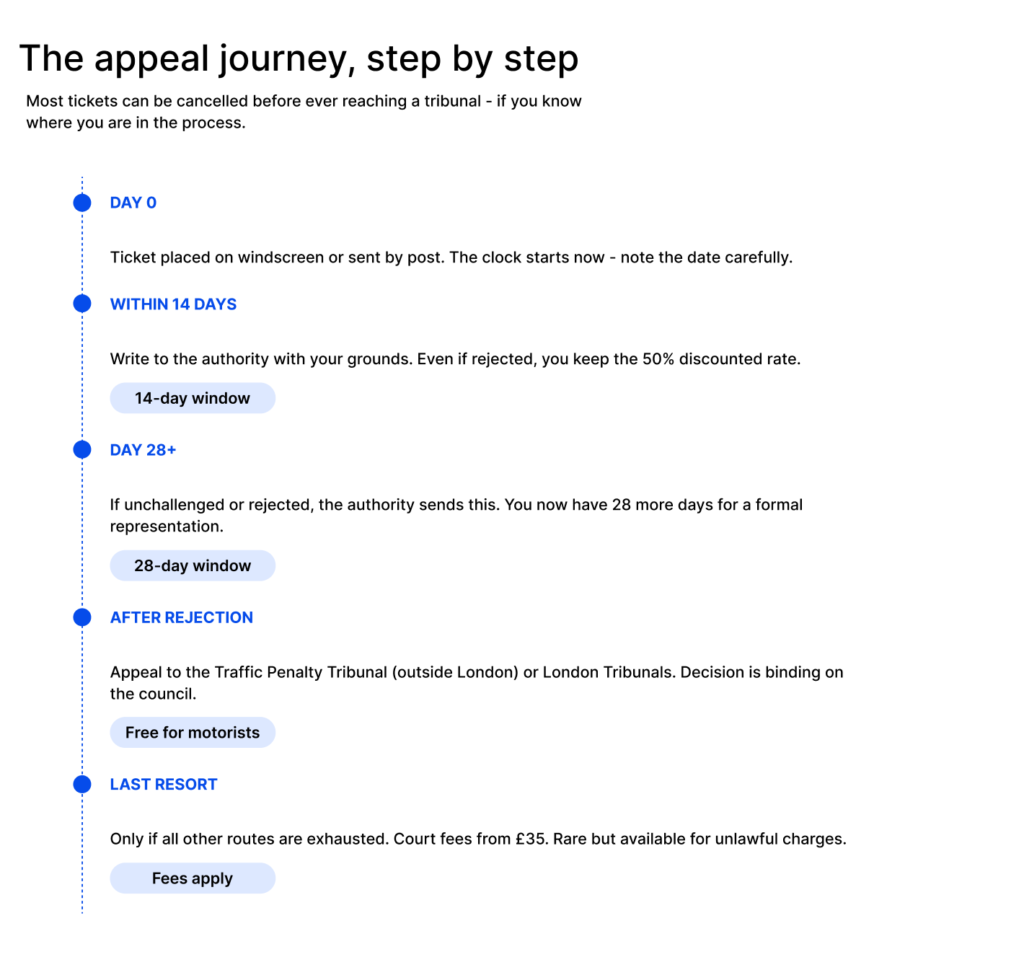
The following five‑step guide shows how to dispute a parking ticket (both council PCNs and private parking charges). Keep everything neat and methodical; courts and adjudicators appreciate organised evidence.
1. Identify the Type of PCN
Look at the letterhead and wording. Challenge a PCN for a council ticket follows statutory rules and deadlines, while a private parking invoice relies on contract law. Check whether it’s labelled “Penalty Charge Notice” (public) or “Parking Charge Notice” (private), and note the issuing authority.
2. Gather Evidence Immediately
Take photos of your vehicle’s location, signage, road markings and any ticket or permit. Keep receipts if you made a purchase. Note the time you arrived and left. Photographs of unclear signs or broken meters are powerful evidence. Record any mitigating circumstances, such as a medical emergency. Include a copy of the Notice to Keeper if it arrives.
3. Submit an Informal Challenge within 14 days
Write or submit an online appeal to the issuing authority explaining why the ticket is wrong. Reference the contravention code, describe the circumstances and attach your evidence. Keep your language factual and concise. For private tickets, send your appeal to the operator’s address listed on the ticket and ask for the parking contract details. Challenging within 14 days preserves discounts (usually 50% for council PCNs and 40–60% for private fines).
4. Make a Formal Representation
If your informal challenge is rejected, wait for the Notice to Owner (council) or Notice of Rejection (private). You then have 28 days to submit a formal representation. Address each point the authority raises, and argue why the evidence shows no breach. Consider citing relevant law (such as the Protection of Freedoms Act 2012, the 10‑minute grace period rules, or defective signage). Keep copies of all correspondence.
5. Escalate to an Independent Adjudicator or Small Claims Court
If the authority or operator still refuses your appeal, take it to the next level. For council PCNs, appeal to the Traffic Penalty Tribunal or London Tribunals, which are free. For private parking fines, appeal to POPLA or the IAS, using the code provided by the operator. Only after you exhaust these appeals should you consider filing a small claims action or defending one. Make sure you understand the fees and time commitment.
Next Steps
Challenging a parking ticket doesn’t have to be an ordeal. Identify whether you’ve received a penalty charge notice from a council or a private parking invoice. Understand the strict timelines: 14 days preserves discounts, and 28 days preserves your right to challenge. For private parking fines, remember that the operator must prove a fair contract with clear signs and should honour the new 10‑minute grace period. Use evidence, stay organised and exhaust all appeal avenues before considering court.
CaseCraft.AI is designed to make this journey easier. The platform auto‑generates legal forms, guides you through the claim process and helps you organise evidence and track deadlines. You only pay a 15% fee if your claim succeeds. Whether you’re challenging a council PCN or disputing a private parking fine, CaseCraft.AI walks you through the process and writes the letter for you.
Start your claim today and turn frustration into action.
Disclaimer: This article is for general informational purposes only and does not constitute legal advice. Parking disputes and small claims cases can vary depending on the facts, the issuing authority, and applicable UK laws. If you need advice on your specific situation, consider speaking with a qualified legal professional or adviser before taking action.
FAQ
Do you have to pay a private parking fine?
No. A private parking fine is a civil invoice, not a statutory penalty. Operators rely on contract law, so if the signage is unclear or you didn’t agree to the terms, you may have no obligation to pay. Always appeal first through the operator and then POPLA or the IAS.
How do I appeal a parking ticket?
If it’s a council PCN, submit an informal challenge within 14 days to keep the discount. If rejected, file a formal representation, then appeal to the Traffic Penalty Tribunal or London Tribunals. For private fines, appeal to the company first, then to POPLA (for BPA members) or the IAS (for IPC members).
What happens if a PCN challenge is rejected?
You receive a Notice of Rejection. You can then pay the full amount or take the case to an independent tribunal. For council PCNs, that’s the TPT or ETA. You do not have to accept the rejection. Many independent appeals succeed, and there is no fee for motorists.
Can I take a parking dispute to small claims court?
Yes, but it’s rarely the first move. Small claims are mainly for recovering unlawful charges or damages. Court fees start at £35 for claims up to £300. Exhaust the appeal process first. If you do go to court, the process is designed for non‑lawyers, but you must prepare evidence and pay the fee.
How long do I have to challenge a penalty charge notice?
You have 28 days from the date on the PCN to challenge. Act within 14 days to preserve any discount. Missing the 28‑day window removes your right to challenge, and the full penalty becomes due immediately.
What is the difference between a PCN and a private parking fine?
A PCN is issued by councils or TfL and has statutory force; it can be enforced by bailiffs. A private parking fine, also called a Parking Charge Notice, is issued by a private company and is a contract claim. The appeal routes and legal weight differ completely.